
There was always something about Boston. It wasn’t just that Emilie was born there. Generations of her family had felt its inspiration. This was where her grandfather started anew after a Portland fire and founded the Boston Herald. It was where her father forged one career in publishing and another in amateur drama, where Emilie and her siblings acted on stage for friends and family. Marriage and motherhood took her to Wellesley Hills, but as her career took off, Emilie Loring returned to Boston.
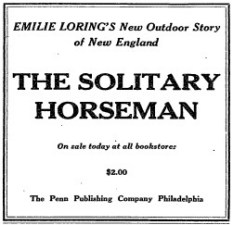 The adage that success breeds success is especially true with books. When The Solitary Horseman came out in March, 1927, The Trail of Conflict, Here Comes the Sun! and A Certain Crossroad were in multiple printings, and publicity came easily. The book was reviewed in both the Boston Herald and Boston Transcript, and John Clair Minot interviewed Emilie on his radio program, “Monday Evening Book Talk.” Soon, it was a best-seller.
The Solitary Horseman begins with a widowed mother whose son David is killed by a drunken driver, Anthony Hamilton. To make amends, “Tony” pledges himself to the family for ten years–to work as David would have worked, to make the family orchards a success.
“Tony, always you remind me of my first hero, the solitary horseman in The Talisman….You never turn your back on difficulties. You face things.”

The Grahame’s home, “White Pillars,” and the town’s orchards are reminiscent Victor Loring’s childhood home and his hometown of Marlborough, Massachusetts.
When the story opens, Tony’s pledge to the Grahames has been fulfilled, the daughter of the house, Rose, is fresh out of college, and Tony is bound in a pretend engagement to the petulant Daphne Tennant. But then, the Hamiltons come to town, “Nap” Long gets in his deviltry, and nothing goes as expected…
Was that lovely girl the child he had seen grow up?… She was a woman, young, radiant, shyly conscious of her charm. Her eyes flashed with mischief as they met his.
Broken rails! The forward wheels of the car hung over the edge of the bridge. The headlights illumined the glittering gulch below… My God, if he touches this car we’re done for.
Emilie’s characters are capable and confident, and Rose Grahame not the least of them. She runs for the town council, even though she suspects that Tony is opposed.
“Most of us women have to consider the dollar. We are trained to that much more than are men. There is criticism of the few women who are filling political offices in the country. Is there any reason why the woman whom we propose couldn’t make good? Let’s elect her and see that she does make good.”

And Emilie, who had just turned sixty when she wrote the book, countered expectations about the passing years.
Her eyes were brilliant with laughter. Her zest for life, her glowing charm made one realize that youth was not the greatest of woman’s attractions, Rose thought for the first time in her young life. No wonder that Nicholas Cort loved her. She regarded her mother with puzzled eyes as she queried: “Do you care about being attractive?”
“Care! Of course I care. Do you think that I don’t care for lovely frocks? That I don’t care when a man’s eyes flash into interest when he looks at me? When I cease to care the real me will be gone though this body of mine lives on.”
“Mother!”
Emilie wrote a stage version of The Solitary Horseman, “A Romantic Comedy in Three Acts.” The play had a dog in it, at first, but Emilie had to take him out, because he proved too hard to control on stage. Dogs did as they were told in novels.

I love her stage setting:
“Time: Just before the guns shook Europe. While we still dressed for dinner.”
“While we still dressed for dinner.” It’s so reminiscent of an older, more graceful time, a time of prescribed social relations and the niceties that went along with them. I know there’s much to be said for casting off artifice and “being yourself,” but sometimes I yearn for the elegance and courtesies of Emilie’s day and her novels.
 The Solitary Horseman was one of Emilie’s favorites, “because it is a mother and sons story. I have two sons.” It certainly has something special going for it. The book was a best-seller when it first came out and again in 1968 when it was released in paperback. I suspect that women of any era are attracted to stories in which a woman is strong, capable, charming, and loved.
Next on our reading list: Gay Courage
 The Emilie Loring Collection
I just reread this for the first time in years. While I remembered it, I was blown away by Emilie’s writing. When Rose became aware of Tony as something more than an adopted brother: “Flame under snow. Lightning slashing a cool sky. Volcanic warning within a green hill.” And then her descriptions of the ice storm: “All about her birch trees swung and clashed softly like the crystal pendants of an old-time chandelier… junipers bent plumed heads upon their breasts, the glittering crowns they bore too heavy to hold… telegraph and electric light wires along the road were ropes of glass fringed with innumerable tiny spikes of ice which clicked.” I always liked this one because of the orchards. Antique varieties of apples fascinate me. A little research revealed that the McIntosh Reds grown in the book are the same McIntosh apples that I enjoy today!
LikeLike
Observation. Tony Hamilton has always struck me as being different from the other heroes. He’s one of the first EL heroes I encountered. He has a smoldering intensity about him. He’s like the character in Magnificent Obsession–which was written a couple years after The Solitary Horseman. The premise is similar, the hero’s drunken behavior causes the death of another. Both want to make atonement. The details of how it plays out are different of course. Interesting similarity. That said, this EL story could be written today–not just because of the immigration issue. Nothing dated about it, except some styles and a few vocab terms. My grandmother said davenport. I haven’t quite determined the differences between davenport, couch, and sofa.
LikeLiked by 1 person
I grew up saying davenport. My parents were from Wisconsin and Seattle; maybe a regional term. We can check “A Way With Words.” I bet they’ve done a podcast on it.
“Smoldering intensity”—nice description!
LikeLike
Good morning. For Fall 2023 I am reading The Solitary Horseman, possibly the first EL book I ever read. (Hard to remember honestly). As Rose and Tony are having tea at the river in the first chapter (after the prologue), Tony references Oliver Optic. I probably skimmed it in the past as it meant nothing to me. Having read your biography of EL, I now know the reference and significance of Oliver Optic to EL! Happy Landings!
LikeLiked by 1 person
It’s fun, isn’t it?! That’s just what happened to me when I started researching Emilie—and why I was committed to the side by side format of the book. I am reading I Hear Adventure Calling now. Maybe The Solitary Horseman next!
LikeLike
We’re on the same path. I just finished I Hear Adventure Calling for my summer at the beach read. Now it’s fall. I may read Keepers of the Faith next, to stick with the season. Both Solitary and Keepers start in September. Sounds fun.
BTW, It occurs to me we should mark the centenary of each of her novels. We missed The Trail of Conflict last year (or did we mark it?). Next year is Here Comes the Sun. I don’t know whether we’ll all make it to 2050 to mark all the 30 original books, but we can try.:-)
Happy Landings!
LikeLiked by 1 person
Great idea. Let’s do it!
LikeLike
Something else occurred to me… Emilie’s reference to Oliver Optic led to me knowing him, and my reference to Oliver Optic led to you knowing him. Now, all of us have heard of this exuberant author who would have been forgotten otherwise. He deserves it; what a prolific author for children!
LikeLike
Yes, the knowledge of Oliver Optic is spread by your writing about Emilie’s connection to and writing about him! That will be fun to mark the centenary of each novel. That’ll keep us busy for the rest of our days. Can’t wait!
LikeLiked by 1 person
Come to think of it, the books in the library were hardback. Mine are all paperback.
LikeLiked by 1 person
Our small town library had all of Emilie Loring’s books that were in paperback in the early 60’s. I brought one home that my dad picked up & read & didn’t approve of–Swift Water, I think. Anyway, it had a hypocritical, sanctimonious church elder in it & my dad, as a minister, thought she was making fun of church people. He forbade me to read any more of her books. I waited a few weeks (months?) and brought home “The Solitary Horseman” having already read it. I left it lying around and my dad read it–he has never been able to resist a book–and told me I could read Emilie Loring again.
LikeLiked by 1 person
What an interesting history! As you discovered, “Swift Water” was an outlier, a book in which Emilie turned a lot of expectations on their heads. I’m glad you persevered, and kudos to your dad for opening his mind to a reevaluation. Did you collect and read them all after that?
LikeLike