Welcome to almost-spring! I write this with gray skies, the temperature just above freezing, and rain and small hail alternating against my window. But outside that window, pushing up amidst the leavings of last year’s garden are four-inch daffodils and eight-inch daylilies. I take heart.
Once again, I undertook a survey of cultural and literary references in an Emilie Loring novel, this time The Solitary Horseman.
Edgar Allan Poe, “Annabel Lee”
“Rose darling, what happened to Annabel Lee?” The little girl looked at the doll clasped in her arms. (p xii)
Rose’s doll took her name from a poem of the same name by Edgar Allan Poe:
It was many and many a year ago,
In a kingdom by the sea,
That a maiden there lived whom you may know
By the name of Annabel Lee;
And this maiden she lived with no other thought
Than to love and be loved by me.
Caruso
The smaller of the two dogs tilted his head and rolled his eyes heavenward as though preparing to scale Carusonian heights of tone. (p 1)
Enrico Caruso was an Italian opera singer, one of the first voices to be recorded and sold commercially.
Reveille
"We must get him out!
We must get him out!
We must get him out of that office!" (p 1)
I’ve known the first words to Reveille since I was a kid. My dad chanted the first lines to us to roust us out of bed during summers at my grandparents’ lake house:
“You gotta get up, you gotta get up, you gotta get up in the morning!”
I hadn’t seen the full lyrics until today:
You’ve got to get up, you’ve got to get up,
You’ve got to get up this morning.
You’ve got to get up, you’ve got to get up,
Get up with the bugler’s call.
The major told the captain,
The captain told the sergeant,
The sergeant told the bugler,
The bugler told them all:
You’ve got to get up, you’ve got to get up,
You’ve got to get up this morning.
You’ve got to get up, you’ve got to get up,
Get up with the bugler’s call.
“Lafayette, we are here!” (p 2)
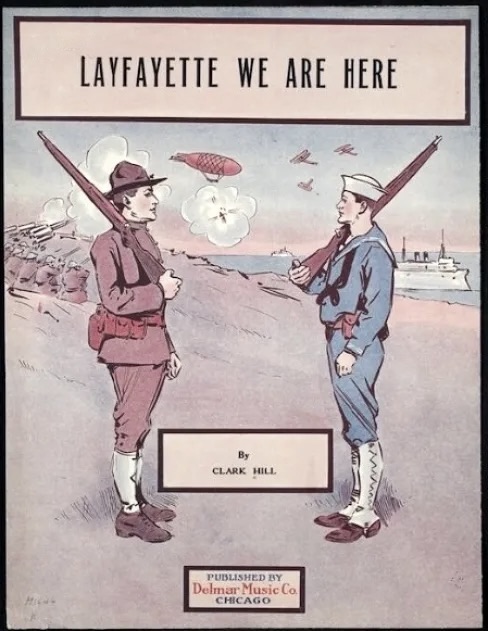
France’s aid to the colonists during the American Revolution was crucial, and it might not have happened without the influence and dedication of the Marquis de Lafayette.
Acknowledging both that debt and the friendship between the countries, Lt. Col. Charles Stanton spoke these words at Lafayette’s grave in Paris on July 4, 1917, when the United States Expeditionary Force arrived to lend aid to France in World War I:
“And here and now, in the presence of the illustrious dead,
we pledge our hearts and our honor in carrying this war to a successful issue.
Lafayette, we are here.”
Alfred, Lord Tennyson, “The Charge of the Light Brigade”
She parodied aloud:
"Apples to right of her
Apples to left of her
Apples in front of her reddened and ripened." (p 4)
The original Tennyson poem was written to commemorate the bravery of the British cavalry during the Crimean War and read, in part:
Cannon to right of them,
Cannon to left of them,
Cannon in front of them
Volleyed and thundered;
Stormed at with shot and shell,
Boldly they rode and well,
Into the jaws of Death,
Into the mouth of hell
Rode the six hundred.
Cervantés, Don Quixote
Tony’s mother… had leased La Mancha, the magnificent estate which adjoined White Pillars. (p 5)
La Mancha was the home of Don Quixote. The town was famous for its windmills, and Cervantés’ story is why an idealistic but hopeless cause is often described as “tilting at windmills.” Further, one who undertakes such a cause is “quixotic.”
The plot had thickened… (p 5)
We know this one now. See my last post, if you want a reminder!
Clinging Vine
“Hmp! Clinging-vine stuff! That’s what he fell for.” (p 6)
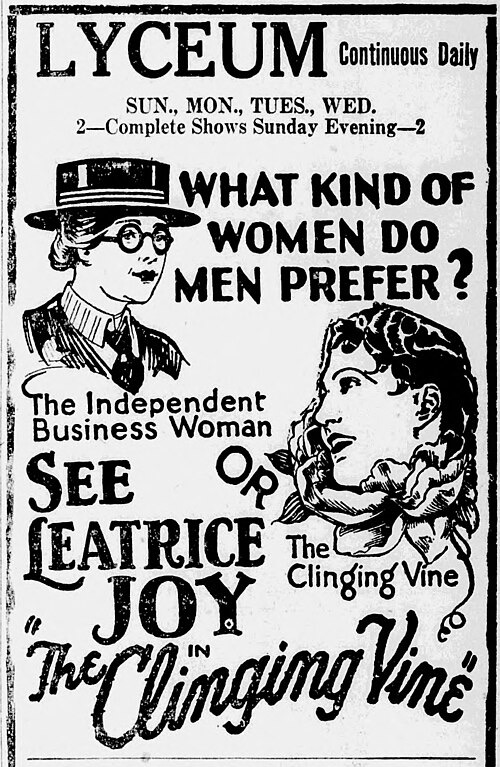
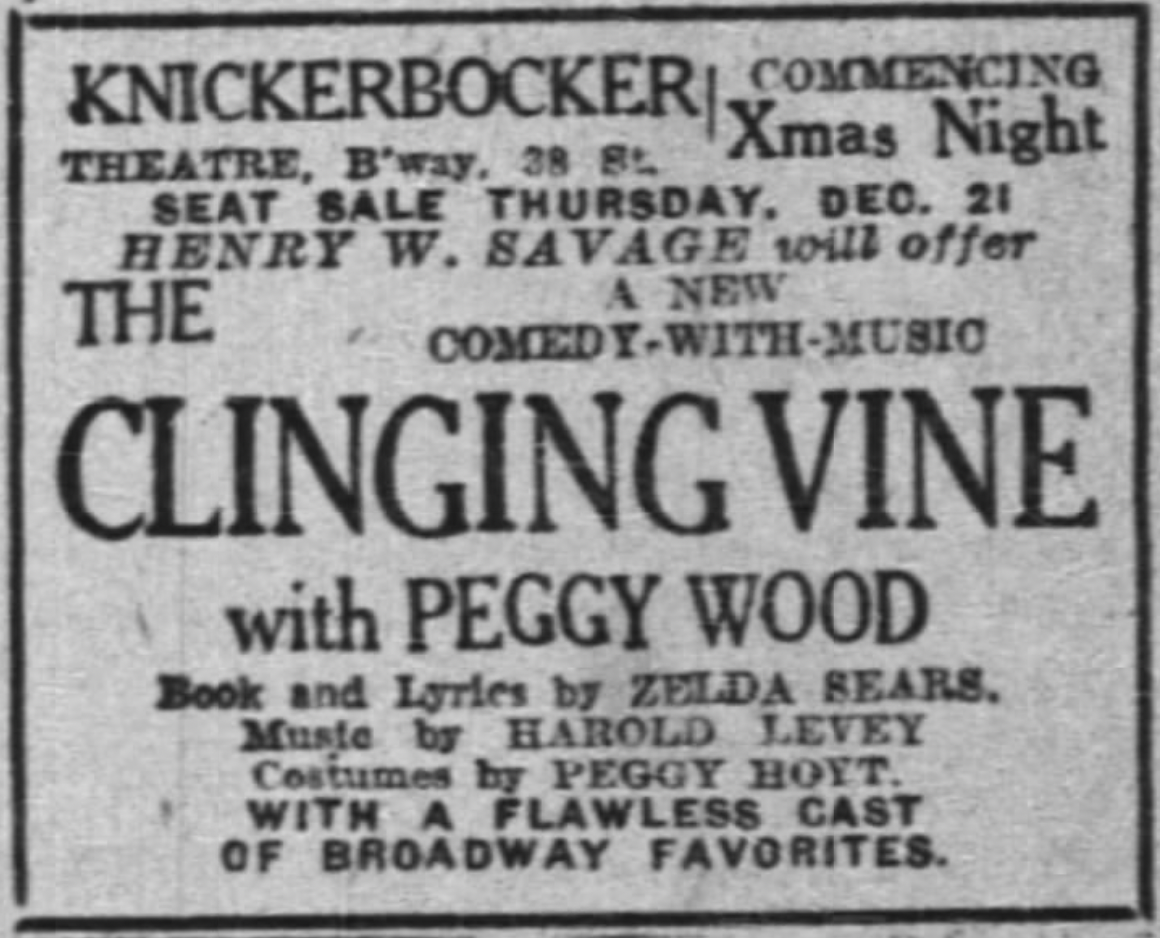
“The Clinging Vine” was a popular silent film in 1926 when Emilie Loring was writing The Solitary Horseman. It was the film adaptation of a Broadway musical by the same name that opened at Christmastime, 1922.
“A. B.” is an ultra-efficient woman employee who is the real smarts behind a paint business. When her feelings are hurt by a casual remark about her unattractiveness, she allows the boss’s wife to give her a makeover. Fluttering her lashes and saying only, “Do go on!” and “Aren’t you wonderful?!” she gets a man to fall for her, but at the cost of expressing her true self. It’s the beginning of a feminist theme that doesn’t quite get there.
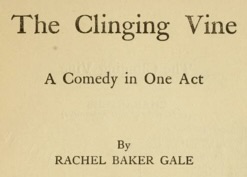
The story is no relation to a play of the same name that Emilie’s sister, Rachel Baker Gale, debuted in 1913. That was a comedy about a women’s club that required its members to “repress all ideals that do not lead toward the emancipation of women.”
On trial is a member who was caught baking bread for her family and sewing clothing for her husband and child–what the group called “being a clinging vine,” a “slave to domestic drudgery.” The member’s defense is cagey: it is her independent decision to care for her family, dismissing the pressures of her fellow club members. She prevails, and the club members decide that they will do both–care for their families and fight for women’s rights. This message is closer to the attitude of The Solitary Horseman, but Rose’s comment about clinging vines referred to the clinging-vine type in the movie.
Classic authors
On one side was her grandfather’s library. Sets of Dickens, Thackeray, Macaulay, Irving, Parkman. (p 7)
Charles Dickens: A Tale of Two Cities, Oliver Twist, Pickwick Papers, A Christmas Carol…
William Makepiece Thackeray: Vanity Fair
Thomas Babington Macaulay: The History of England, Lays of Ancient Rome
Washington Irving: The Legend of Sleepy Hollow
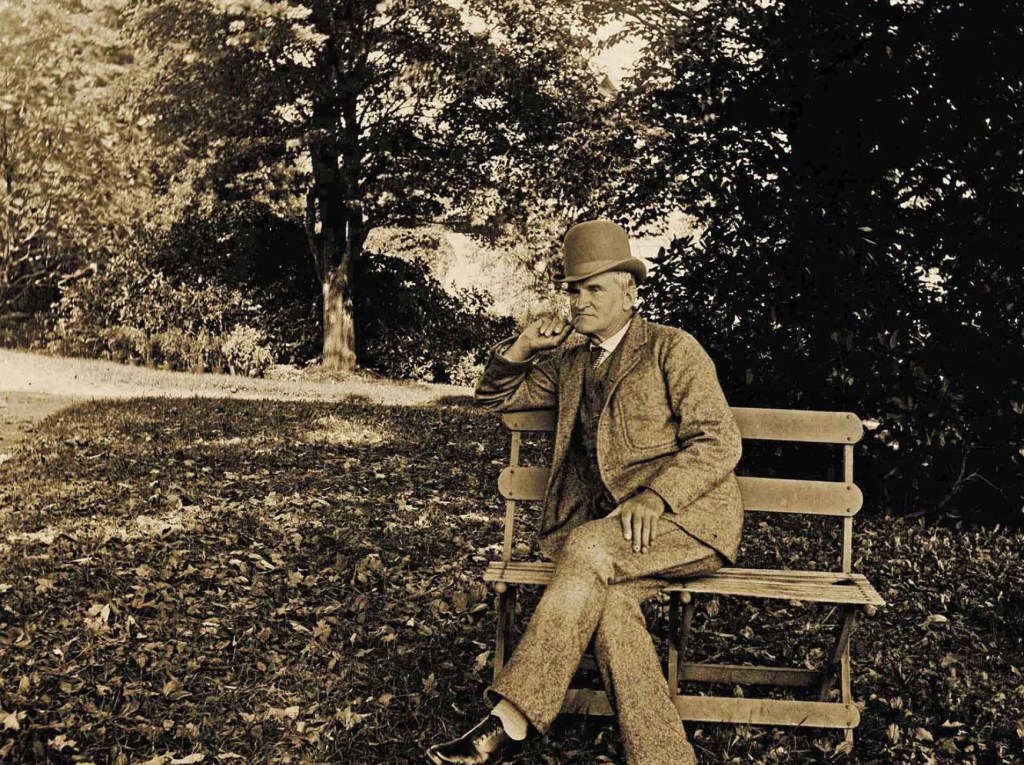
Francis Parkman was a renowned historian and also a Bostonian. At mid-career, he lived at Bowdoin Square, where Emilie would be born a decade later (just around the corner). Later in life, he lived on Beacon Hill at 50 Chestnut Street, just down the block from Emilie’s future apartment at 25 Chestnut. They didn’t overlap, because Parkman died in 1893. Best known works: The Oregon Trail: Sketches of Prairie and Rocky-Mountain Life and France and England in North America (multiple volumes)
Sir Walter Scott:
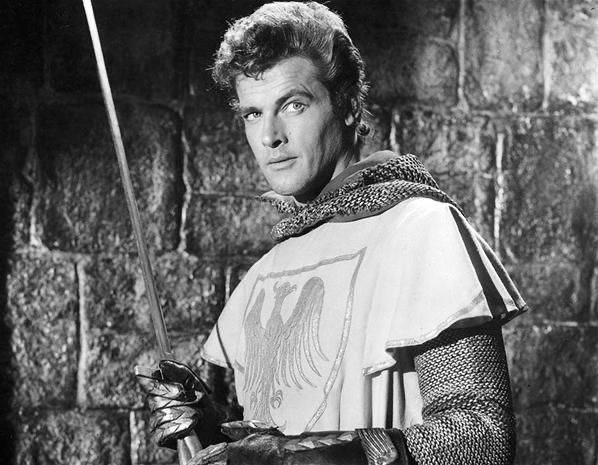
The title of this book comes from Sir Walter Scott’s The Talisman, which Emilie continues to reference.
She smiled as her eyes rested on the Cadell edition of Scott. (p 7)
“Tony, always you remind me of my first hero, the solitary horseman in The Talisman. I know that story by heart.” (p 12)
Other works by Scott include Ivanhoe, Rob Roy, The Lady of the Lake, The Pirate, and Guy Mannering. I especially liked Ivanhoe. I watched the Saturday morning TV show by that name when I was little and was both surprised and delighted when the book turned out to be fully fascinating.
Pierrot
“Take Pierrot home!” the captive whinnied a reproach, pirouetted daintily before he submitted to the steady tug on the rein.
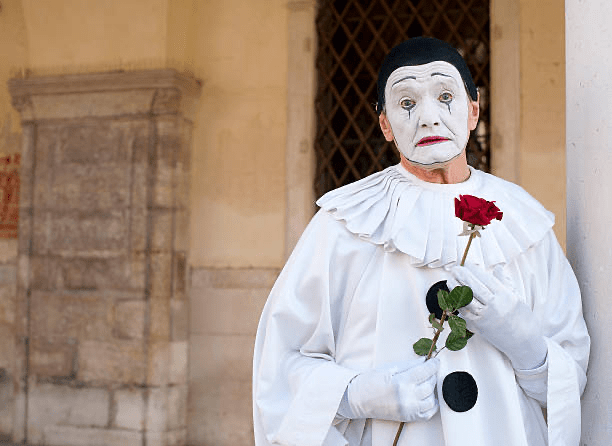
In the long history of clowns, the 18th Century French Pierrot was the first to work without a mask, instead powdering his face white and dressing in all white, too. In the early 1800s, a new “Pierrot” created a back-story for the character, always sad because he could not win the love of “Columbine,” who, unfortunately, was in love with “Harlequin.” (Harlequin Romance, anyone?)
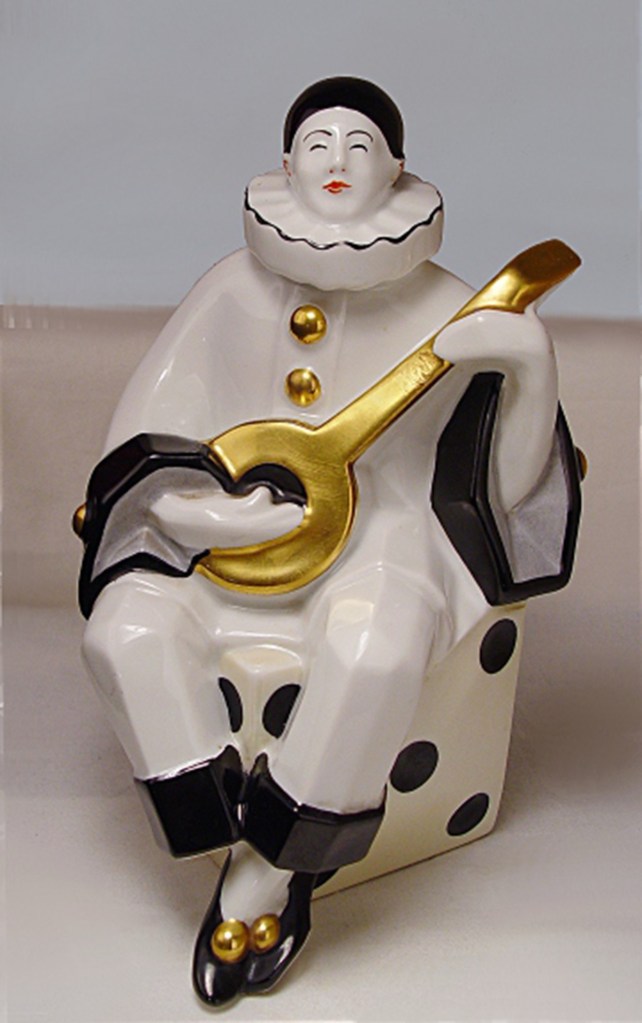
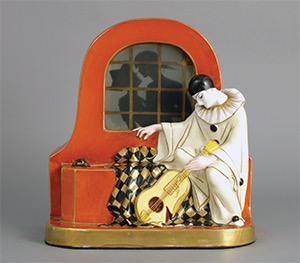
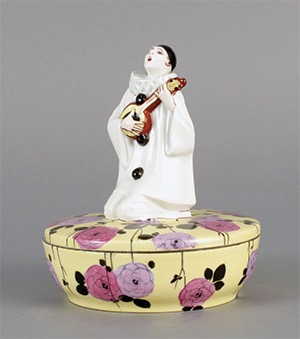
The Art Deco movement produced glass and ceramic figures of not only Pierrot but also “Pierrette,” his female counterpart, who pines for Pierrot but cannot break through his constancy for Columbine. Key characteristics of the figures are their all-white costumes with ruffles at the neckline and morose expressions.
Scylla and Charybdis
“Aren’t you between Scylla and Charybdis? Your mother and Daphne?” (p 14)
Scylla and Charybdis are sea monsters of Greek mythology who guarded either side of the Strait of Messina. Sailors passing through had to choose whether to pass nearer the six-headed monster (Scylla) or the deadly whirlpool (Charybdis). Together, they represent being faced with two dangerous choices.
Oliver Optic
“He is one of the Oliver Optic-Trowbridge heroes come to life–from newsboy to multi-millionaire type.” (p 17)

I’ve developed a real fondness for this fellow. His face is genial, and he wrote more than a thousand good-hearted adventure stories that Emilie grew up reading. His Soldier Boy series is called one of the most authentic descriptions of the Civil War experience. He and Emilie’s father, George M. Baker, created Our Boys and Girls, a magazine for children. Even as an adult, I find Oliver Optic’s stories too good to put down.
John Townsend Trowbridge wrote many books for children and adults. Like Oliver Optic, he edited a (rival) magazine for boys and girls, Our Young Folks.
Larry Semon
“Look at the cream on his whiskers! Larry Semon stuff, what?” (p 30)
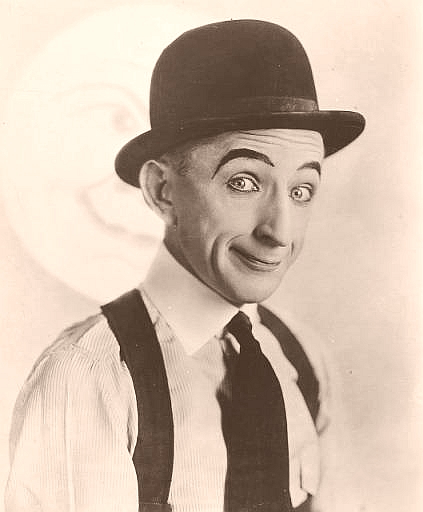
Larry Semon was a silent film comedian. This comment about the monkey and cream refers to the habit of 1920s comedians wearing exaggerated face makeup, including white-face powder and fake moustaches. White-face made their faces easier to see on stages with poor lighting, and the exaggerated features emphasized their humorous intent.
Another reference to Thomas Babington Macaulay
"Pomona loves the orchard
And Liber loves the vine" (p 51)
I had to check twice to see if the Grahame orchards grew peaches or apples. They grew both! Elberta peaches and both Baldwin and MacIntosh apples. Baldwins were long the most popular apple for both eating and cider making in New England, but a widespread freeze in the 1930s destroyed most of the trees. They are rare heirlooms today.


Pomona loves the orchard;
And Liber loves the vine;
And Pales loves the straw-built shed
Warm with the breath of kine;
And Venus loves the whispers
Of plighted youth and maid,
In April’s ivory moonlight
Beneath the chestnut shade. (Macaulay)
Bartlett’s Familiar Quotations
“They doubtless pore over Bartlett’s Quotations till they find a line which includes the word orchard. Why else should they all quote the same sentiment?” (p 51)
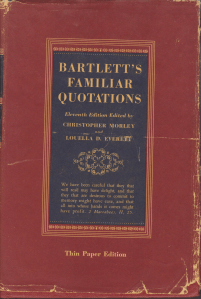
John Bartlett (1820-1905) ran the University Bookstore in Cambridge, Massachusetts. He was often asked for quotations, so he compiled a selection from the Bible, Shakespeare, and a number of famous poets. As a writer and publisher himself, the first several editions were his alone, and each included new additions. Little, Brown picked up the fourth edition in 1863, and it remains in print, new editions, adapted to the times, appearing from time to time.
Lips that touch liquor
“Lot you know about wine.” Mark Hamilton grinned engagingly. He intoned theatrically:
"'Lips that touch likker
Shall never touch mine.'" (p 68)
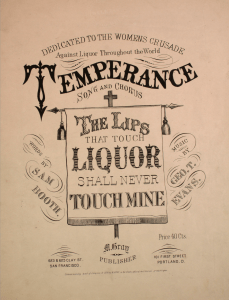
O, mothers whose sons tarry long at the bowl,
Who love their good name as you love your own soul,
O, maidens with fathers and brothers and beaux,
Whose lives you would rescue from infinite woes,
Let war be your watchword from shore unto shore,
Til Rum and his legions shall ruin no more,
And write on your banners in letters that shine,
The lips that touch liquor shall never touch mine.
TBM/TBW
“TBW so soon?” “I am not a tired business woman, but I just can’t bear to see you worried.” (p 76)
The London Observer complained in 1922:
“The T.B.M. now goes to the play with the T.B.W. The tired business man and the tired business woman are responsible for an entertainment which is guaranteed not to make any demand whatever on the human mind. “
The footfall of Destiny
“I have seen that man but twice before but each time he produced an uncanny feeling.”
“Sort of footfall of Destiny stuff?”
“Exactly. The creepy rolling up of mystery.” (p 77)
I am glad to unearth this one. Emilie Loring studied her craft and read both literature itself (especially historical fiction) and advice to writers. Edith Wharton’s The Writing of Fiction (1925) describes:
“Destiny is knocking at the gate. The next knock may not come for a long time; but the reader knows that it will come, as surely as Tolstoy’s Ivan Ilyitch knew that the mysterious little intermittent pain whicch used to disappear for days would come back oftener and more insistently till it destroyed him.
“There are many ways of conveying this sense of the footfall of Destiny; and nothing shows the quality of the novelist’s imagination more clearly than the incidents he singles out to illuminate the course of events and the inner workings of his people’s souls.”
I stayed until I had read The Writing of Fiction in its entirety. I’m beginning a project for which it could be useful.
“Fearless but feminine”
“And then, why then, I caught up Old Gloom, stuffed him in a chest and sat on the lid. Fearless but feminine again. I relaxed. Thought.” (p 129)
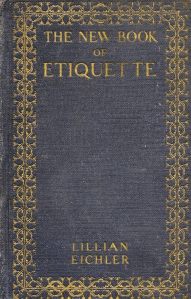
I found this phrase in, of all places, an etiquette book published in 1924. The New Book of Etiquette by Lillian Eichler Watson advises:
“Be self-reliant but not bold, firm but not overbearing. Be strong and fearless, but feminine.”
I appreciate her further counsel:
“You are your own best judge of what you shall do and what you shall not do. Nothing, no one, can tell you better than your own conscience and your own good sense what is correct and what is incorrect.”
Nemesis
She stalked out like an avenging Nemesis. (p 141)
In some Greek dramas, Nemesis deals out one’s “just desserts,” good or bad, much as we think of Karma. In others, Nemesis is specifically the bearer of retribution, punishment, which is what Emilie Loring meant in this passage. Now, when we speak of one’s nemesis, it’s in lower-case and refers to a force of long-standing that keeps undoing or defeating what one attempts to accomplish.
Before you can say “Jack Robinson”
“Hungry, old dear? We’ll be at home before you can say, ‘Jack Robinson.'” (p 157)
This phrase was in common use long before Emilie Loring’s childhood. The Handy- book of Literary Curiosities (1892) attempted to trace it but offered no final solution as to the source of this phrase. Dipping back further, an 1828 article, “Curiosities of Slang,” in The Newcastle Magazine (1828) gives this explanation:
Before you can say “Jack Robinson” – A saying to express a very short time, originating from a very volatile gentleman of that appellation, who would call on his neighbours, and be gone before his name could be announced. — When, then, did this gentleman live? We are sorry there are no other facts to establish his existence, and we believe Jack Robinson to have been nothing but a name. The phrase itself is on a par with those common expressions as quick as lightning, as sharp as a needle, as sound as a top…
Mother Goose
“I am like that old woman in Mother Goose. Trying to realize that I am really I.”
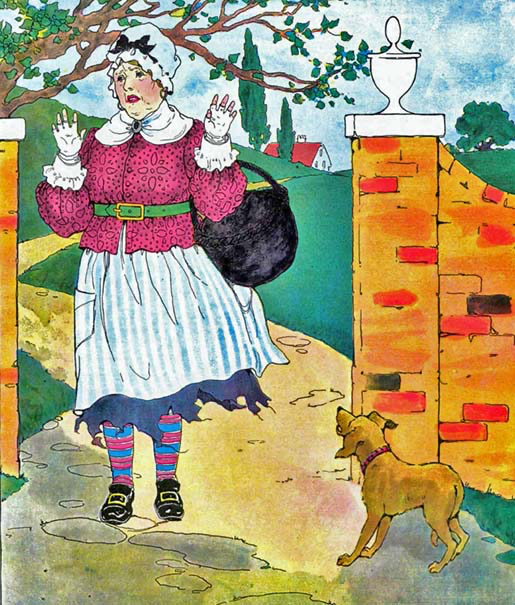
I thought first of the old woman in a shoe who had so many children she didn’t know what to do. But Emilie is referring to an even older Mother Goose rhyme, The Old Woman and the Pedlar:
There was an old woman, as I’ve heard tell,
She went to market her eggs for to sell;
She went to market all on a market-day,
And she fell asleep on the King’s highway.
There came by a pedlar whose name was Stout,
He cut her petticoats all round about;
He cut her petticoats up to the knees,
Which made the old woman to shiver and freeze.
When the little old woman first did wake,
She began to shiver and she began to shake;
She began to wonder and she began to cry,
“Lauk a mercy on me, this can’t be I!
“But if it be I, as I hope it be,
I’ve a little dog at home, and he’ll know me;
If it be I, he’ll wag his little tail,
And if it be not I, he’ll loudly bark and wail.”
Home went the little woman all in the dark;
Up got the little dog, and he began to bark;
He began to bark, so she began to cry,
“Lauk a mercy on me, this is none of I!”
Dante
“I lived through Dante’s frozen hell getting here. If anything had happened to you…”
The deepest level of Hell in Dante’s Inferno was not hot at all but hard frozen, the punishment reserved for treachery. The Devil himself is imprisoned there.
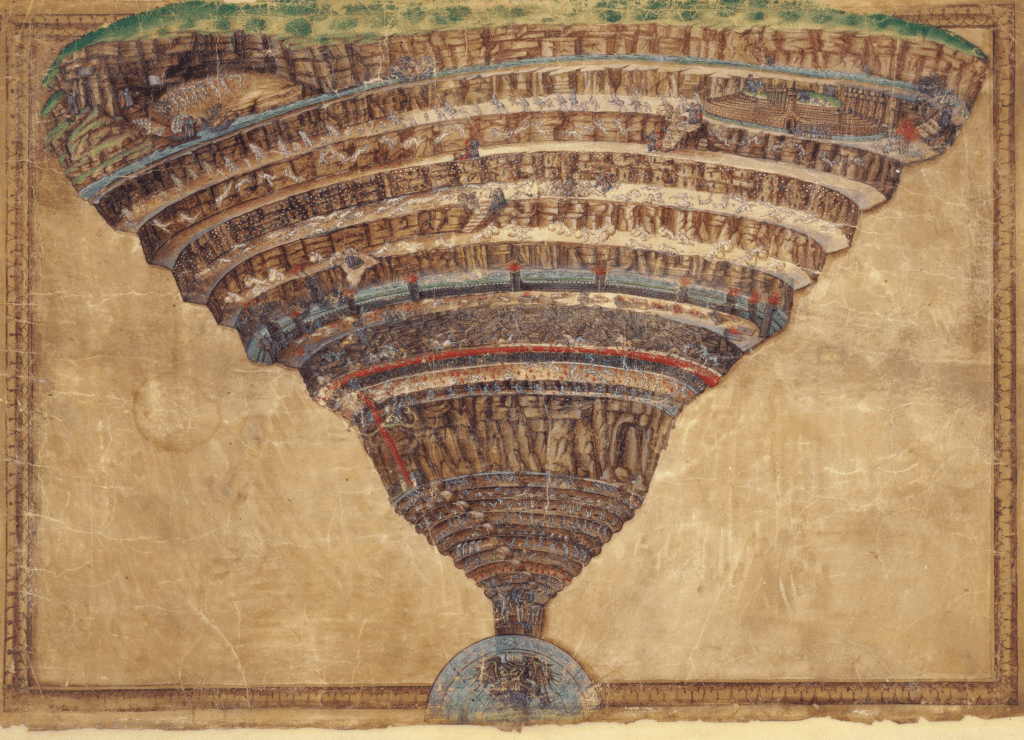
Levels of Hell in Dante’s Inferno
Shakespeare
“Et tu, Brute?” (p 207)
It’s hard to avoid Shakespeare quotes, they are so common in speech. This is from Julius Caesar. As he is slain, Caesar recognizes his old friend Brutus and asks, “And you, Brutus?”
As is common with Shakespeare, there are layers to this. There is a sense of unbelievability–You, too, Brutus, are among my killers? There is also a sense of challenge–And what about you, Brutus? What do you have to say for yourself? What have you done? What shall you do?
In this context, Rose is exasperated that Mark is like the others: “Everyone persists in treating me as though I were on the verge of a decline.”
Sought but not found:
I searched high and low, near and far, for a Spanish-style hacienda that might have inspired La Mancha:
The result was a Palm Beach palance in a Puritan setting… The huge hacienda hall was embellished with little balconies which flaunted gay embroideries flung over their railings. There were unexpected winding staircases, curious casements, lace-like grills of forged iron-work.

I thought I was onto something when I found the Spanish Revival guest house of Larz and Isabel Anderson, built in Brookline in 1927. The Andersons were an eccentric couple, and Isabel was a member of the Boston Authors Club for exotic titles like Polly the Pagan and Zigzagging the South Seas. But it was too small and without the detail we need for La Mancha.
Spanish Revival architecture had a big moment in the 1920s, so the style was up-to-the minute for her novel, but Emilie’s specific inspiration will have to remain a mystery.
I hope I didn’t miss any. The literary references in this story came in spurts between sections of dialogue and action. It makes me curious to see if this is a trend that she continues or a one-off departure.
Next up is Gay Courage, but I may take a little break from literary and cultural reference research. These are fun to do, but gosh, they sure take time, and spring gardening chores beckon!
If you have requests, let me know. I’m happy to talk all things Emilie!


I know these posts take a lot of research on your part, but I do enjoy them. Some of the references in the books I do get right away. I’ve begun looking up novels and songs mentioned and found myself listening to the music she uses in her books as I read the book and creating a playlist just for that novel. It’s fun to have be more submersed reading experience, especially since her books are ‘of the era’ in which she lived and wrote and played.
LikeLiked by 1 person
How interesting! Do you use just the songs in the book or add others that seem to fit the story or period?
LikeLike
I hadn’t thought to use other songs from the same time period…Mostly I’ve just used her references, which are plentiful. She seems to have enjoyed music as much as fashion and decor. I’ve looked up events she might mention that were current to her time of writing. I’ve also looked up clothing styles and jewelry she’s mentioned to see what might come up. It’s really a fun way to go through the books. Not hard for me to do since I love history anyway.
But I also sometimes just sit down and binge read through them and don’t look anything up, lol. There’s a time and place for everything under the sun, right?
LikeLiked by 1 person
Indeed. One woman wrote in who made doll houses and miniatures, and we talked about how fun it would be to reproduce one of the home settings. I still love that idea. Maybe we could try a “book nook” mini example.
LikeLike
Greetings! Patti!Thank you for all things culture! Who of us don’t need a bit more
LikeLiked by 1 person