Tea, Tea, Tea! Happy Birthday to Emilie Loring!
As I post this, I am in Brattleboro, Vermont, heading to Blue Hill this morning, where I will quickly assemble my own tea, take photos, and prepare to receive yours.
Enjoy a tea any way that you like, take photos to share, and send those, along with a description of your event to:
contact@pattibender.com
I’ll begin posting Saturday evening and continue through Sunday until all of the photos are in. I love this event. It’s so fun to see what everyone comes up with. I have an idea for mine, and it all depends on whether a certain shop on my route has what I hope it does… If not, it will be Tea Surprise!
Now, as promised…
Mysteries in Marlborough
My trips to New England this year are to make sure I have all the material I need for Emilie Loring’s New England. A place that I had never visited, except online, was Marlborough, Massachusetts. In addition to being Victor Loring’s hometown, this rural town with its apple and peach orchards is the setting for The Solitary Horseman.
The Lost Loring House
I’m not sure how many times I need to learn this lesson, but there is absolutely no substitute for actually going to a place.
Emilie’s husband, Victor, grew up in this house. His father, Hollis Loring, was a shop owner, postmaster, and a staunch abolitionist. Victor remembered the basement being used as a stop on the Underground Railway when he was a boy.
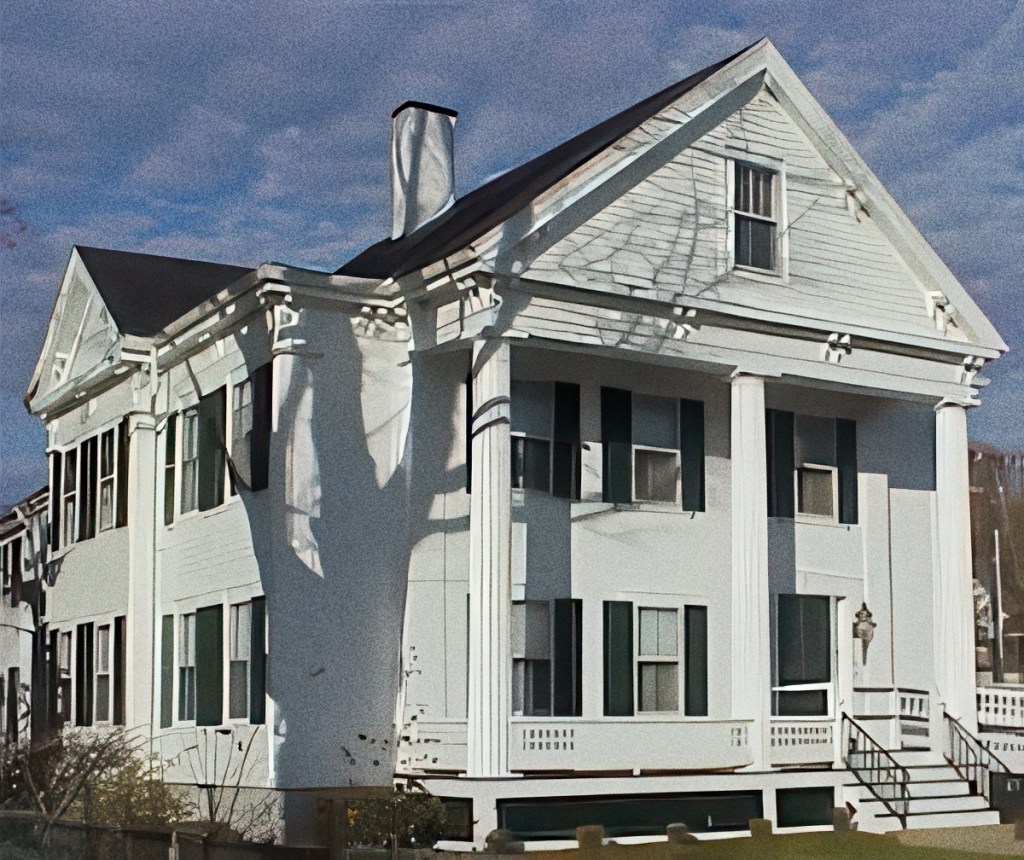
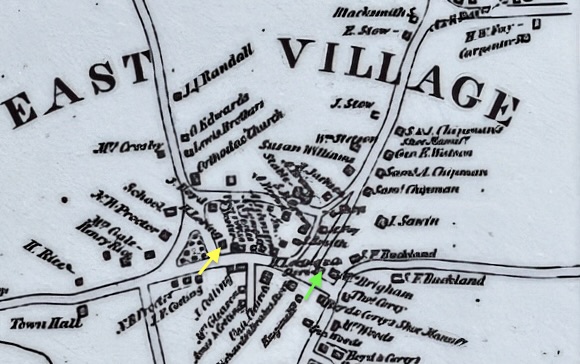
Expectations high and map in hand, I drove into town, parked on Main Street, and looked for this big, white house, which should be at 57 Main Street. A historic map across from the old Town Hall confirmed its relative location along the street.
I looked for 57 Main… and there it was, not on the Loring house but at the top of a highrise apartment building.

The historic Hollis Loring house, I am sorry to say, is… GONE.

With a little digging, I learned that it was torn down on August 19, 2024 to make way for the apartments. Oh, I wish I’d visited it sooner, and I’m sorry that it can’t be on the tour of Emilie Loring’s New England. (And may I just say, the Loring house was more attractive.)
That was disappointing. But as long as I was in Marlborough, why not explore a little more? Hollis Loring’s father, Hollis C. Loring, was buried in the Spring Hill Cemetery, only a couple of blocks away and clearly marked on my map.
Three Gravestones for One Man?
I won’t take you on the long journey I traversed in trying to find the Spring Hill Cemetery, but suffice it to say that 45 minutes later, I discovered that there is only one way in, and it lies at the end of a well-disguised alleyway.
“Spring Hill Cemetery: 1675”
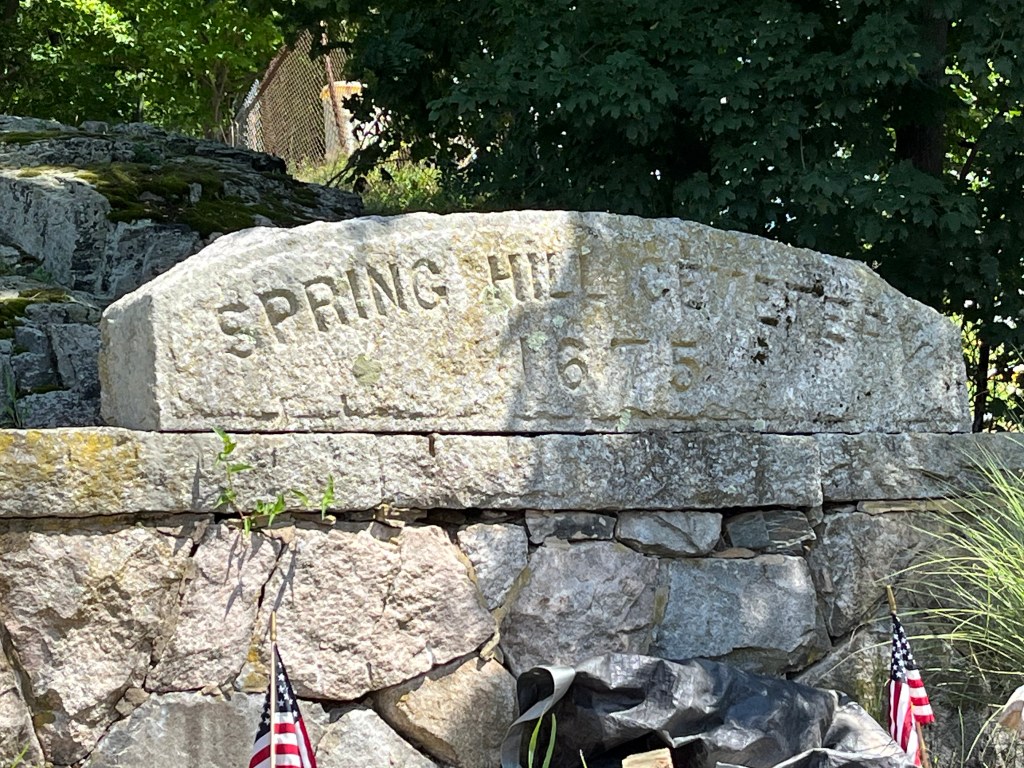
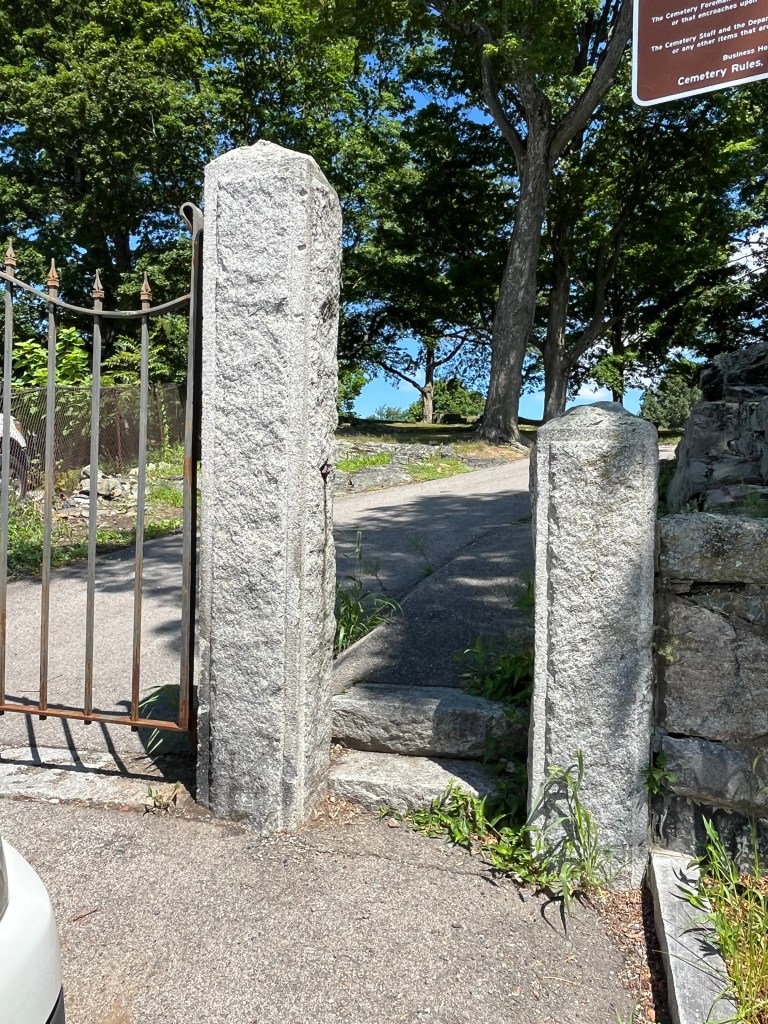
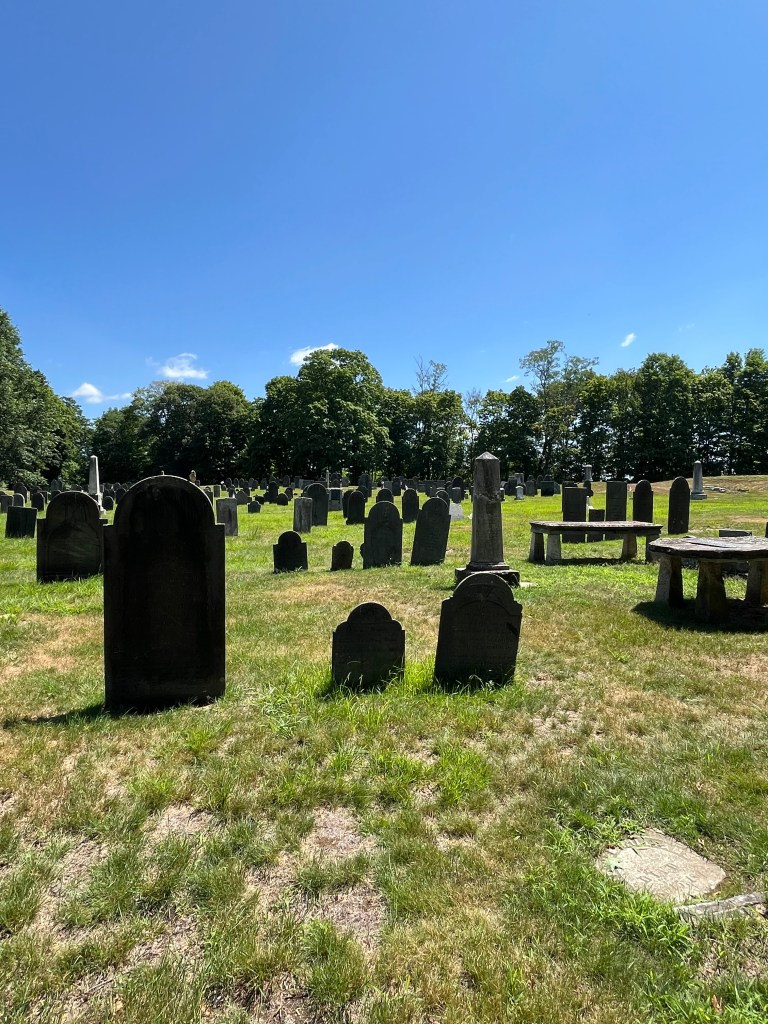
There were hundreds of graves and all were dark and hard to read from a distance. Luckily, the website FindAGrave had the coordinates, and using my phone’s approximation of the old game, “You’re getting colder, you’re getting warmer, you’re getting even warmer,” I soon found a large and lovely old stone for Victor Loring’s grandfather, Hollis Clark Loring.
Sacred
to the memory of
Mr.
Hollis C. Loring
who died
Nov. 15, 1826
Ea 35
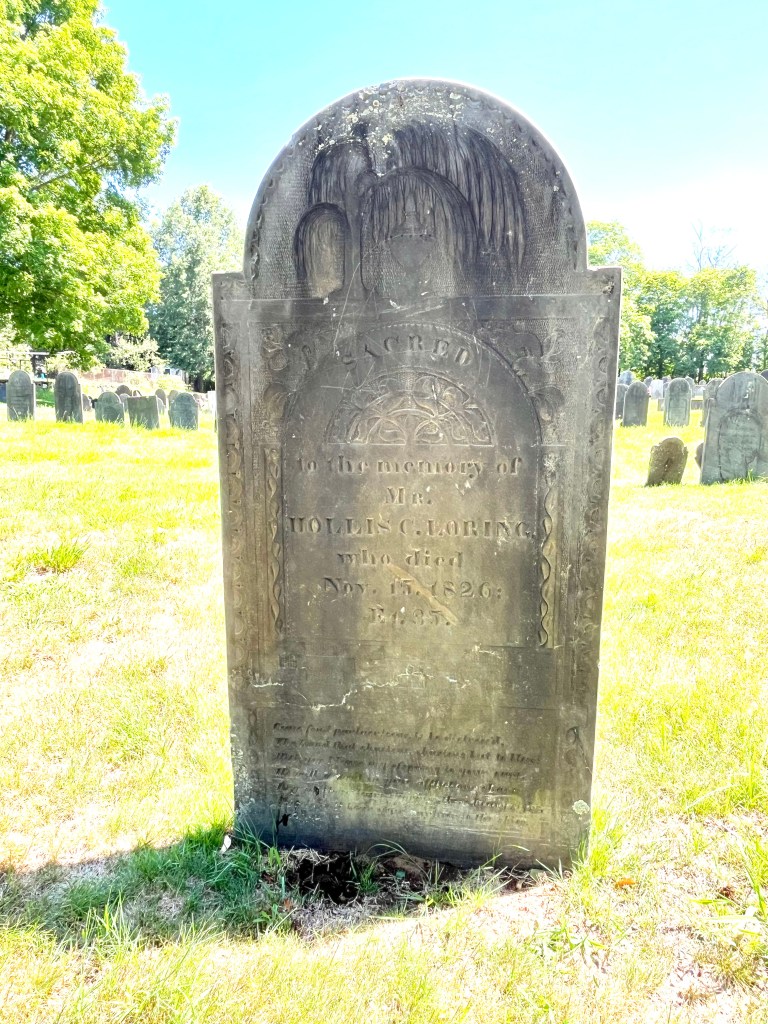
[To keep the history straight, Victor’s father was simply “Hollis Loring,” and his grandfather was “Hollis C. (Clark) Loring.”]
The poem at the bottom of the stone is for Catherine Wilkins Loring, Hollis C’s second wife, who raised Hollis to adulthood.
Cease fond partner! cease to be distress’d,
The hand that chastens, chastens but to bless
With you I leave my offspring to your care
He will a part in your afflictions share
Dry up those tears, suppress those heavy sighs
Angels will bear your partner to the skies
Neither Catherine Loring nor Victor’s parents were in the Spring Hill Cemetery, so I went to the Rocklawn Cemetery nearby to see if I could find them.
“Rocklawn Cemetery”
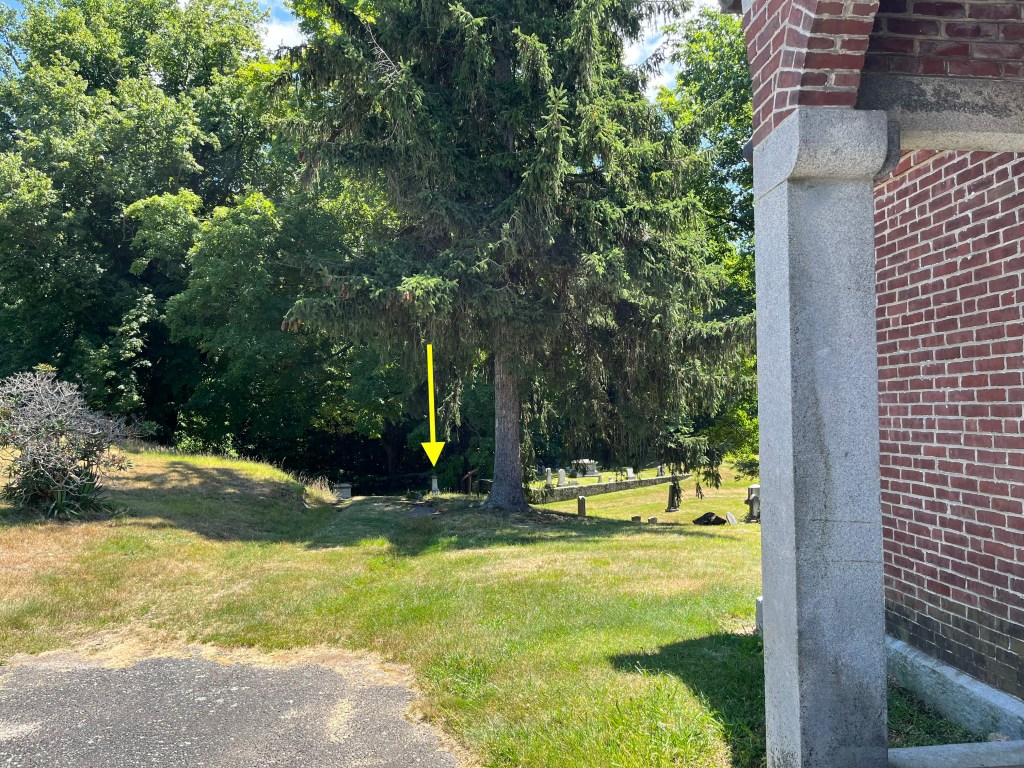
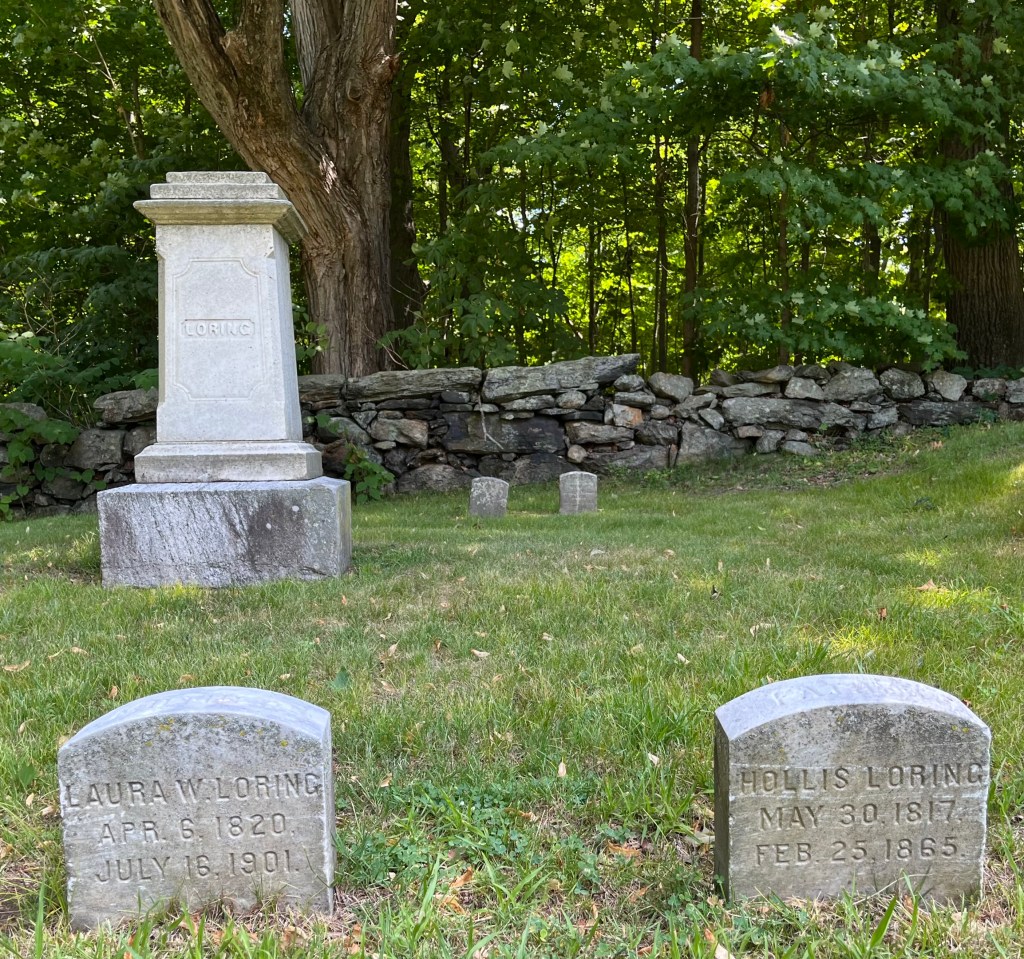
All the way to the back, along a rock fence, I found a marble monument that said simply “Loring.” The stones for Victor’s parents, Laura and Hollis, were side by side in front of it, with the words “Mother” and “Father” on their tops.
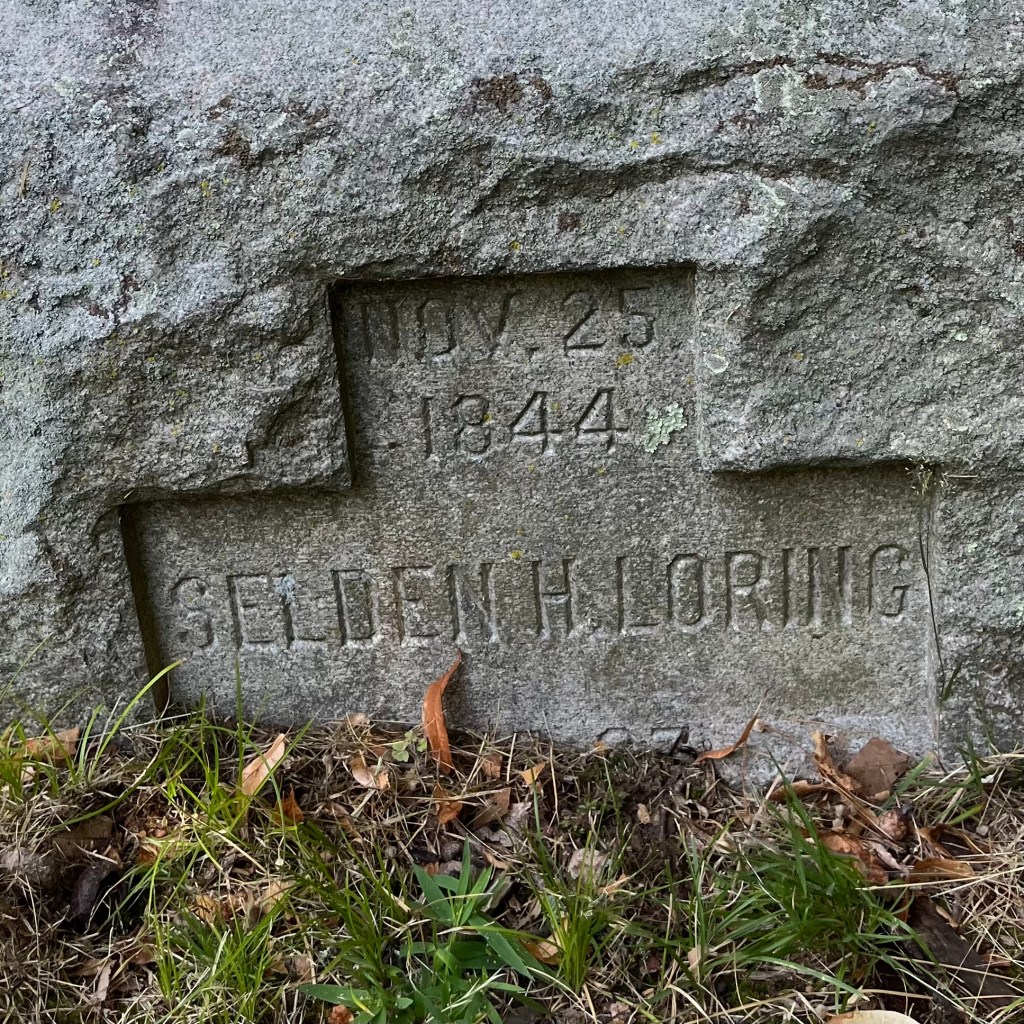
To the left of the Loring monument was an artistic stone for Victor’s brother, Selden Hollis Loring. Selden served in the Civil War and the Franco-Prussian War and spent several years as the American consul in Hong Kong. He died only months after Emilie’s marriage to Victor, and they named their younger son after him.
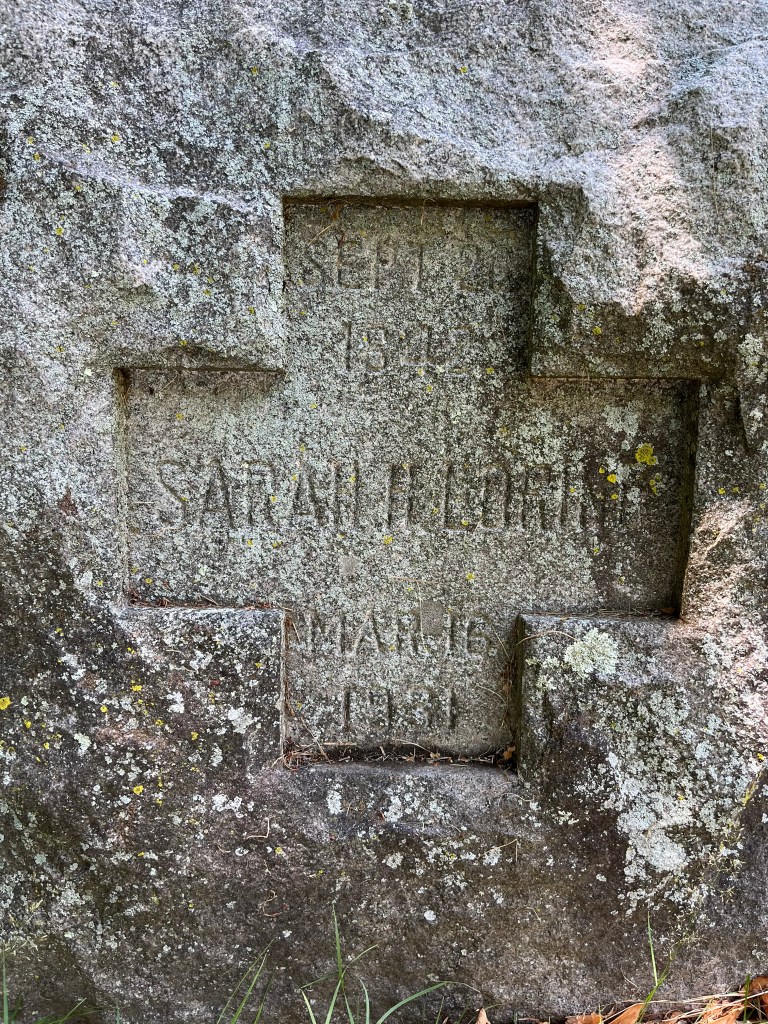
The lettering on Selden’s stone is in the Adirondack style, to honor his efforts on behalf of the American wilderness, including the Adirondacks and the Appalachian Trail. His wife’s name, Sarah H. Loring, is inscribed in an indented cross on the reverse of Selden’s stone.
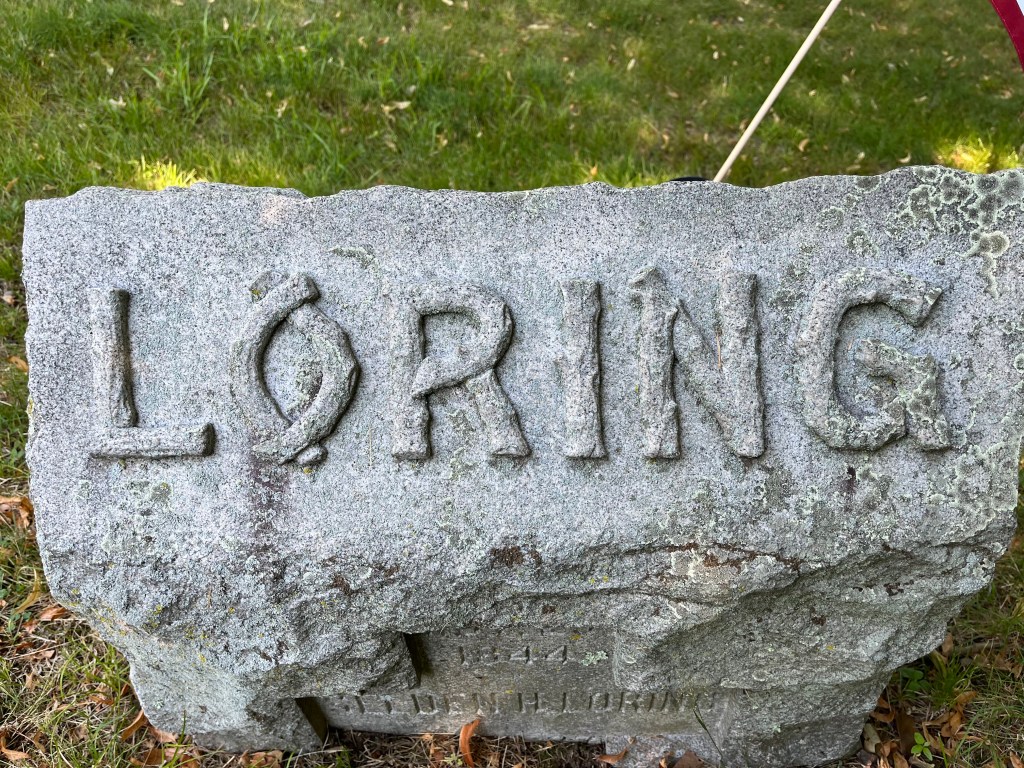
Unfortunately, the stone has settled in the past 130 years. I hope it can be raised and reset to preserve it.
The two small stones beyond the Loring monument were covered in dirt and lichen and hard to read, but I figured them out. They were Victor’s aunts, sisters to his mother, Laura (Hitchcock) Loring.
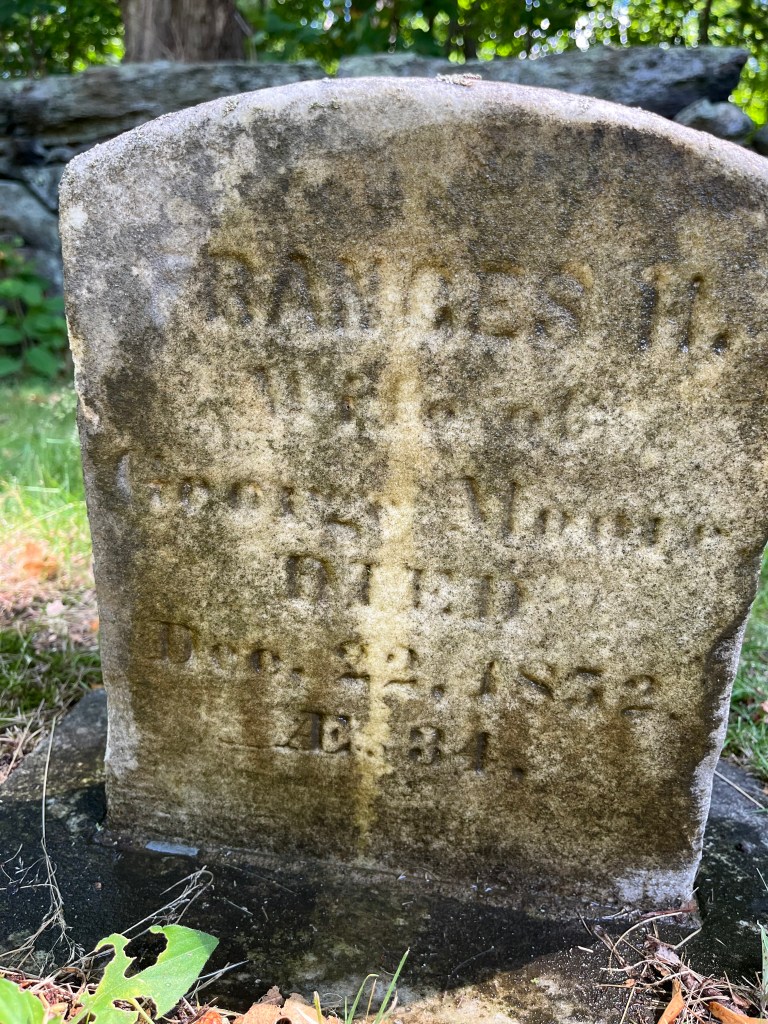
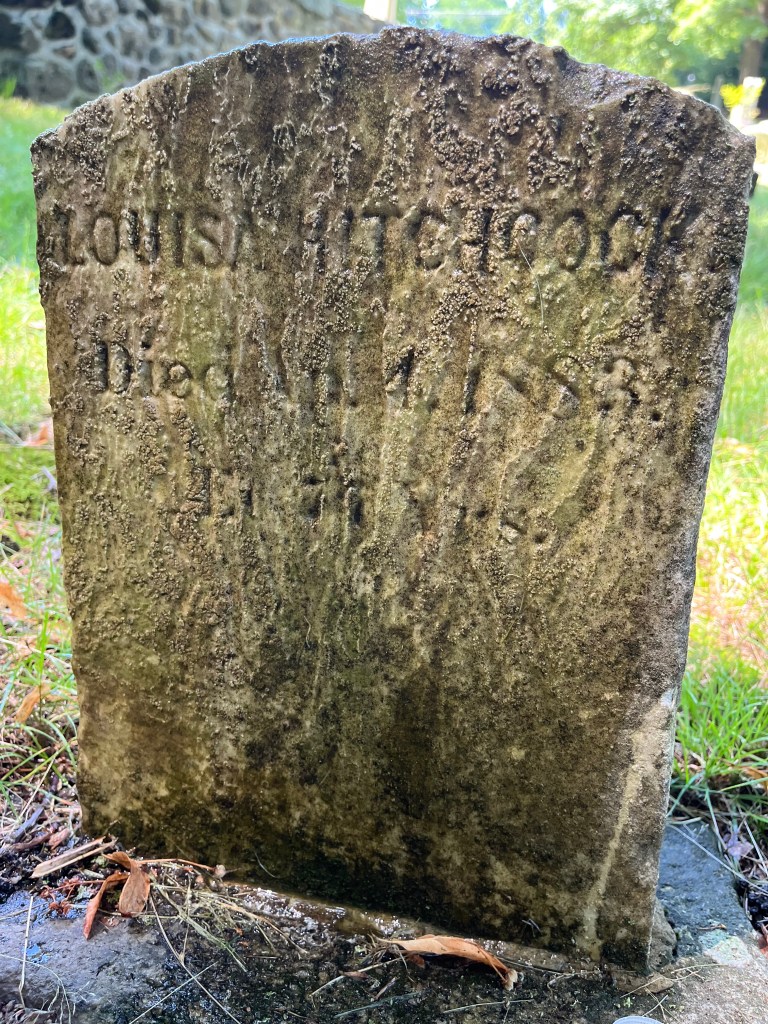
Frances (Hitchcock) Moore died of bronchitis before Victor was born. Her stone was so worn, I initially thought it said “Banges.”
Louisa Hitchcock was one of the two aunts that lived with the Lorings while Victor was growing up and whom Emilie describes in Gay Courage. Louisa died of a heart clot at the Loring’s home in Boston, 364 Marlboro Street on 4 April 1883. [The other aunt, Senia, died in 1881, but I don’t know where she was buried, perhaps by one of her two husbands.]
To the side of the sisters’ stones were several stone fragments, mostly covered by dirt and unreadable. Brushing aside the dirt with my fingers, I uncovered a fragment that said, “Hollis C…. Di…”
“Hollis C?” Hollis Clark Loring, Victor’s grandfather? But we already saw his stone in the Spring Hill Cemetery. What’s up?
Furthermore, FindAGrave lists the Loring monument as Hollis C’s grave, complete with his dates, which I did not find anywhere on the stone or its base.
That makes three stones for Hollis C: the large stone at Spring Hill, the marble Loring monument, and the broken stone.
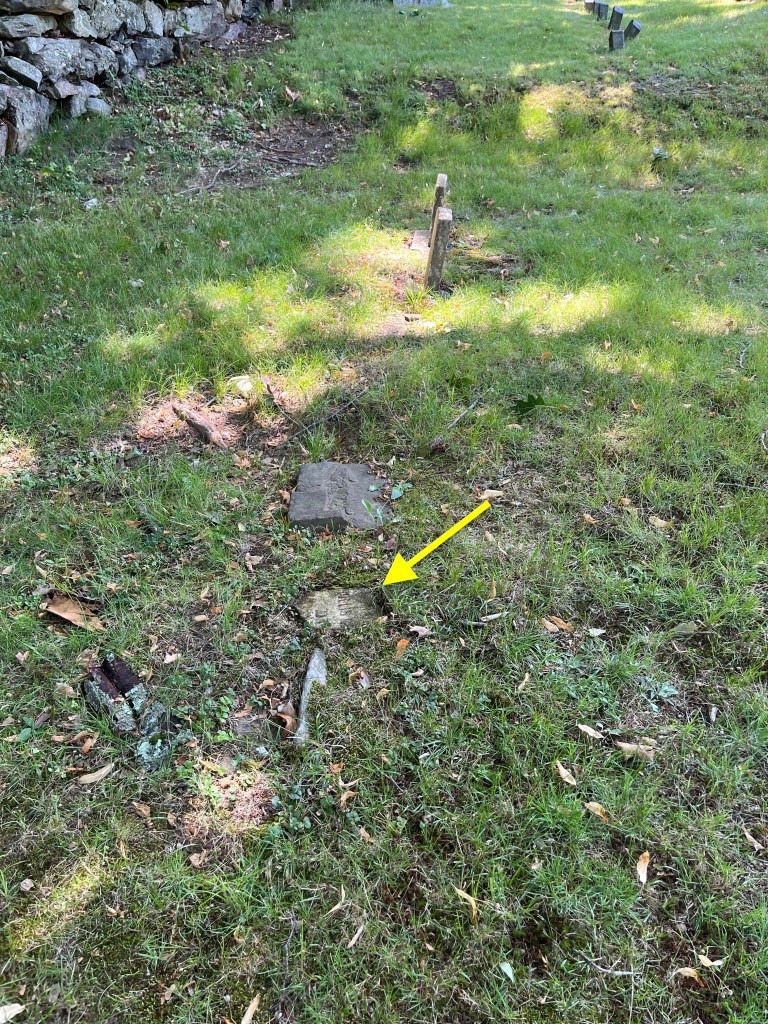
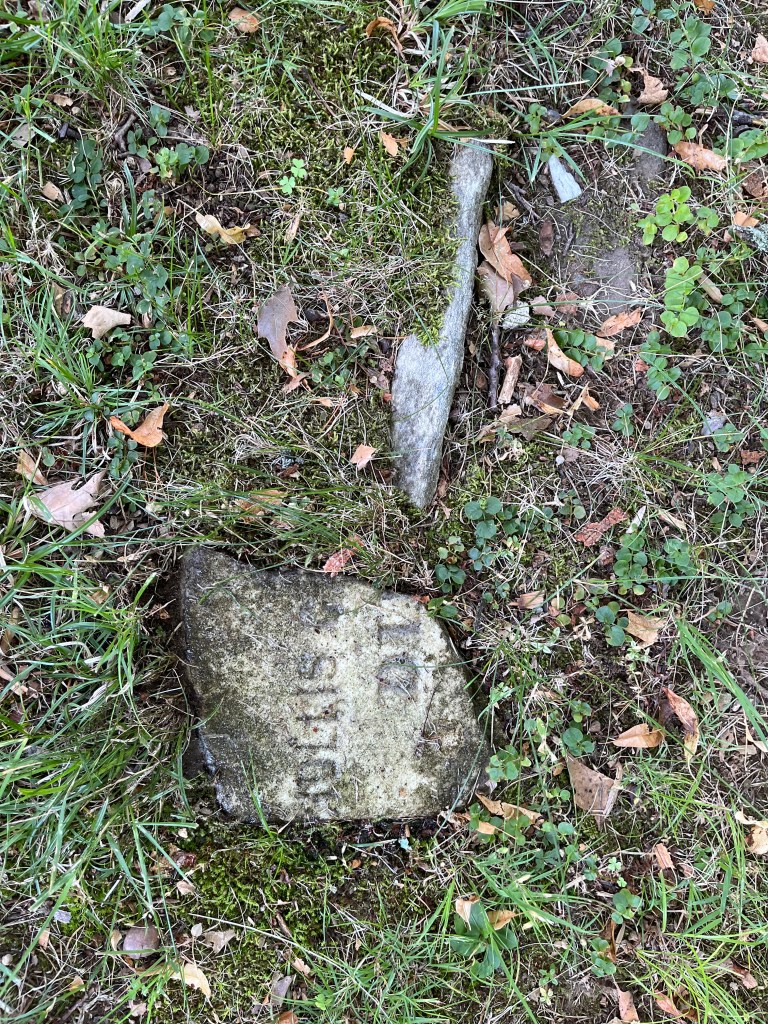
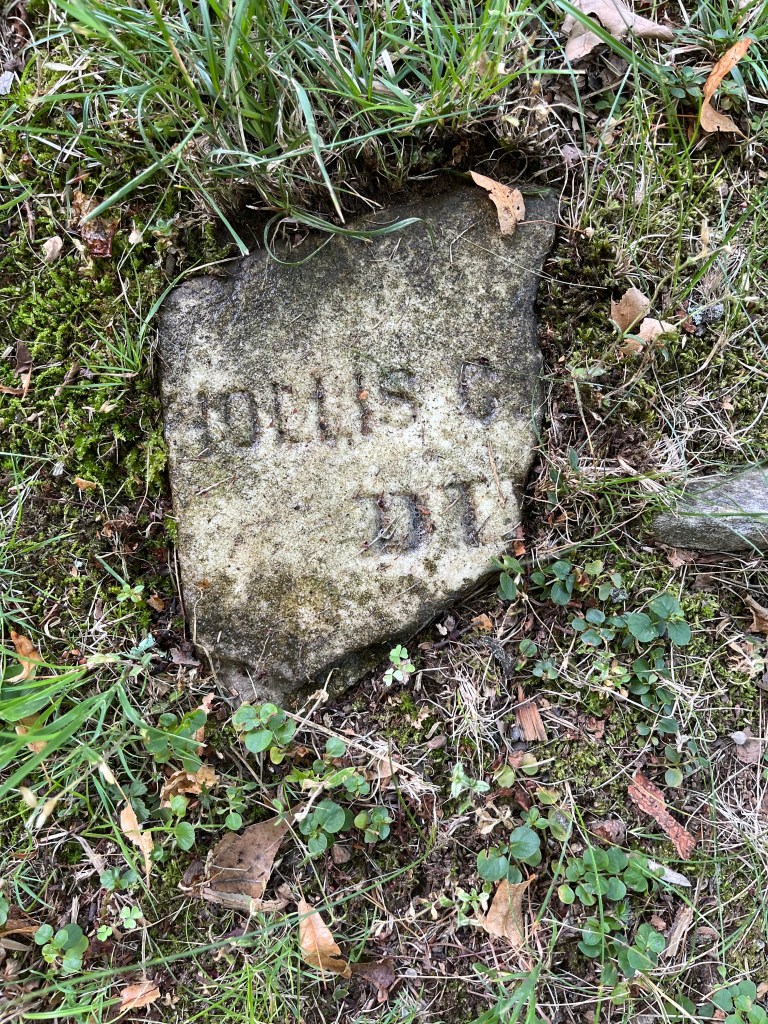
I would love to know what’s on the buried stones next to the fragment. Are they bases for stones that fell over or gravestones themselves with clues that would make all of this very clear?
Hollis C’s wife Catherine died in 1864, 38 years after her husband, and left directions in her will.
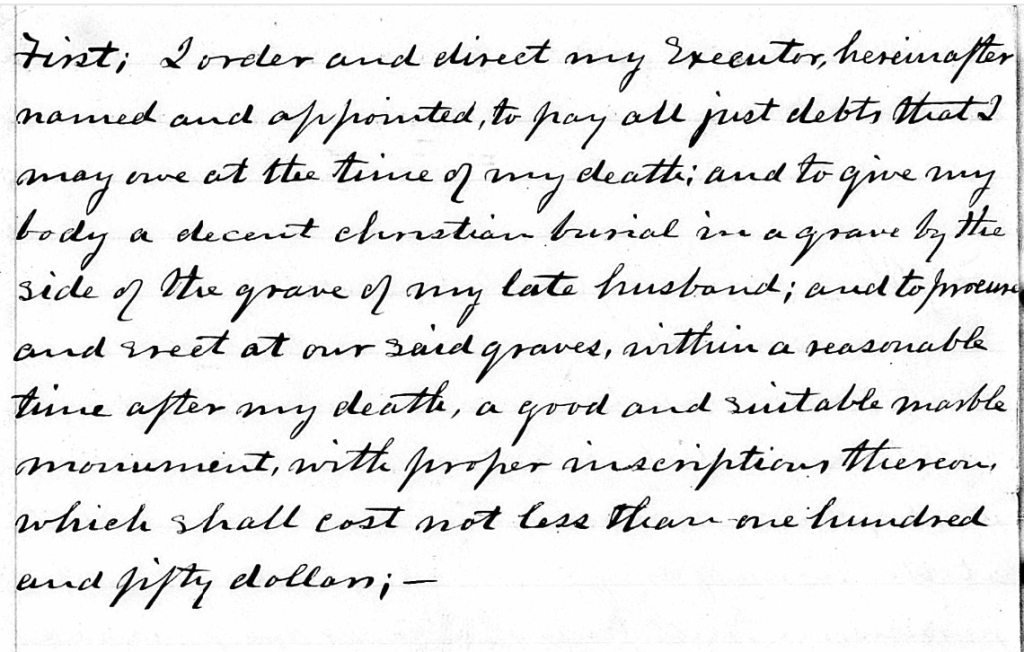
Only part of that happened.
It may have gone like this:
- Between Hollis C’s death and his wife Catherine’s, burials had largely switched from Spring Hill Cemetery to Rocklawn Cemetery. Hollis C. was in Spring Hill, but Catherine would go to Rocklawn. Maybe Hollis and Laura wanted to establish a Loring plot with all of the family together.
- The gravestone fragment for Hollis C was the original stone made after his death, before the large stone “Sacred to [his] memory” at Spring Hill.
- Catherine was likely buried at Rocklawn, and the original stone for Hollis was placed there, too.
- The marble Loring monument was erected, but the inscriptions were never made, possibly because her son, Hollis, was carrying out her instructions and died before they were completed. Catherine died July 30, 1864, and her son Hollis died February 20, 1865.
- Victor’s little brother, Willis, died one month after their father, Hollis Loring, in 1865. Was his one of the broken/missing stones?
Lost Orchards
There are no commercial orchards remaining in Marlborough. The 300-acre Rice orchard was the city’s most famous, but it has been replaced by an Apex Center–go-carts, arcade, axe-throwing, and bowling. Sigh… If you are in the area, you can still find orchards in the neighboring communities, fifteen minutes away.
Before I leave the topic of orchards, though, let me just make one potential connection. Hollis C. Loring was born around 1791 of unknown parentage and adopted by William Loring, but we don’t know at what age. From 1793 to 1797, William Loring engaged in several land deals with the Rice family, both buying and selling. Something to probe further…
Whew! After all that, I think I need a cup of tea!