Here is the long-promised post about literary and cultural references in A Certain Crossroad:

The Trail of Conflict (1922) and Here Comes the Sun! (1924) were so filled with literary references that I steeled myself for a long journey through a multitude of quotes in A Certain Crossroad (1925). But that’s not what I found.
This book was lighter in literature, heavier in the other arts, and Emilie Loring emphasized the mystery and adventure that her husband and sons liked. I hadn’t noticed this before, and it’s given me a new appreciation for this “detectival season” in her writing.
Why shouldn’t she unravel the mystery? The suggestion sent an electric tingle through her veins.
I’m often struck by the way that Emilie mixes modern references with classical ones, so I grouped my observations by literary period.
Modern Period / Twentieth Century
Literature
Sir Arthur Conan Doyle, Sherlock Holmes mysteries
Why shouldn’t she unravel the mystery? … she would be beating Ollie at his own game! Ollie who had been in the Intelligence Department during the war, who considered that only for his fatal habit of blushing he would surpass the immortal Sherlock…” (p 42)
Mystery is afoot in A Certain Crossroad, so it seems right that the lone literary reference from the twentieth century–and it really spans both Victorian and Modern–is this nod to Sir Arthur Conan Doyle’s Sherlock Holmes. His books were published from 1887 through 1927 and never seem out of currency, a permanent part of our cultural literacy.
Music
“On the Road to Mandalay“
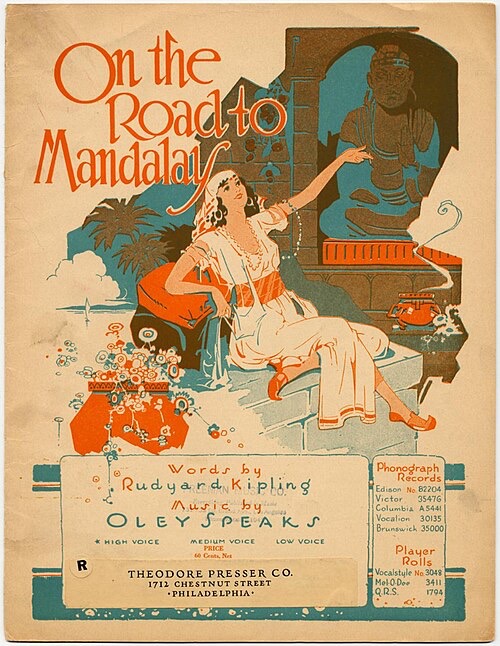
"By the old Moulmein Pagoda, lookin' eastward to the sea,
There's a Burma girl a'settin', and I know she thinks o' me;
For the wind is in the palm trees, an' the temple bells they s-a-a-y----"

What the temple bells said was drowned in a splash of water... (p 24)
The temple bells said, “Come you back, you British soldier, come you back to Mandalay.” This song was composed in 1907 by Oley Speaks, with lyrics by Victor Loring’s favorite, Rudyard Kipling.
“Marcheta, Marcheta“
“Marcheta, Marcheta,
I still hear you calling me back to your arms once again,
I still feel the spell of your last kiss upon me,
Since then, life has all been in vain.” (p 29)
These lyrics are really the romantic theme of A Certain Crossroad. Neither Neil nor Judith has found happiness since they parted. The poem and music are by Victor Schertzinger (1913).
“Doodle Doo Doo“
"How d'you-do! How d'you do!
How d'you-doodle-doodle-doodle-doodle-do!
How d'you--" (p 131)
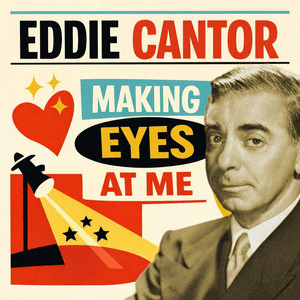
This is not an exact quote but uses the “doodle” sounds of a 1924 song by Eddie Cantor. It may be that Emilie didn’t get permission to use it and paraphrased his original:
Please play for me the sweet melody
Called do-do-do-do, do-do-do-do
I like the rest, but what I like best
Is do-do-do-do, do-do-do-do
Simplest thing, there's nothing much to it
Don't have to sing, just do-do-do-do it
I love it so, wherever I go
I do-do-do-do-do-do
Film
Buster Keaton
“I have had a private view of some of Oliver’s releases and believe me, they are the funniest things outside a Keaton film.” (p 32)
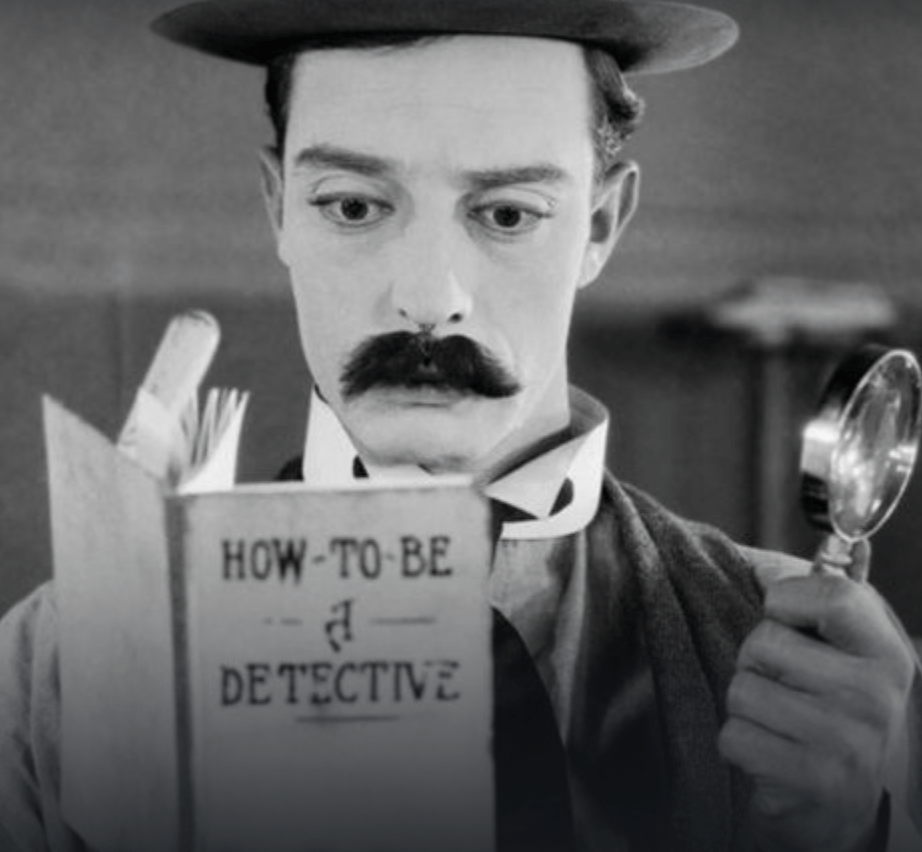
In keeping with the mystery/Sherlock theme, Buster Keaton’s most recent release was “Sherlock, Jr.” (1924). Keaton acted in and directed this silent film about a boy who works as a moving picture operator while also studying to be a detective.
Vaudeville
“… I am engaged in the scientific if not remunerative pursuit of photography. You know the kind, ‘Sees All Knows All.'” (31)
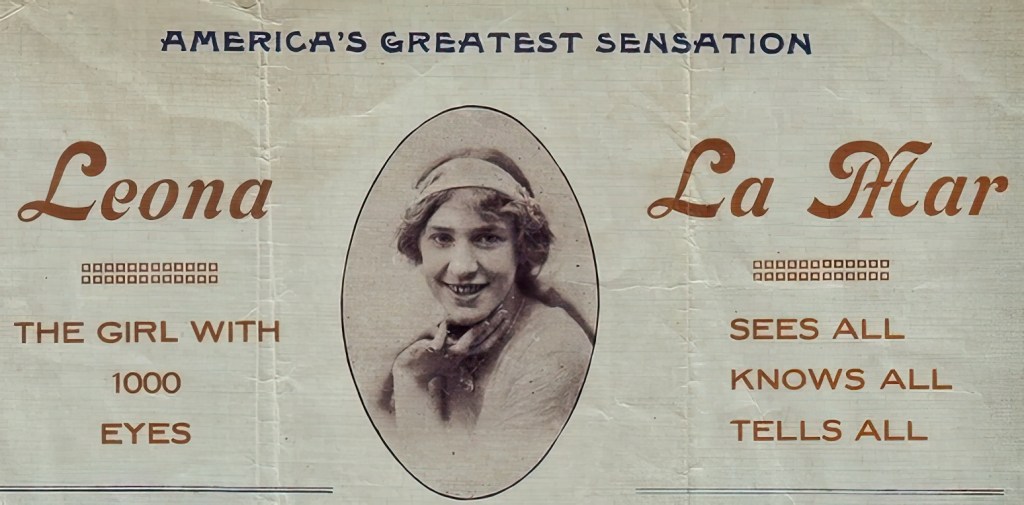
This Girl has some hidden and unrevealed Power. Ask her anything. She will tell You!”
Leona LaMar’s mindreading shows broke theater attendance records in the early 1920s. She claimed a fictional past for herself and claimed, for years, that she was just nineteen. In all her fifteen years on the stage, no one claimed the $1000 prize for proving that she prearranged any of her audience’s questions.
Advertisements
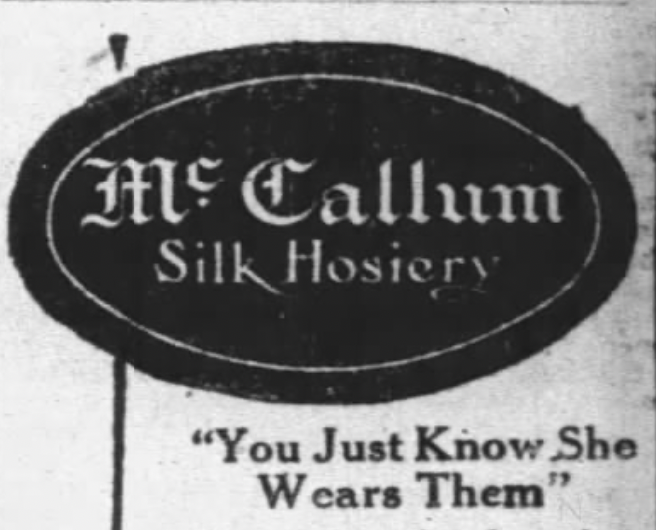
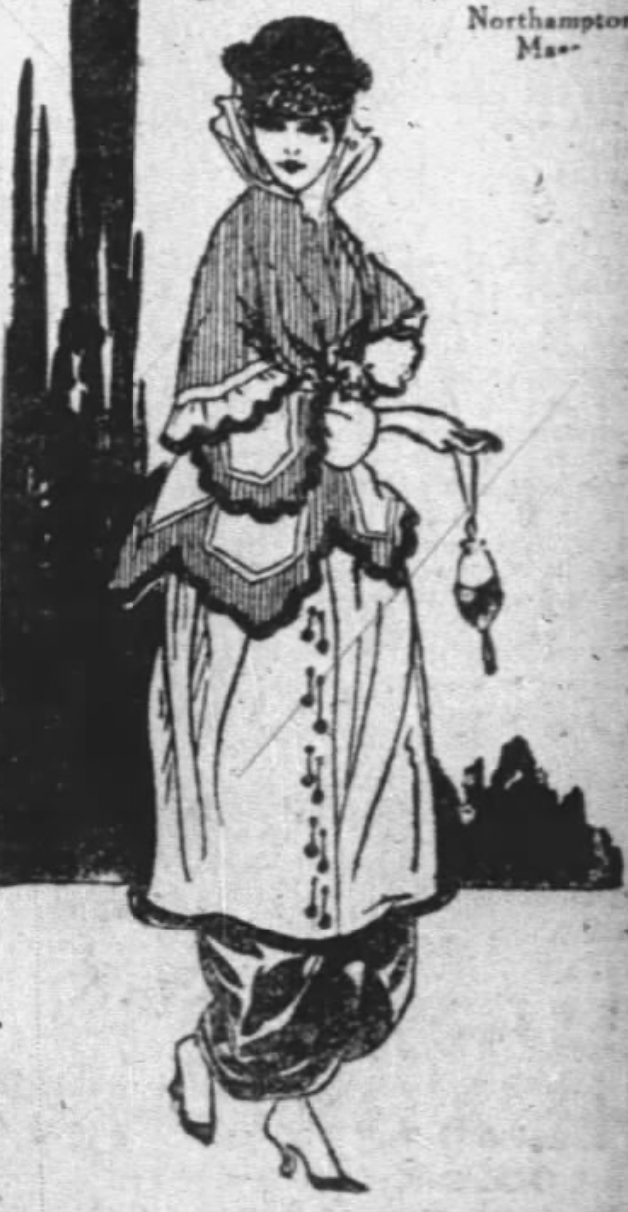
McCallum silk stockings
“‘You just know she wears them,'” Fleet chuckled as Judith Halliday with Boris Stetson in attendance came up through the garden. (p 30)
Gold-Dust Twins
“I’ll get along home. Pansy raises the roof if I’m not there in time to wash up before supper. She’s one of the original Gold-Dust twins.” (p 20)
This is a reference to a racist advertising campaign that featured two Black toddlers, “Goldie” and “Dustie,” on a can of cleaning powder. The woman of the house didn’t do the cleaning; the Black help did. The campaign began in 1903, and by the 1920s when A Certain Crossroad was written, the Gold-Dust twins were as well-known as Aunt Jemima (1889). [source: J. Dennis Robinson, New Hampshire author of local histories and essays on culture, 2021]
Museum of Fine Arts, Boston
Peyton turned his back upon his uncle to frowningly inspect a procession of Chinese ladies of the T’ang period, protected under glass as befitted a painting attributed to the great Emperor Hui T’sing. p 79
Although the artwork was produced in ancient times, I consider this reference a contemporary one, as the piece was then on display at the Museum of Fine Arts in Boston.

Politics
“I may be small but, understand, I can lick my weight in wildcats.” (p 52)
He paused for an instant as the girl’s clear voice flung its challenge in Johnny Brewster’s very words and intonation: “Little thing! Understand, if I am small I can–I can lick my weight in wildcats!” (p 119)
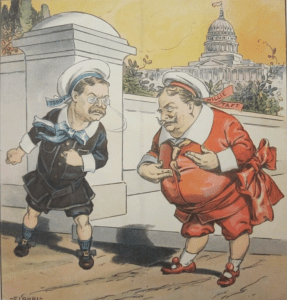
The most famous reference for this bold claim, and likely the one that Emilie knew, was a 1906 political cartoon in which Teddy Roosevelt says, “I can lick my weight in wildcats,” to which William Howard Taft replies, “Oh, that’s nothing. I can eat my weight in possums.”
As early as 1879, though, a story in an Ogden, Utah newspaper told of a drunken man shouting, “I’m the jobberwock with tongue of flame, an’ I can lick my weight in wildcats!” So there may be an even earlier reference, but I find none with a general search. Anyone?
Victorian Period
Literature
Harriet Beecher Stowe
“Be fair, old scout. Judith never had the chance most girls have. Like poor little Topsy, rich little Judy just growed.” (p 27)
In Uncle Tom’s Cabin (1852), Topsy is asked who made her, and she responds, “I ‘spect I grow’d. Don’t think nobody never made me”.
Lewis Carroll
“What sort of stuff are you shooting?” “Oh, ‘shoes–and ships–and sealing wax’ and perhaps, ‘cabbages and kings,'” Fleet retorted lightly. (p 32)

This is from a Lewis Carroll poem, “The Walrus and the Carpenter” found in Through the Looking Glass, 1871.
"The time has come," the Walrus said,
To talk of many things:
Of shoes--and ships--and sealing-wax--
Of cabbages--and kings--
And why the sea is boiling hot--
And whether pigs have wings."
Emilie’s next Lewis Carroll quote is from Alice’s Adventures in Wonderland :
“If you are going to turn into a pig, my dear, I’ll have nothing more to do with you. Mind now!” (p 120)
Casket of Poetry
As she turned the leaves of the gold and purple Casket of Poetry on the center table she looked down at the thimble and button beside the work-basket. The mysterious voice had inquired for that button. (p 44)
The full title of this work is The Casket of Prose, Poetry and Pictures : For the Improvement of the Young : a juvenile forget-me-not : with fine engravings. Several editions were published between 1838 and 1847.
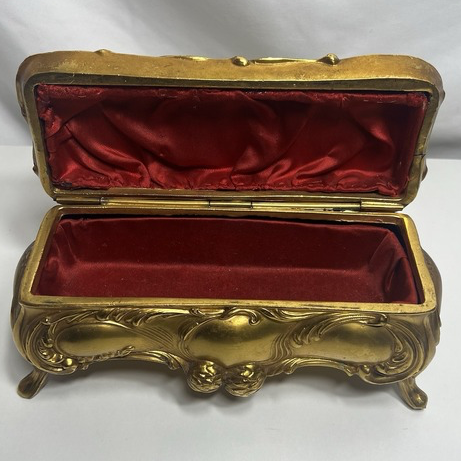
This title always sounds a little macabre to me, since I associate it first with a coffin. However, the first definition of “casket” is “a small ornamental box or chest for holding jewels, letters, or other valuable objects.” In this light, the Casket of Prose, etc. is meant to convey a lovely volume with valuable contents.
Robert Louis Stevenson
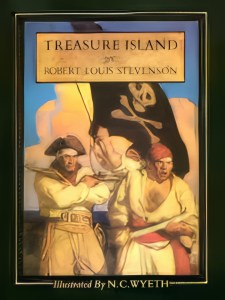
“Fifteen men on the dead man’s chest– Yo-ho-ho, and a bottle of rum!” (p 114)
Emilie already told us the origin of this quote:
“The situation was not unlike a Robert Louis Stevenson classic brought up to date.”
The classic was Treasure Island. Take note of the illustrator for this edition: N. C. Wyeth. We’ll see him again soon.
Terrible Turks
“If one has it, is there anything better upon which to lavish it [money] than a home?” Judith cleared her voice of wistfulness. “There are your Terrible Turks now! Don’t they look like angels?” (p 22)
Gretchen and Gregory are Diane Turkin’s children, so “Turk” was a natural enough shorthand. However, the full term, “Terrible Turks” had associations that Emilie would have known.
This is another reference with a pejorative origin, normalized over time and then forgotten.
The earliest use that I found was in a London publication of 1828, after Greece had won independence from Turkey, and for the next fifty years, “terrible” and “Turks” appeared close to one another in print, if not always directly together. In the 1870s, the term was first capitalized, “Terrible Turks,” in reference to atrocities committed in Bulgaria and Serbia. Turkey’s partnership with the Central Powers (German Empire, Austria-Hungary, and Bulgaria) in World War I and the Armenian genocide, which continued across decades, kept the political meaning of “Terrible Turks” alive through the 1920s when Emilie wrote this novel.
In 1890, though, Margaret Wolfe Hungerford’s novel April’s Lady (published under her pseudonym, The Duchess) used the term much as Emilie Loring would thirty-five years later: “They love each other, and the children are things to be loved, as well–darling children! well-grown, and strong, and healthy, though terrible little Turks at times!–God bless them!”
Over time, the term was normalized, its origin forgotten, so that, by the early 1920s, professional wrestlers in New York, a YMCA basketball team in Virginia, and an amateur baseball team in Somerset had adopted “Terrible Turks” as their team name.
Classical Period
Richard Lovelace
I could not love thee, Dear, so much
Loved I not honor more. (p 26)
This comes from a seventeenth century poem by Richard Lovelace (~1649). The speaker admits to his love, Lucasta, that he is leaving, taking on a new “mistress” with “a sword, a horse, and a shield,” and he expects that she will support his decision to report to the battlefield with honor. The parallel is that Neil left his medical practice to help his Uncle Dave, but unlike Lucasta, Judith Halliday does not support the decision and feels abandoned instead.
The Plot Thickens
“The plot thickens!” she murmured theatrically. (p 41)
I have used this sentence many times myself, entirely unaware that its first, acknowledged use in print was in 1671. The work was George Villiers’ comedic play, The Rehearsal in which a character satirically based on the poet John Dryden says, “Ay, now the plot thickens very much upon us,” to describe an increasingly complex play-within-a-play. The sentence is now used commonly for any situation that becomes more complex or mysterious, often preceded by “Ahh!” in a most dramatic voice –“Ahh, the plot thickens!”
Daniel Defoe
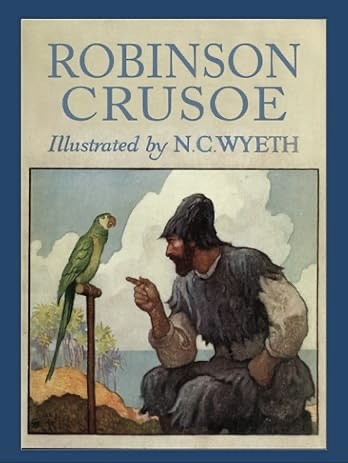
“I feel as abandoned as Robinson Crusoe.” She added with a reckless attempt at gaiety: “Will you be my man Friday?” (p 124)
The reference is Daniel Defoe’s Robinson Crusoe (1719) in which Crusoe is marooned on an island for twenty-eight years. He learns to make do with the materials around him and rescues a man from cannibals who becomes his faithful servant, “Friday.” The book is of its time, which means that it reflects British colonialism, but the phrase of one’s “man Friday” has been lifted and imbued with the positive connotation of an assistant who can always be counted upon. Before I ever read the novel, I knew the title,”His Girl Friday” from the movie with Cary Grant and Rosalind Russell. [Notice the illustrator: Yes, N. C. Wyeth again]
Renaissance Period
Shakespeare – The Taming of the Shrew
“I wish that you had forced her to play Katharine to your Petruchio, had thrown her over your shoulder and brought her along here.” (p 27)
“Do you remember that line of Petruchio’s? ‘Little fires grow great with little wind.'” (p 51)
Both of these refer to William Shakespeare’s The Taming of the Shrew (1594) in which Petruchio tries to woo the headstrong Katharine. Petruchio’s methods are unsubtle, as he explains to his father:
I am as peremptory as she proud-minded;
And where two raging fires meet together,
They do consume the thing that feeds their fury.
Though little fire grows great with little wind,
Yet extreme gusts will blow out fire and all.
So I to her and so she yields to me,
For I am rough and woo not like a babe.
Raphael
Each with an elbow on her knee, each with a chubby hand supporting a dimpled chin, the children suggested the cherubs of Raphael as, intent upon the story she was reading aloud, they gazed breathlessly up at the girl. (p 69)
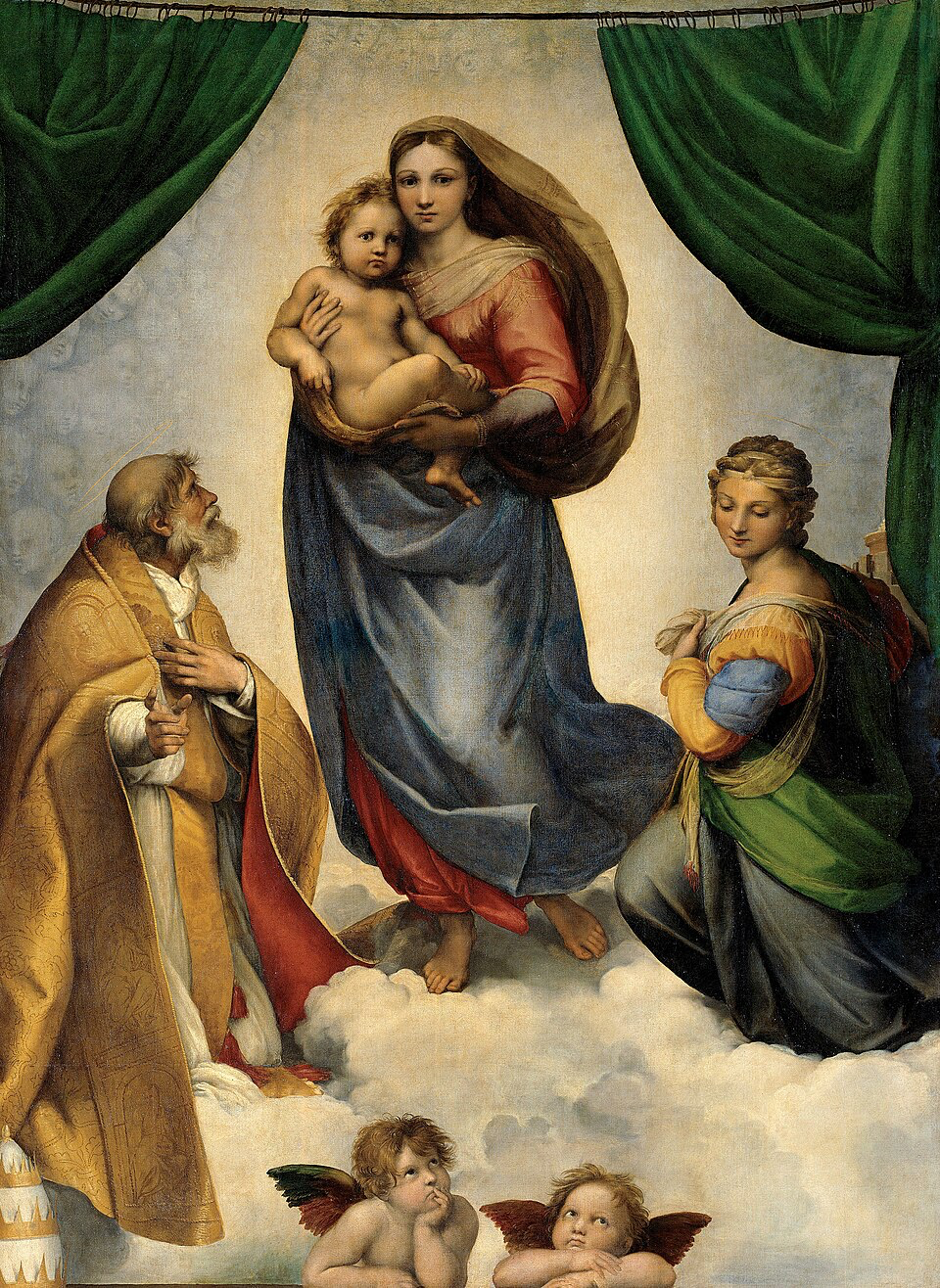
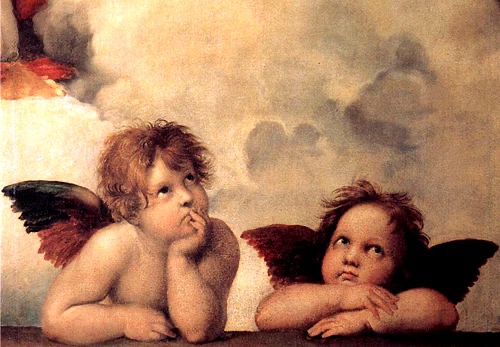
Raphael (Raffaello Santi) became an independent master painter at the age of seventeen, and by twenty-five, he was painting the papal apartments in Rome. At thirty-one, he was the architect in charge of St. Peter’s–the same age as when he painted the “Sistine Madonna” (1513/14). The cherubs became popular in their own right and have been used on boxes of chocolates, greeting cards, and wrapping paper. One can never tell what people will notice and remember!
Middle Ages
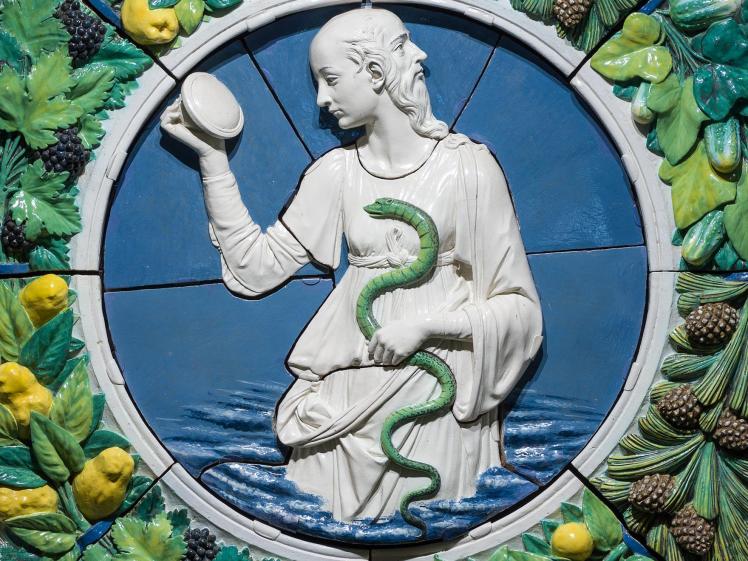
Della Robbia
Under a dome of Della Robbia blue conical heaps of clouds rested upon a snowy horizontal base. (p 41)
This is the second time Emilie’s used Della Robbia to describe a scene with blue against white. For my taste, there can never be enough blue and white in the world. 🙂
The Quest for Sir Arthur’s Knights
Even as she read from their favorite chronicle of the adventures of Sir Arthur’s Knights Judith wondered if the children understood the meaning of the story or if it were the rhythm of the text which held them in absorbed attention… (p 69)
This is another era-spanning entry, as the original Le Morte d’Arthur was published in 1485, and tales of King Arthur and the Knights of the Round Table continue to be published today.
I am stuck on Emilie Loring’s reference here and not for lack of trying. In 1924, when she was writing A Certain Crossroad, what would have been her favorite chronicle of Sir Arthur’s Knights? One that she had read to her sons? One that she had grown up with?
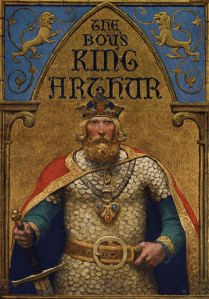
Illustrated by N. C. Wyeth
A Certain Crossroad mentions several adventures illustrated by N. C. Wyeth. An edition of The Boy’s King Arthur: Sir Thomas Malory’s History of King Arthur and His Knights of the Round Table, edited by Sidney Lanier and illustrated by N. C. Wyeth was published in 1917. At that time, Emilie Loring’s sons were grown, and she had no grandchildren yet, but of course she could have known of it. She may also have known its first edition in 1880 when she was fourteen.
Unfortunately, only the 1929 edition is available online. It has no quote similar to that which Emilie attributes to her “favorite chronicle of the adventures of Sir Arthur’s knights.”
Here is the quote we’re looking for. It’s nearly the same as the dedication to Victor at the front of A Certain Crossroad, except that she omitted the bold portions in the dedication:
“‘And sometimes the sky was like unto a great turquoise for blueness and sometimes it was like a gray pall and sometimes the highway wound through level, radiant fields, and sometimes the rough road plunged down a steep declivity of rocks to grope blindly through dark and evil forests, and sometimes the yellow-gold moon made mysterious twilight in the shadows. But always the Knight kept the Lady’s hand close in his, the hand of the lovely lady who was clad in white samite which glistened with silver threads. And always he stepped forward firmly, shining eyes straight ahead, for even in the gloom all was sharp-cut and clear to his vision. For you must know that this great Knight was the crowning glory of his house and name. He was the most noble of spirit, the most beautiful, the bravest of heart, the greatest knight in all the country round.’” (p 69)
I have a vague memory–maybe it was only a dream–of finding the quote in its source, but can I find it again? No.
How about the publishing company where her father worked? In 1884, Lothrop, Lee & Shepard published an enlarged and revised edition of The Age of Chivalry; or Legends of King Arthur by Thomas Bulfinch (1858). The editor for that volume was Edward Everett Hale, whose statue resides in the Boston Public Garden. Hathi Trust has that volume, so let’s see…
No search results for “turquoise,” “even in the gloom,” “declivity,” or “silver threads.” This isn’t her source.
What are our other choices? There are SO many books on the Arthurian legends! Here are some of the more popular:
Le Morte d'Arthur, Sir Thomas Malory, 1485

The Age of Chivalry, Thomas Bulfinch, 1858, 1884

Idylls of the King, Baron Alfred Tennyson, 1859

The Legends of King Arthur and His Knights, James Knowles, 1862, 1912

King Arthur and His Noble Knights, Mary MacLeod, 1902

The Story of King Arthur and His Knights, Howard Pyle, 1903

King Arthur's Knights, Henry Gilbert, 1911

Tales of King Arthur and the Round Table, Andrew Lang, 1918

The Boy's King Arthur, Sidney Lanier, 1880, 1917, 1929
All of these are available online, and alas, none has the sought-for passage.
I don’t believe that Emilie Loring penned these lines herself, in the style of Arthurian legends. If she had, the citation in text and in the dedication would not have differed as they do. And we’ve seen how readily and accurately she generally cites quotations. Maybe I should check the holdings of the Boston Athenaeum where she was writing…
Knights of the Round Table ; stories of King Arthur and the Holy Grail, William Henry Frost, 1897

King Arthur and the Table Round, William Wells Newell, 1897

Morte Darthur : Sir Thomas Malory's book of King Arthur and of his noble Knights of the Round Table : the original edition of Caxton revised for modern use, 1870

Tales of King Arthur and his knights of the Round table, Margaret Vere Livingston, 1888

Romance of King Arthur and his knights of the Round Table, Sir Thomas Malory, 1917
It is truly amazing, how many editions of these tales are available online. Every one of these is, and not one has our quote in it.
The word declivity is from the 17th century and less common in speech. I’m going to guess that her book was for adults, not children… although I could be wrong there. My grandfather’s fourth grade reader was mighty difficult according to modern standards!
Another thought: The line, “He was the most noble of spirit, the most beautiful, the bravest of heart, the greatest knight in all the country round” is the kind of description usually reserved for Sir Galahad, the son of Sir Lancelot. Sir Galahad was the knight so pure and noble that he sat without injury in the seat at the Round Table reserved for the person destined to find the Holy Grail. Do we go on to tales of Sir Galahad?
Do you have an idea? We have some pretty smart cookies who read these posts. Let’s see if one of you can find the source for this quote!
Illustrators: Howard Pyle and N. C. Wyeth
These, too, are of the Victorian/Modern period, but I place them here for their subject matter.
She broke into her colorful imaginings with a laugh. Her hectic memory showed the ineradicable influence of Howard Pyle and Wyeth. Ollie had brought her up on their illustrations. Her thoughts were too lurid for comfort. (p 130)
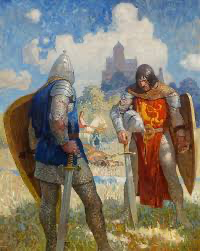
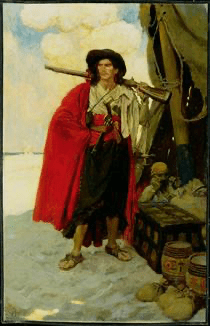
We’ve seen several samples of N. C. Wyeth’s work already. Together, he and Howard Pyle illustrated much of what adventurous boys and girls read in the late nineteenth and early twentieth centuries.
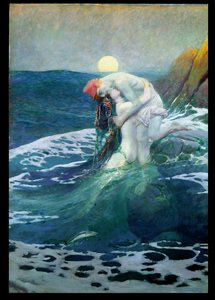
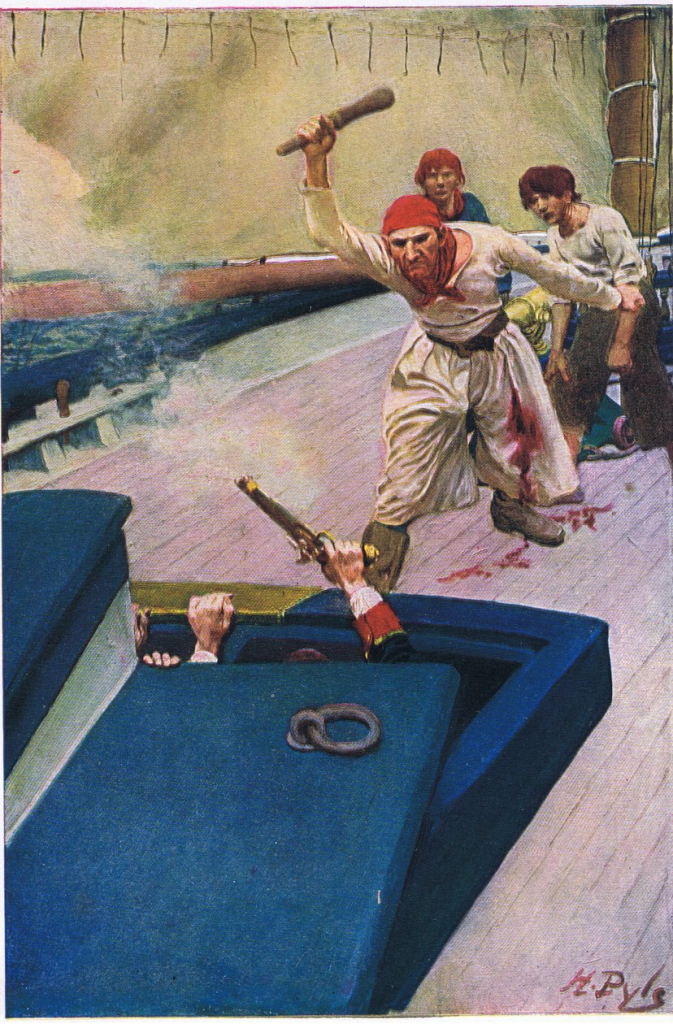
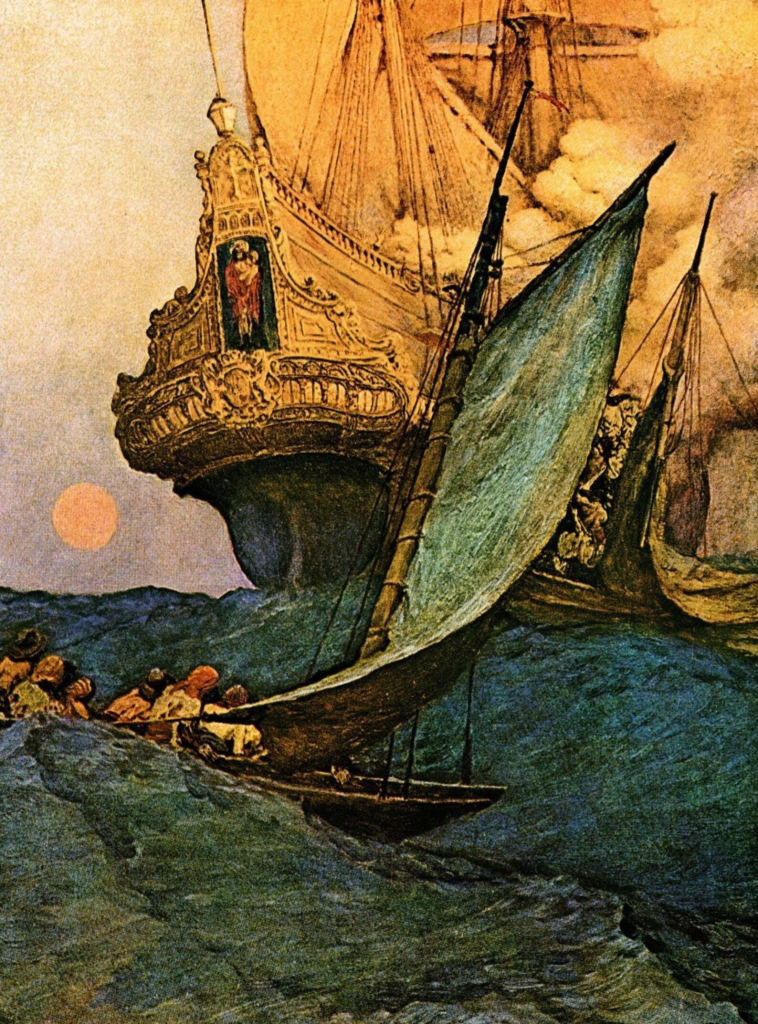
I’m a little envious of these illustrations that began as full-size paintings. With few exceptions, my books as a kid were illustrated with line drawings or cartoon-type artwork. These are amazing.
Ancient World
Latin, “susurrus”
[The sea] was all sparkling charm. Its faint susurrus gave no hint of slumbering passion, or lurking treachery, of the rages into which it could lash itself, of the sullen swells it could roll up at the nod of its master the wind. (p 60)
Count on Emilie Loring to add words to our vocabulary. A susurrus is a “whispering, murmuring, or rustling.”

Orb of Day, Destiny, Fate
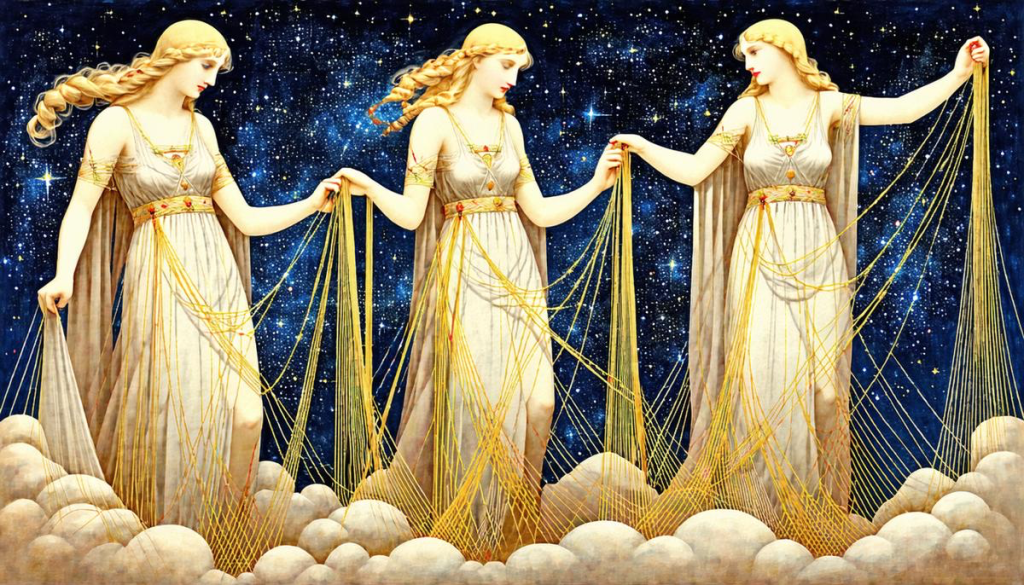
In Greek mythology, the three Fates of Destiny spin the threads of life, measure its length, and cut the thread when life ends. The “orb of day,” of course, is the sun.
Emilie Loring’s Prose
I suspect that Emilie Loring had an especially fun time writing this story.
The clothes from the cot bed lay in a torn heap on the floor. In their midst stretched a man, face down. One outflung arm from elbow to shoulder was bound with a bloody bandage.
In the clenched hand was a key.
Read A Certain Crossroad again with mystery foremost in your mind. It’s a treat.
From me to you, with a nod to Emilie Loring:
Thank you, my dear readers, for your patience as these last months unfolded. Caring for my mom, I sometimes felt like a Solitary Horseman or alone in Swift Water, keeping the faith over Uncharted Seas. But How Can the Heart Forget the love of a mother who, Across the Years, showed me that There Is Always Love and made home a place Where Beauty Dwells? For All Your Life, I told her, We Ride the Gale together, with Gay Courage. Today Is Yours.

Lighted Windows
Now, Here Comes the Sun and that Fair Tomorrow When Hearts Are Light Again. It’s A Great World, and I Hear Adventure Calling. Beckoning Trails lead me onward, High of Heart, to Hilltops Clear.
Happy Landings, everyone!

 The Emilie Loring Collection
Dear Patti,
I am always amazed at the way you compartmentalize your thoughts and readings of Emilie into historical, theatrical, prose and poetry. You cited several favorite books of mine like Robinson Crusoe and King Arthur and the Knights of the Round Table.
The theatrical side with songs and lyrics from Buster Keaton and Eddie Cantor bringing one to a whimsical side of her writings and always the farcical use in politics and history.
I am enjoying your classical and Literary writings and quotes from her books as it changes my perspective on many happenings in her life and begins to understand the REAL EMILIE LORRING as you brought her to life in your book.
Love and stay warm with your frigid weather, Raqui♥️
LikeLike
Thank you as always, Raqui. The more I dig into Emilie Loring’s novels, the more I think of her and of her writing. There is more depth than she is credited with. It’s a good thing the Defenders are on the job!
LikeLike
Bravo! Another impressive thorough piece of research of so many varied cultural/literary references from any age in human society! That takes much time! Also, a beautiful and well-crafted salute to your late beloved mother. May she rest in peace.
When I read about the doodle, doodle song, a song I remember from my youth immediately became stuck in my head. No, it would not have been known to Emilie as it is modern, but the words are very similar. “How Do you Do” from the PBS children’s show in the 1970s Zoom. https://zoomseries.fandom.com/wiki/How_Do_You_Do. The kids sing “How do you do dee do dee do…” quite close to the way Emilie forms the song. Oh, and Zoom originated in Boston. (Could the writer of that song have read Emilie? Oh, I’m just stretching things here…)
This is a favorite book of mine. I like the illustrated cover of this book also. I picture the Emilie leading ladies of these early books as having spunk and a spirit of adventure and fun.
LikeLike
Thanks, Peggy. I’ve gotten a little carried away, looking at more than just the books I originally wanted to find for our Emilie Loring Reading List, but that’s me, I guess. 🙂 I have a doodle song in mind that doesn’t match yours or Emilie’s, and I can’t quite remember where it came from. Was it the movie “The Holiday?” Next up: The Solitary Horseman!
LikeLike
Well done and expertly researched. Thank you for this post.
LikeLiked by 1 person
Enjoyed the insight almost as much as the book! Thank you for sharing.
LikeLiked by 1 person
I love all of it! Thank you for doing all the digging. It’s amazing. I never took the time to look.
LikeLiked by 1 person