If you had an afternoon to spend with Emilie Loring, what would you ask her?
What’s your favorite song? Do you have a copy of the short story that Victor wrote? What did you keep in the secret drawer behind your bookshelf? How did Victor propose?
Today, Emilie answers a question she often received from her readers: How does one begin to write?
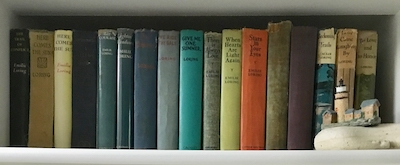
“How to Begin?”
by Emilie Loring
“I want to write a novel. Please tell me how to begin.”
You would be surprised to know how often I find that query in my fan mail. Sometimes it is in regard to a short story or a play. Whichever it is, the question is always the same. “How to begin.”
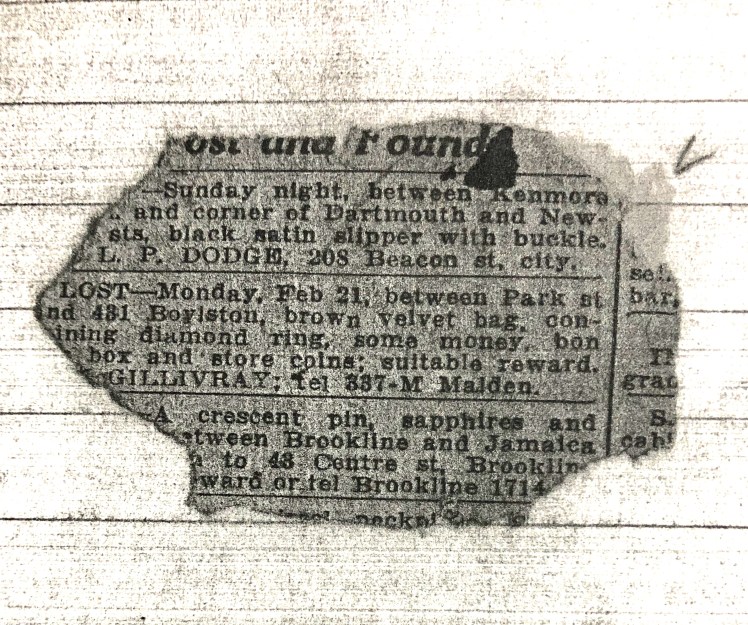
As I read the latest plea for help, I thought over my articles, short stories, novels, and plays and tried to remember how they started. Sometimes it was with a theme which had pricked in my mind for expression for months; sometimes with a character which had taken possession of my imagination; often with an incident of which I had heard or with an experience of my own; perhaps the genesis had been an ad in the “Wanted” or “Lost and Found” columns of a newspaper which are mines of suggestions.
The only way to begin writing a novel is to begin. Trite but true. The opening sentence or paragraph doesn’t necessarily remain as first written, It may be changed a dozen times, but the mere act of putting it on paper is like pressing the self-starter of a car. You’re off! After that, it is a question of the construction and endurance of your mental engine, of the quality of gas used to keep it going which must be rich in determination and the urge for improvement of ideas and style.
You may decide to develop into a story an experience of your own which has vitally interested, amused, excited, or saddened you; perhaps with one by which you have profited. Select the quality in the incident which impressed it indelibly on your memory and make that the theme. Was it friendship, love, fear, loyalty, sacrifice, villainy, humor? A theme helps. It is like the motif which runs through an opera. It keeps one from dashing off at a tangent and coming out at the finish, pages and pages away in atmosphere and characterization from the start. Such a result would be the ruination of a story no matter how well it was written.
That doesn’t mean plotting a story before you start. I never think a story through before I put pencil to paper. My characters are alive to me. They are lovable, unlikable; ambitious, lazy; gay, sombre; and oftentimes maddeningly exasperating. How can I tell before I know them and have lived days and weeks with them, what experiences they may encounter before they return to the imaginary world from which they came? With their loves and hates, joys and sorrows, disappointments and achievements, they build the story, and not until they have worked out their problems have I a plot. To my mind, this method gives freshness and spontaneity to a story.
Having begun your story, if you are in earnest about becoming a writer, don’t knuckle when the going gets hard–and it will get hard, terribly hard in spots. Keep on, everlastingly keep on keeping on. It is said that not more than ten percent of those who start out to be writers give the profession a fair trial. Of every one hundred who begin, there are perhaps ten who persist for a year, not five who keep steadily on for two years, and probably not more than one or two who plod on and arrive. And this is because a beginning writer is absolutely on his own. Unless he is taking a college course, he can write or not as he pleases. No professors, no classes to keep him up to the mark, he must be his own monitor.
If you are determined to be a writer, set aside a certain amount of time each day for reading. Read the best books, subscribe for the magazines for writers, don’t be contented with one reading of their articles; file them, that you may read and re-read them. Work regularly. Perhaps you can devote yourself to writing but once a week, but hang on to that time as you would to a lonely spar were you shipwrecked on a wide, wide sea with never a sail in sight. Well-meaning friends or relatives, who would be horrified at the thought of taking something material from you, will try to steal that precious time by tempting you with committee work for which “you have a perfect genius” or with invitations. Don’t let them succeed. Hold on to it as you would to gold. For it may bring gold, in the form of a “Pay to the order of” slip of paper.
No one knows better than I what may be accomplished by spare-time writing if one has the vital urge and determination to succeed. My father, George M. Baker, whose play Among the Breakers has been the best-selling play of all time for amateurs, did his writing in the evening after he had spent the day as a publisher. He had about eighty plays to his creadit which have sold steadily through the years. Which goes to show what may be accomplished by systematic work when one’s time is limited.
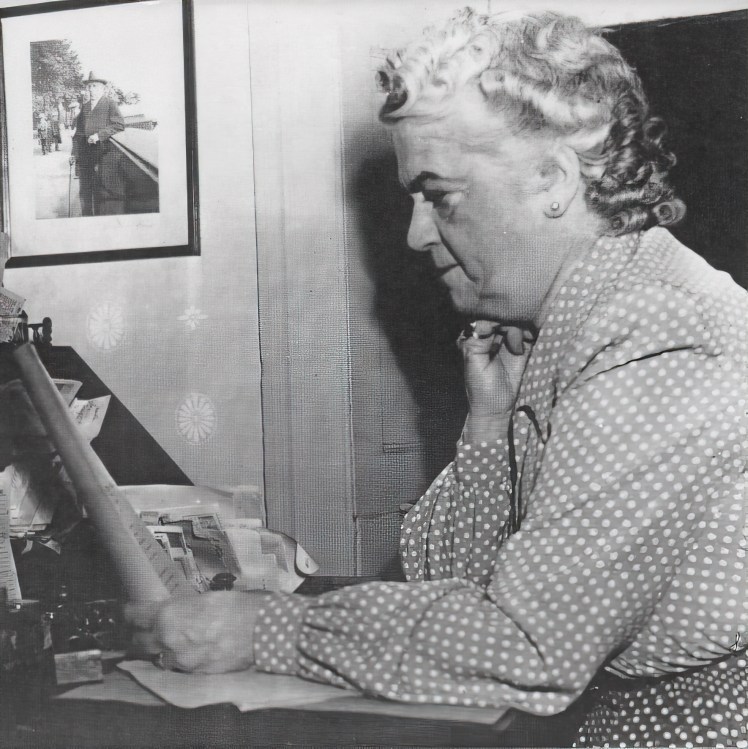
If when you sit down at your desk to start work your mind feels like an empty attic without even the mouse of an idea scuttling round it, take up your manuscript and read your story from the beginning. Often I resort to that pick-me-up and by the time I have reached the page at which I had stopped, I am so thrilled and interested that the characters seize the story and carry me along with it in a burst of exhilirating speed.
Do I revise? Over and over and over again. I never leave a page, a sentence, until it is as well written as I know how to write it. As a story grows, much develops that must be fore-shadowed and back I go to–I believe the technical term is “plant.” Don’t mistake me, I don’t mean that I forecast and suggest what is to happen several chapters ahead, but the reader must be prepared for what is to come–when it comes–it isn’t fair to spring a situation on him which is in no way related to what has gone before. That doesn’t mean, for example, “Had Nora known what awaited her at the end of the bridge, she never would have crossed it.” The author might just as well have stuck his, or her, head through the page and crooned, “Yoo-hoo! Here I am again!” The illusion of the story is smashed, gone. The bridge and incidentally Nora have been blown up as far as I am concerned. Never intrude your author self into a story, and if you tell what only you know will happen later, you are intruding.
Cut the word “discouragement” from your dictionary, surely from your vocabulary, if you are determined to be a writer. Stories aren’t “dashed off” between meals. They are accomplished by a little word of four letters, W O R K. Work. Work. And more work.
Only yesterday I received a letter which ended:
“Please tell me how to make a story click. My first has come back three times and I tore it up.”
Three rejections and she tore it up. I thought of my first attempt at a short story. Except for the fact that I belonged to a “writing family,” and had grown up in an atmosphere of books, creative writing, and dramatics, I had had no training in writing fiction or anything else for that matter.
How I worked over that story. Writing, revising, rewriting time after time. When it was as well done as I knew how to do it, I sent it to a literary critic. I consider an honest literary critic to be of inestimable help. Suppose a relative or friend acts in that capacity; if he says your work is good you wonder if he knows. If he decides that it is not, you are sure he doesn’t, and where are you? A professional critic is an unprejudiced reader who will tell you the truth, without being either brutal or discouraging, unless you rate utter discouragement, and even that last is a kindness, for if you haven’t the vital something on which writers grow, better to know it and stop wasting time.
To get back to my first short story. The critic returned it with the verdict: “In style it will please the most exacting editor, but the theme is unpopular.” The title of that story was THE WOMAN WHO STAYED AT HOME.
I reread the script. I said to myself, “If it’s well written there must be one editor in the United States who is in sympathy with my theme. I’ll submit it.
To market, to market, to market it went. Home again, home again, home again it came. Each time it returned I would read it, think, “It is a good story.” If the manuscript was in the slightest degree crumpled or grubby, I would re-type it, perhaps change a word or phrase to improve the text and send it winging forth. It sold on the forty-fifth trip to an excellent market. So, you see, long before Dorothea Brande had proclaimed it to an eagerly waiting world, I was putting in practice her infallible rule for success. “Act as if it were impossible to fail.”
And so I say: To begin a story, begin it, and don’t take “no” for an answer unless you are convinced it is no.
Thanksgiving will be here soon, and this year, I am especially grateful for the life of my mother. I was fortunate to have had her with me full-time for the last few years, and she and I eked out every last bit of pleasure that we could together, right up to the end, four weeks ago.
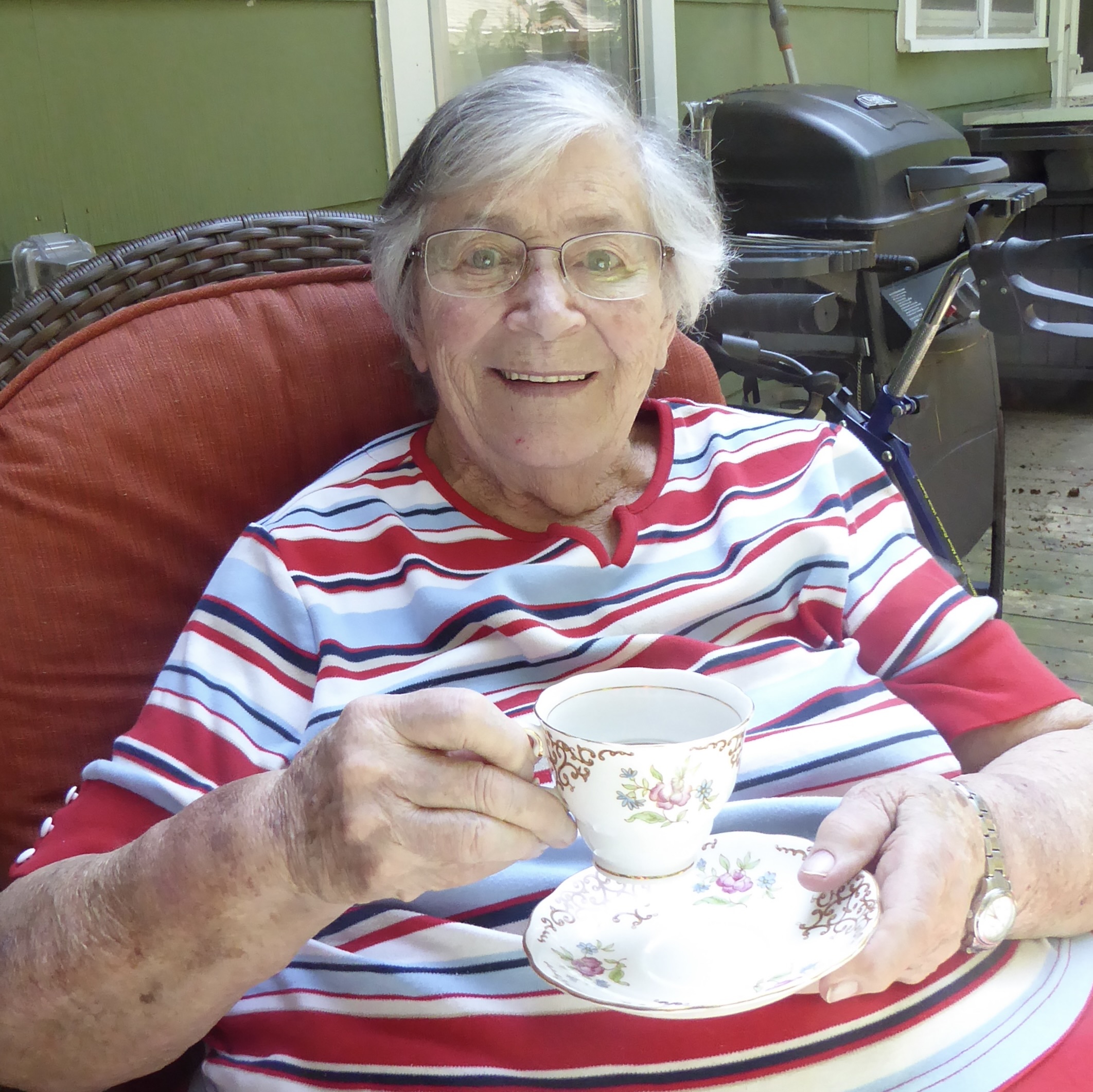
There’s been a lot to do, and as the business part of that wanes, the realization and processing has begun. I still have a literary analysis of A Certain Crossroad in the works, but until I get back to it, I’ll share more of Emilie’s original writing. Next, let’s read the story she just told us about, “The Woman Who Stayed At Home.”


My condolences on your loss ❤
LikeLiked by 1 person
Thank you, Carla.
LikeLike
I love the picture of your mother with a cup of tea. My mother is 87 and has told me that she often has a cup of tea at 4:00. You and your mother have inspired me to join her as often as possible. Maybe we will pick a day of the week and make it a tradition. My mother tells me often how lucky she is to have me close. I’m sure that your mother felt the same way. Blessings and peace as you grieve. Remember to be good to yourself. Much love, Barbara
LikeLiked by 1 person
Thank you, Barbara. I’m sorry it’s taken so long to respond to your kind thoughts. There was a bit of a blur in there, as I tried to manage everything at once. I still am, but I’m giving myself more breaks. 🙂 I love the idea of “Tea with Mom.” Do you two have favorites?
LikeLike
I’m very sorry to hear about your mother’s passing. May she rest in peace and may perpetual light shine upon her. I’m glad you have the experience and memory of her presence with you these past few years. My father passed away 2 years ago. Mom is 87 and needing more assistance. I am grateful to have been near my parents these past several years.
Thank you for taking the time to make this post. I look forward to the literary review of A Certain Crossroad.
LikeLiked by 1 person
I appreciate your message of condolence, Peggy. Mom was a perpetual light in life, so I can only imagine that she is fully that now. She and I had family history projects together that now fall to me. Being the keeper of family memories is a fun task and a weighty one. Be sure to ask your mom everything now. As to what “everything” is, try to jot down your family history and see how many holes quickly appear! At least, it has been so for me, and I’ve been doing genealogy for forty years.
LikeLike