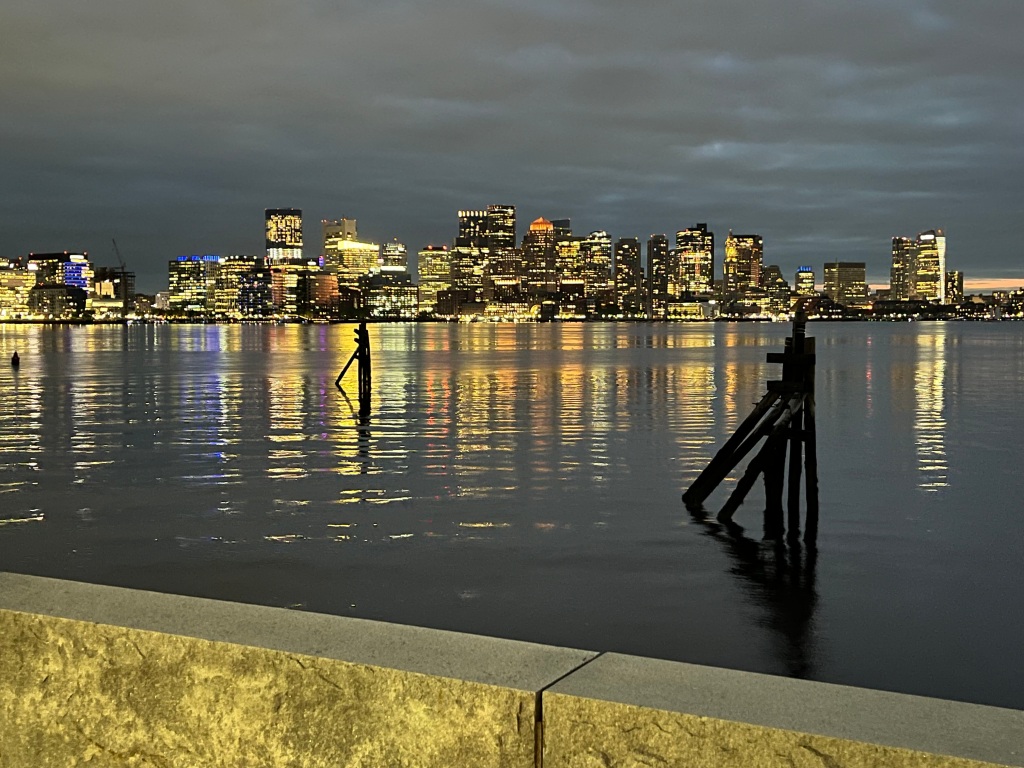
Greetings after a short trip to Boston and the Cape (yay!) and some weeks afterwards to manage my mom’s hospitalization and recovery. I expect this pattern to continue, so I will write as I am able and invite any of you to submit guest posts for us to read in between times. Let me know you are interested at: contact@pattibender.com
Independence Day

The arrival of strawberries, sweet corn, and watermelon at the local produce stand heralds the approach of Independence Day. Across the nation, fireworks, concerts, and family picnics celebrate the day. It’s a tradition in Boston on the Fourth of July for the Declaration of Independence to be read aloud in a public square.
We hold these truths to be self-evident, that all men are created equal,
Declaration of Independence
that they are endowed by their Creator with certain unalienable Rights,
that among these are Life, Liberty and the pursuit of Happiness.–
That to secure these rights, Governments are instituted among Men,
deriving their just powers from the consent of the governed,
Emilie’s Grandmother, Mary Ann Shaw (Remick) Baker, was proud of her grandfather’s role in the Revolutionary War. When British troops burned Falmouth (now Portland, Maine) on October 18, 1775, Nathaniel Shaw‘s harness shop was the first building to be set afire. Nathaniel enlisted and served three years in the 15th Massachusetts Regiment which fought at Saratoga, Valley Forge, and Monmouth.
Emilie joined the Daughters of the American Revolution on Nathaniel Shaw’s record, but she might have chosen others of her 2nd-great-grandfathers.

Soldier Stories
John Baker and his brother Josiah likely enlisted together in Captain Samuel Noyes’ Company, Colonel Edmund Phinney’s Regiment, on May 15, 1775. Their first job was to prevent the British from seizing livestock to use for food. Next, they walked the long journey to Cambridge, going from tavern to tavern where they could find accommodation. They were a company of fifty, so it was no small feat to find lodging and food along the way. Colonel Phinney’s regiment “assumed the dangers and responsibilities of soldiers. They participated in the skirmishes and picket firing and saw many killed and wounded about them, but during their entire service they saw no great or decisive battle.” (History of Colonel Edmund Phinney’s Thirty-first Regiment of Foot…, 1896)
Thomas Hodgkins served in the regiment commanded by Colonel Moses Little. He was served as quartermaster for his unit in Cambridge from May 1, 1775 until March 1, 1776. He was present at the Battle of Bunker Hill on June 17, 1775 and served later at Butts’ Hill in Rhode Island. His brother Joseph is better known, having been a commander and also because of the correspondence that survives between himself and his wife, Sarah.

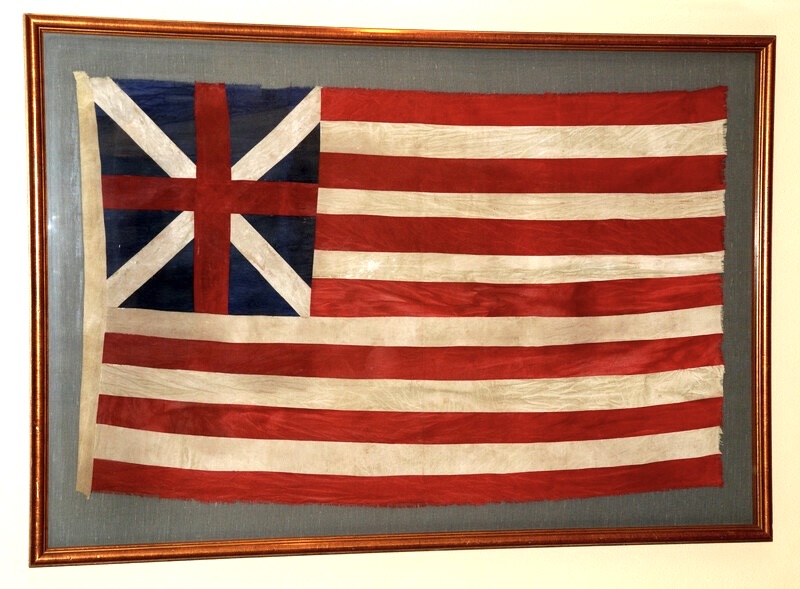
Reuben Boles served first in his local militia, which was true of many Revolutionary War soldiers, because the Continental Congress didn’t establish the Continental Army until June, 1775. Reuben reported for the Battles of Lexington and Concord and was then stationed at Chelsea, one of many regiments stationed outside Boston to beseige the city, which was then occupied by British troops. He was present at the Battle of Bunker Hill and remained in service when George Washington took command in July. These troops had no regular uniforms, and they had no flag, either, until December 3, 1775, when they fought under the “Grand Union Flag.”
Elisha Woodbury joined the Battle of Bunker Hill from New Hampshire and served in the seige of Boston. He participated in the failed Canadian campaign which sought to occupy Quebec and recruit Canadians to their cause and was later stationed at Ticonderoga. He got into a couple of scrapes that brought him up on charges, but each time, the charges were dismissed, and he was acquitted “with Honor.” I was interested to see that he was a member of Stark’s brigade which endured the famous “hard winter” at Morristown, New Jersey (1779-80), but fortunately for him, he had already been discharged by then. A side note to Elisha Woodbury is that his son Elisha (brother to Emilie’s great-grandmother) was a bugle boy at Bunker Hill.

(spelled many ways!)
Samuel Hazelton of Haverhill served first as Second Lieutenant in Captain Joseph Eaton’s 14th county militia, March through April 1776. He next served as an Ensign in Captain John Peabody’s Company, Colonel Ebenezer Francis’ regiment. These men were stationed in Dorchester from August to December 1776 to protect Boston after the seige of Boston was completed and the British evacuated. He received one penny per mile for his travel into camp (45 miles) and home again, “Gun and Blanket money,” and day wages. I haven’t yet found his death record, but he died in 1776–perhaps in war, perhaps from disease or another cause.

John Bean of Rockingham, New Hampshire served in Captain James Norris’ Company in the 2nd New Hampshire Regiment under the command of Colonel Enoch Poor. The regiment was formed in May, and he joined on June 12 to reinforce the seige of Boston following the Battle of Bunker Hill. He traveled fifty-five miles roundtrip and served one month and twenty-two days. For his service, he earned a little over five pounds in wages, but after subtractions for coal, blankets, and “stopages,” he was paid one pound sixteen shillings and five pence (about $240 today). John wore a gray linen frock coat and linen trousers or overalls, a less elegant uniform than that worn later by the regiment.
They Came from All Around
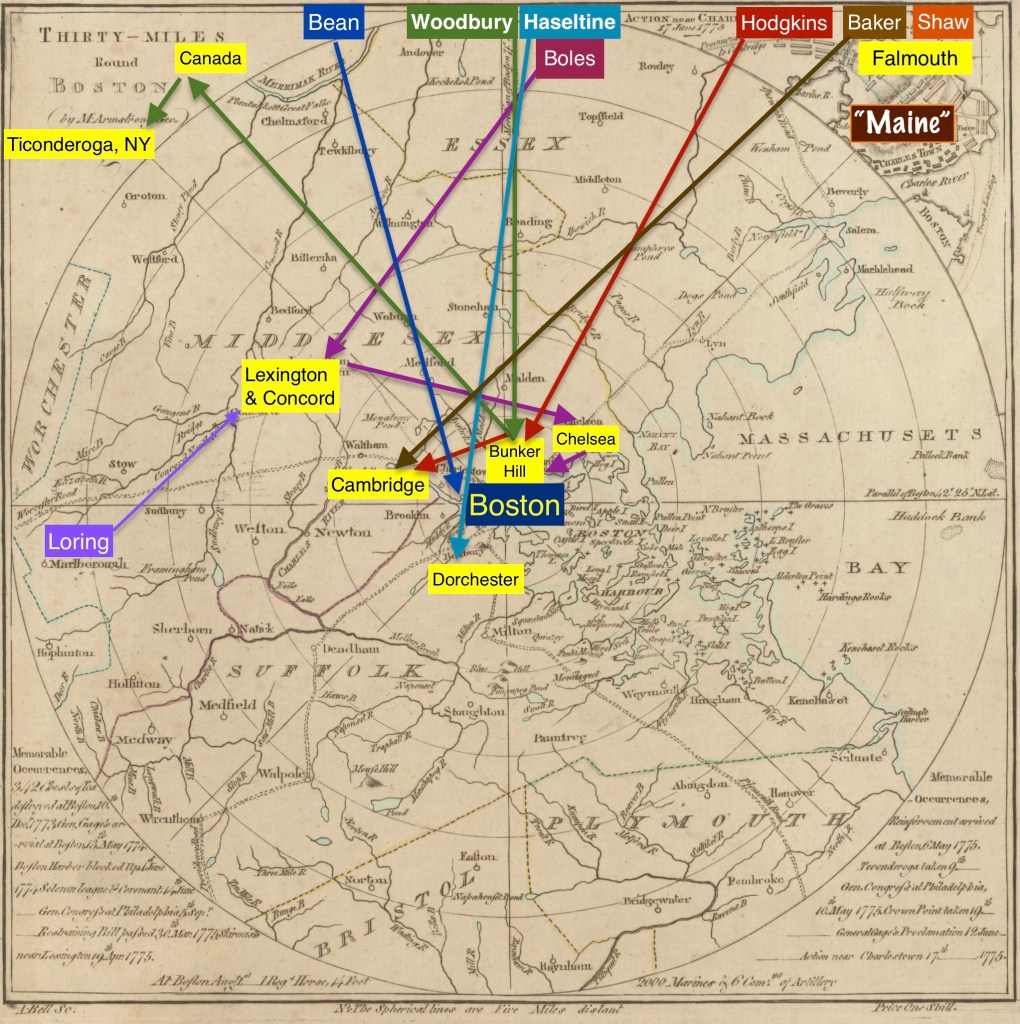
Boston’s involvement in the Revolutionary War lasted only until the British were driven out after the seige. But the battles of Lexington and Concord were the first of the war and especially important because thousands of rag-tag militia men came from farms and villages to defeat the organized British military. Victor Loring’s great-grandfather answered the Lexington alarm from Marlborough. Maybe your ancestors came, too?
When war broke out between England and America he had been commissioned captain by the Continental Congress. After he had surprised the garrisons of two forts, spiked their guns and fired the shipping in the harbor, he had been promoted to Commodore, later to Rear Admiral. He had survived terrific engagements and storms at sea. We Ride the Gale!


It’s good to remember the collective will that drove our patriot ancestors to secure our nation’s independence and create a government “of the people, by the people, and for the people.” May we always remember their stories and be prepared to show the same will when our turn comes.
There’s still time before the Fourth to tell your ancestors’ stories. Feel free to share them in the comments section below.
 The Emilie Loring Collection
Dear Patti,
You never fail to amaze me with your creative posts everyone timed to the events and history of the nation like Independence day! I would love to comment as I do on your writings.
Thanks for this one as it brings me back to my Ramsey family like Ed and Nadine Ramsey and their courage and sacrifice during WWII and their legacy through my book, REFLECTIONS.
if we have a Defenders meeting on July 9, I will not be able to join as I have an XRAY appointment for my neck as Dr. Riley thinks the hot flashes could be from a pinched nerve. Let me know if we can change the date.
HAPPY 4th of JULY!
Love and thanks,
Raqui
LikeLiked by 1 person
Hi. I’m new here and I’ve surely enjoyed all your blog entries, as well as your book. Emilie Loring has been part of my life for a long time and it’s nice to read things written by someone so knowledgeable. It was interesting to read about Emilie’s ancestors and their involvement in the Revolutionary War. Do you know if she was a member of the DAR? Paul Revere was a second cousin of mine, either 9-10 generations removed. I always liked that story of his midnight ride when I was growing up. Thank you for all your posts. Happy Fourth of July!
LikeLiked by 1 person
Welcome, Penny! Yes, Emilie joined the DAR on Nathaniel Shaw’s record. Paul Revere’s a fun one to be related to. Other than Mayflower passengers, my ancestors seem to have kept a low profile, albeit always close to the action. 😊
LikeLike