Goodness, Emilie!
You’d think that after reading Emilie Loring’s works so many times, I would have had a better idea of how many literary references she made in them.
But I underestimated her.
I started with her first novel, The Trail of Conflict, thinking, in my innocence, that I’d construct a full booklist of her thirty novels in two or three blog posts, and then we could choose books to read for our book club. Ha!
If I found them all, in The Trail of Conflict alone, she made more than twenty literary references, plus references to music, artworks, a dance, and a moral philosophy. The book is a veritable humanities course!
Grab a sack lunch, and we’ll dive in! (Page numbers in parentheses are from my 1971 paperbook copy.)
Literary References
King Cophetua and the Beggarmaid
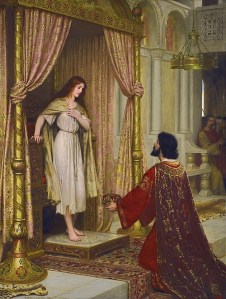
“I had to sign a paper and show him my empty purse to prove that I was really the Beggar-maid, bare-pursed instead of barefooted, following my King Cophetua out into the cold, cold, world.”
“Your simile is faulty. As I remember it the Beggar-maid loved the King.”
“Also the King loved the Beggar-maid. You’re right, the similarity ceases with my lack of funds.” (p 48-9)
“King Cophetua and the Beggarmaid” was a broadside ballad from the 16th Century. Broadsides were single-page song sheets, used to distribute music before there was a means to record it.
Emilie would have read about it in Shakespeare’s plays, several of which mentioned the story or the song. Also, when she was seven, her father’s publishing firm, Lee and Shepard, produced a volume of works by Alfred, Lord Tennyson that included his poem, “The Beggar Maid.”
Her arms across her breast she laid;
She was more fair than words can say;
Barefooted came the beggar maid
Before the King Cophetua.
In robe and crown the king stept down,
To meet and greet her on her way;
"It is no wonder," said the lords,
"She is more beautiful than day."

And shines the moon in clouded skies,
She in poor attire was seen:
One praised her ankles, one her eyes,
One her dark hair and lovesome mien.
So sweet a face, such angel grace,
In all that land had never been;
Cophetua swore a royal oath:
"That beggar maid shall be my queen!"
Samuel Taylor Coleridge, “Rime of the Ancient Mariner” (1798)
"The wedding guest sat on a stone,
He could not choose but hear;
And thus spake on that ancient man,
The bright-eyed mariner."  (p 62)
This is the same poem that gave us:
Water, water, every where,
And all the boards did shrink;
Water, water, every where,
Nor any drop to drink.
Thomas Carlyle, The Works of Thomas Carlyle, 1897
“Work is the grandest cure for all the maladies and miseries that ever beset mankind.” (p 64)
In the original, Carlyle adds, “–honest work, which you intend getting done.”
Mary Artemisia Lathbury, “Day is Dying in the West”
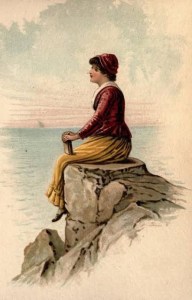
Day is dying in the west;
Heav’n is touching earth with rest;
Wait and worship while the night
Sets her evening lamps alight
Through all the sky. (p 83)
Mary Artemisia Lathbury was in the generation of Emilie’s mother. A talented writer and painter, she was known as the Poet Laureate of Chautauqua.
The Chautauqua Movement began in New York and spread across the country. Chautauquas were like summer educational camps for adults and families. Often set near lakes, they included lectures, entertainments, and outdoor activities. Emilie was an active participant in the Women’s Club Movement, a natural outgrowth of Chautauqua.
There is an old Chautauqua camp on the lake where my family has its cottage. My grandparents took us to see the musical “The Fantasticks” there one summer, and although the Chautauqua mission has faded, their carillon still rings out hymns twice a day during the summer. It’s lovely.
I led a Women’s Chautauqua for two years. Each meeting offered fellowship, something to learn, an activity of some sort, and, of course, goodies to eat and drink. I think our community here is a little Chautauqua-like.

Oliver Goldsmith, “The Deserted Village”
"And still they gazed, and still the wonder grew
That one small head could carry all he knew." (p 84)
These lines reminisced about the learned Parson of a village whose inhabitants have since gone. The poem’s overall tone is melancholy, but Goldsmith’s enthusiasm for old times in the village is felt in these lines.
Meg Merrilies
“I don’t wish to appear before the guest from the effete East like a Meg Merrilies.” (p 87)
As Sir Walter Scott was one of Emilie Loring’s favorite authors, you can be sure she encountered Meg Merrilies in his novel.
Sir Walter Scott, Guy Mannering, 1815

That proved true. Once created, Meg Merrilies appeared in numerous stories, songs, and artworks, including a poem by John Keats.
John Keats, “Meg Merrilies,” 1818
Old Meg was brave as Margaret Queen
And tall as Amazon:
An old red blanket cloak she wore
A chip hat had she on –
God rest her aged bones somewhere
She died full long agone!
Zane Grey
“I thought that every honest-to-goodness he-man on a ranch wore chaps and tore about with his six-shooter ‘spittin’ death and damnation,’ but the man who brought out my trunks evidently has a passion for overalls, and Mr. Benson met me at the train looking like a model of the Well-Dressed Man.”
Her sister laughed. “You’ve been reading Zane Gray [sic] et als. Please understand that we are ultra-civilized on this ranch after six o’clock.” (p 100)
The Trail of Conflict was first published as a serial in Munsey’s Magazine. Zane Grey also published in Munsey’s, and his most famous novel, Riders of the Purple Sage, was published and made into a film before Emilie wrote her serial. By then, Grey had also published The Last Trail, The Rainbow Trail, and The U. P. Trail. I wonder if there wasn’t a little savvy calculation in giving her western book a “Trail” title.
I don’t have the Penn first edition of this book, so if you do, find the Zane Grey quote on about page 165 and see how it is spelled–Gray or Grey? It is correct in the Munsey’s serial and incorrect in Grosset & Dunlap’s and Bantam’s editions. Do the same for Merriles/Merrilies on about page 144–same situation. (I had never noticed these before–still making discoveries!)
Shakespeare
The Trail of Conflict quotes not one, not two, not three, but seven Shakespeare plays. Clearly, Emilie was familiar with his works! No surprise, of course. Not only was he read in school, but Lee And Shepard had published his complete works in 1880, just before Emilie left for her year in the English course of study at Dean Academy.
Lee & Shepard (1880)
“How is’t with you that you do bend your eye on vacancy?” (p 63) Hamlet
“I dare do all that may become a man. Who dares do more is none!” (p 64) Macbeth
… he struck an attitude and paraphrased theatrically:
“But soft! What light through yonder doorway breaks?
It is the east and Juliet is the sun…”
“‘Alack there lies more peril in thine eyes
Than twenty of their swords.” (p 86) Romeo and Juliet
“This morning, like the spirit of a youth that means to be of note, begins betimes.” (p 101)
“I never knew a young lady with so old a head.” (p. 105) The Merchant of Venice
“Once more into [sic] the breach, dear friends, once more.” (p 104) King Henry V
“When Caesar says, ‘Do this,’ it is performed.” (p 187) Julius Caesar
“O what a world of vile, ill favored faults looks handsome in three thousand pounds a year.” (p 198) The Merry Wives of Windsor
The Thousand and One Nights, or The Arabian Nights Entertainments
Literally from the beginning of her life, Emilie had access to this book. Lee & Shepard published it–under her father’s direction–in January, 1866.
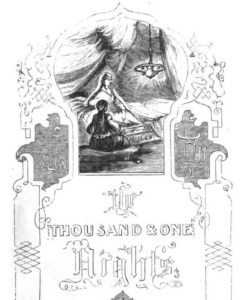
Scheherazade, the white Persian cat, occupied the wing chair. (p 177)
Lord Byron, “Don Juan”
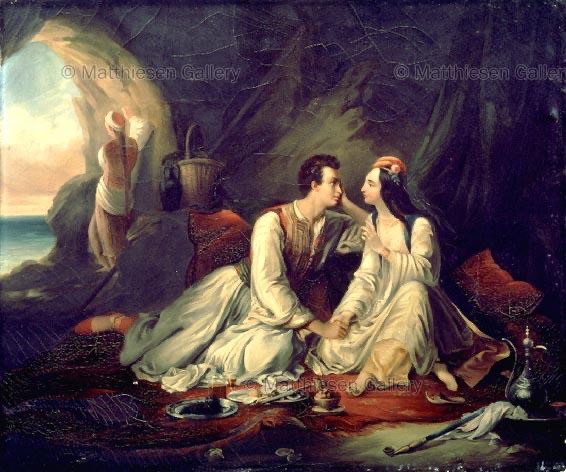
Emilie Loring quoted only the last two lines and applied them to Geraldine Courtlandt, “Jerry,” but the original was about Don Juan and his devastating effect on women.
Sincere he was--at least you could not doubt it,
In listening merely to his voice's tone.
The devil hath not in all his quiver's choice
An arrow for the heart like a sweet voice. (p 197)
The Bible, Matthew 8:26, 14:31:
“O ye of little faith.” (p 190)
James Whitcomb Riley, “Wet Weather Talk”
It ain't no use to grumble and complain;
    It's jest as cheap and easy to rejoice:
  When God sorts out the weather and sends rain,
      W'y, rain's my choice. (p 148)
There are five long stanzas before this refrain repeats. An Indianan, Riley was known for his humor and “Hoosier dialect.”
Artworks and Artists
Portrait of Nelson
His features might have served as the model for the portrait of Nelson in the Metropolitan Museum. His eyes were darkly luminous, the eyes of a dreamer; his white hair curled in soft rings over his head; his hands were long and patrician. (p 1)


If I’ve tracked it down correctly, the portrait on the left was once at the Metropolitan Museum and now is in the National Portrait Gallery of London. Like Peter Courtlandt, Emilie’s father “might have served as the model for the portrait of Nelson.”
Cyrus Edwin Dallin

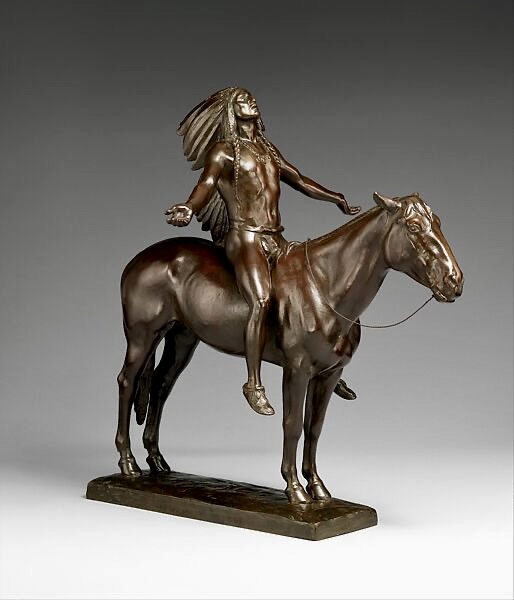

Jerry’s heart unaccountably skipped a beat as he answered her question.
“No, I saw you from the road. You looked like one of Dallin’s bronzes.” (p 59)
Della Robbia glaze
Overhead the sky spread like a Della Robbia glaze, the atmosphere was so clear that the snow-tipped mountains seemed reachable. (p 99)

Playlist
[Each of the following has a link to a recording on YouTube. You’ll have to manage the ads/Skip features.]
Schumann, “Papillons”
“Do you know–Schumann’s ‘Papillons’? That was one of his favorites.” For answer she played the first bar of the exquisite thing. (p 15)
Listen HERE
Bach, “Praeludium” – Introduction to the Well-Tempered Clavier, 1722
She drifted into Bach’s “Praeludium.” Separated chords or flowing melody, she played with a sympathy and sureness which showed the touch of an artist. (p 32)
The piece was two hundred years old when Emilie wrote, three hundred years old now.
Listen HERE
Peg o’ My Heart (1913)
“Give me one more trial, Peg-o-my-heart, and I’ll do better,” promised Steve. He had taken an immense liking to the girl, she was so genuine, so unaffected, so brimming over with the zest of living. (p 36)
Listen HERE (near the bottom right of the page)
John Masefield, “Roadways” (1917)
My road calls me, lures me
West, east, south and north;
Most roads lead me homewards,
My road leads me forth--

To add more miles to the tally
Of grey miles left behind
In quest of that one beauty
God put me here to find. (p 71, 82)
This poem by England’s Poet Laureate had six stanzas, but Emilie used only the last two. Hermann Löhr set the poem to music in 1921, and I imagine this is the tune that Jerry might have sung.
Listen HERE.
Beethoven, The Kreutzer Sonata
“Listen! The Kreutzer Sonata,” she whispered. From somewhere up-stream came the notes of a violin. There was a rare brightness, an aerial quality to the music that most artists take too gravely. The variations of the slow movements gave the sense of a glorified voice. (p 80)
Emilie has a real point of view here. We have the sense that she knows the piece well. When I looked for recordings, I tried to find someone who played with brightness, not too gravely!
Listen HERE
Offenbach, Barcarole from Tales of Hoffman
Searching to find this one for you, I learned something new about this beautiful, familiar music: numerous survivors of the Titanic remember that it was the last song played before the ship sank. A sad thought, but still beautiful music. It’s hard not to keep humming it afterwards.
With a smile at Tony, Jerry placed Tales of Hoffmann on the rack. She sang the Barcarole. As the exquisite, langorous notes floated out over the court the shadows lengthened, the sun dropped behind the mountains. (p 83)
Listen HERE
Philosophy
Immanuel Kant
A fragment from Kant which had been the text for a college theme teased at the tip of his tongue. He had it! “No one of us can do that, which if done by all, will destroy society.” (p 91)
Individuals have an inherent right to freedom of choice, and moral action comes from reason and good intent. Because everyone has freedom of choice, cooperation and good will are required to achieve perpetual peace.
Personally, I would love to see more of these in our world today.
I’ll finish with one more poetic reference. Emilie used just the last four lines (p 152):
John Oxenham, “The Way”
To every man there openeth
A Way, and Ways, and a Way,
And the High Soul climbs the High Way,
And the Low Soul gropes the Low,
And in between, on the misty flats,
The rest drift to and fro.
But to every man there openeth
A High Way and a Low,
And every man decideth
The way his soul shall go.

 The Emilie Loring Collection
I love this post! Reading your blog has inspired me to look up more references as I read, particularly the music. We should create a shareable playlist of songs :-)
LikeLiked by 1 person
I agree! I’m not sure which platform is better to use. I suppose we could create the list, and people could find the music and choose favorites wherever they liked.
LikeLike
What an amazing post! I’ve read Emilie’s books dozens of times, but I’m ashamed to say I never looked up the origins of some of the references she used. I had heard them and in a few cases knew them, but that was all. Thank you for doing this. It adds a whole new dimension to Emilie’s books. By the way, in Swift Water Christopher was singing a song. One of the verses said, “From the desert I come to thee … “ Do you happen to know what that is?
LikeLike
Thank you. I had fun researching this post. Those lines are from “The Bedouin Song” which was popular when Victor and Emilie married in 1891.
LikeLike
What a lovely piece, Patti!! Truely a lesson in the classics. Can’t wait for the next installation.
LikeLiked by 1 person
Regarding knowledge of Shakespeare, in some book I’ve read, there is a mention of the father quoting Shakespeare as he shaved and saying something about being surprised he didn’t cut off his ear… Was that Emilie remembering her father, or now that I think about it, that may have been an Essie Summers novel. Essie quotes Emilie in one of her books.
My mother is 92 now, has macular degeneration and can no longer read. Right now I’m reading Georgette Heyer’s The Reluctant Widow to her, but after that we may start on Emilie. She knows them well, she says when she was in school, their library was a closed room, the students had a list and could choose a book by title, they couldn’t look at the books before deciding if they wanted to check it out. She said sometimes books were disappointing, but she knew that Emilie Loring would always be a good read…
LikeLike
I think you’re remembering Gay Courage: Through her mind flashed the bit from Kingsley’s Last Buccaneer which was her father’s favorite bit of declamation when shaving; “There were forty craft in Aves…”
I love the story about your mother and Emilie! Which will you choose to read aloud? My mom is 98; I wonder if she would enjoy that, too. She read Happy Landings, but now has trouble reading for long stretches.
Thanks for writing today!
LikeLike
amazong researah Patti — are those this year’s peonies?
LikeLiked by 1 person
They are! They make a happy show!
LikeLike
Dear Patti,
You showed a treasure throve of literary references in Emily’s works especially Shakespeare plus the art work and paintings like the Don Juan.
I did not know about broadsides and learned so much about her influences in philosophy, and poetry and the many quotes from well known writers like Carlyle and Keats whose poetry I admire.
Ending with your peonies was beautiful and they are so lively as spring comes and weather changes for the outdoors and picnics which were Emilie’s favorites.
I will see you on the 6th on Zoom. I will await your link.
Love and thanks for sharing your post this Sunday night,
Raqui
LikeLike
Thank you, Raqui. I felt I had returned to my days as an English major when I worked on this post. I have the feeling that her quotes and references were natural to her. She read so much and returned to books she’d enjoyed, over and over. She and I are alike in that!
See you later today on Zoom!
LikeLike
Dear Patti,
It was so nice to see you today at our meeting. Thanks for writing a review of my book, TAKING FLIGHT and posting it on Amazon.com.
You and Emily are cut from the same cloth and I am proud to know you as you opened my eyes to Emilie Loring with your incredible writing and research. I enjoyed so much your book and it helped me overcome my health challenges.
Travel safely and enjoy your family and I look forward to seeing you here in November for the Premiere of Taking Flight.
I will keep you posted on more details as the date approaches with Invitations and Programs.
Love and HAPPY MOTHER’S DAY!
Raqui
LikeLike
I was aware that her books contained many references to art, music, literature, etc., but not HOW MANY! Wow! By the way, your peonies are beautiful. My grandmother had a large row of them in her front yard. She used to cut them for Memorial Day to decorate the graves of her family in the cemetery. I would go along and carry the heavy boxes for her. The only problem with the peonies was the fact that they attracted ants in large numbers. If you cut some and placed them in a vase on the dining table, you were liable to end up with crawling ants on the white tablecloth.
LikeLiked by 1 person
My peony blooms earlier than the standard ones. It’s a Japanese tree peony with a woody branch structure that doesn’t die down in winter. Those flowers are 8” across! Sadly, the ants love them, too. 🙂
LikeLike