


Emilie Loring loved color!
“Makes no difference where I see it, in a shop window or a gay gown. Color does to me what the touch of the earth did to the giant Antaeus—sends new life, vitality, courage, initiative surging through me. Sometime the scientists will discover that color is a renewer of life.” (Hilltops Clear)
That’s why I was excited when I first saw this photo of the Stone House living room. Flowers everywhere! I could imagine summers here, coming in from the blue and green of water and trees to a veritable garden indoors. How I yearned to see it in color!

I tried colorizing software, but the results were disappointing.

Imagine my excitement, then, when I found Emilie’s 1918 article in The Country Gentleman with this description:
“‘We’ll buy that house and we’ll plant hollyhocks, the gayest of the gay, in front, and we’ll have hollyhock hangings in the living room. That place is just starving and thirsting for color!”‘ I cried rapturously…
“The casement windows, sunk into the two-foot granite wall, are hung with cretonne, gay with the rose and crimson and green of hollyhocks. The green wicker furniture has cushions of the same material.”
I had never heard of “cretonne” before. Like chintz, it is a floral fabric used for drapes and upholstery, but with a matte instead of a polished surface.
“Cretonne is more picturesque than ever and will probably be much used for upholstering summer furniture.” (The Daily Item, 1909)
“Like a gorgeous garden in full bloom… From France, Holland, and England come roller and hand prints of exquisite design and coloring which imitate Nature wonderfully. The rich, red roses and vari-colored hollyhocks are seen in their perfection. ” (Boston Evening Transcript, 1914)
I searched high and low for hollyhock cretonne produced between 1909 when the Lorings bought Stone House and 1918 when Emilie published the article. Maybe I could match the pattern.
No dice.
Then, shortly before I left for Maine this year, Captain Bob Slaven’s daughter, Merrill, wrote to me: “I have a beautiful pillow cover that came from Stone House… I’d like to give it to you. It’s quite pretty.”
When we spoke on the phone, she added, “It’s the same one that’s in your book.”
Could it be?
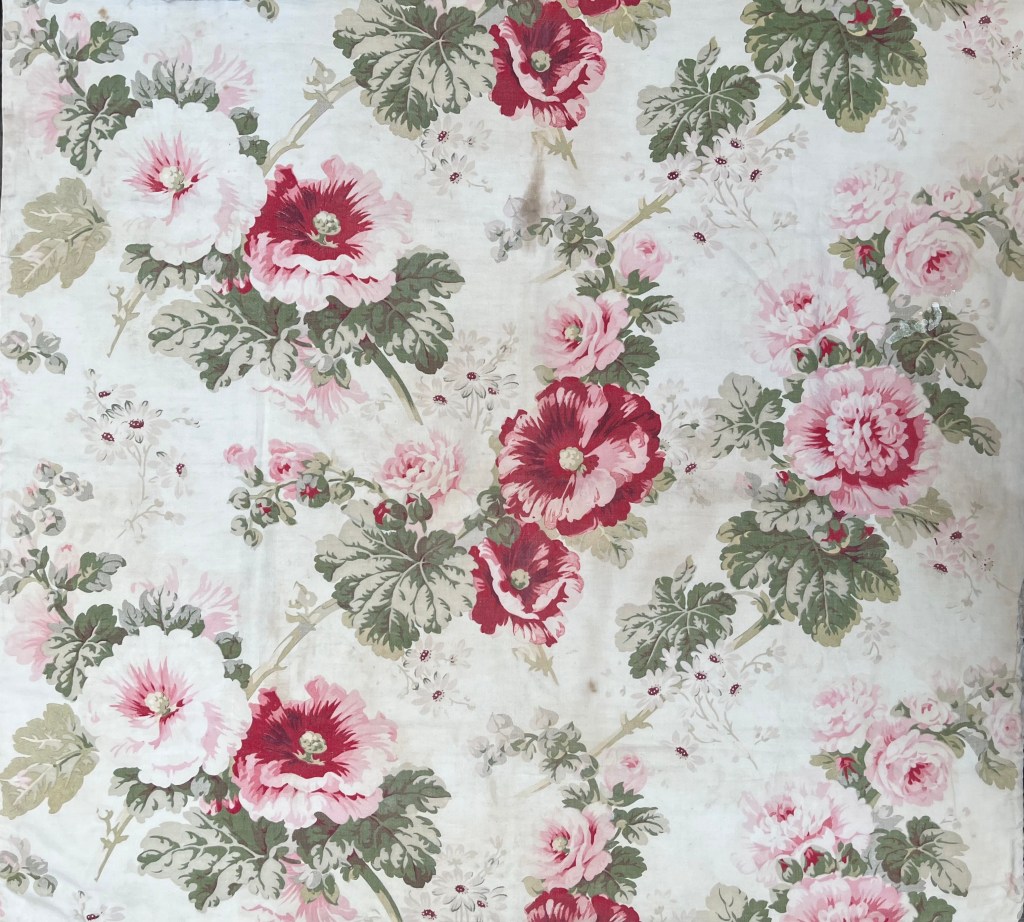
Oh my, yes. More than one hundred years later, I held Emilie’s pillow cover in my hands. It’s very soft, and it’s still so pretty!

What a cheerful room it must have been! I assume the fabric has faded with use and time, but it’s still lovely, and it must really have been pretty atop the green wicker. I can look at the black and white photo now with new eyes, imagining these colors onto it.
Thank you, Merrill. This means so much to me and to all of us who care about Emilie Loring.

Happy Landings!
 The Emilie Loring Collection
Beautiful! I love Emilie Loring’s descriptions of rooms. She was definitely a decorator.
LikeLike
I cannot imagine the thrill to hold and own a piece of Loring history! I am grateful every time you add bit more view of Emilie’s world. Thank you for this particularly delightful piece!
Vanessa Behun
LikeLiked by 1 person
I gave a book talk in Kansas last spring to which I took a “Show and Tell” collection of Emilie Loring keepsakes. Maybe I should consider that a part of future presentations. It IS neat to see the real items.
LikeLiked by 1 person
It’s especially nice, not only for its provenance but because of its lovely colors and soft, soft hand. I have to decide what to do with it… Frame it? Keep it folded somewhere? Use it? That’s the thing about heirlooms. One wants to preserve them, but the pleasure is in having them about, using them if possible, while keeping the possibility of passing them on.
LikeLike
Oh, thank you Merrill and Patti! Emilie’s heroines were always so fashionable, and I often wondered what some of the fabrics looked like (looking at you malines). I had to look them up, and it doesn’t compare to seeing the actual cretonne pillow. It’s lovely!
Along the same lines – I really wish I could see some of the gardens that Emilie’s heroines describe in her books – the color combinations, and sometimes flowers I’m not familiar with, in arrangements that I don’t see around me. I was just looking at a book called The Once and Future Gardener: Garden Writings from the Golden Age of Magazines, 1910-1940, and I wished they had color pictures of the actual gardens there too. Garden design seemed to be taken fairly seriously, even by the amateur gardeners!
LikeLike
I’m with you on the malines! I have partially-sketched gardens from Emilie’s descriptions. I had a dream of making them into watercolors… once I’d developed that skill. 🙂 Gertrude Jekyll wrote an influential gardening book, Color in the Garden, I think, and it was all in black and white. I feel sure Emilie read it, as her gardens follow Jekyll’s recommendations. I have another book, the title escapes me right now, that provides the flowers in bloom in Massachusetts for every month. It was one of the books Emilie reviewed in her early years doing book reviews for the Boston Herald, so I know that she knew of it. I can well imagine her checking it as she wrote and designed her book gardens–not to mention her real ones in Wellesley Hills and Blue Hill.
LikeLike
How wonderful to have one of the actual pillow covers!! So exciting!! That fabric would definitely have brightened up the room!
LikeLiked by 1 person
So cheerful for summer! Emilie’s garden was in her front yard, so one would walk in past flowers to see more flowers inside!
LikeLike
The hollyhocks would have provided a real splash of color! I’m still on the hunt for the original producer of the fabric. I wonder if the colors have faded much; they are perfectly lovely now.
LikeLike
Dear Patti,
What a discovery! Color adds life to an image just like when colored pictures replaced black and white ones like the movies.
You have given me new life with this pillow case of Emilie’s and added more history to her story and character. I love it!
Continue your search and share your findings as you brought me joy today.
Love and Thanks,
Raqui
LikeLiked by 1 person
Thank you, Raqui. Color gives such a lift, and it feels special to hold the pillow cover, knowing that Emilie did, too, that her family saw it, relaxed upon it, kept it for all the years that they owned Stone House.
LikeLiked by 1 person
That’s amazing that you found the fabric!! Very tenacious of you, I say.
LikeLiked by 1 person
I searched high and low, but the actual “finding” was done by Merrill Slaven, who discovered it amongst her family’s Stone House memorabilia. (Merrill’s grandparents bought Stone House from the Lorings and owned it for the next forty-plus years.)
LikeLike
How exciting for you to have a piece of history from Stone House!! And thank you for the history lesson – I was a bit confused when I read your email title. What the heck was cretonne? Now I know!
Denise
LikeLiked by 1 person
I was in exactly the same place about cretonne. I looked it up in the dictionary and had to listen to an online pronunciation guide for it. But now we know!
LikeLike
What a lovely blog post Patti, and what wonderful, detailed research of the pillow cover fabric as well! How beautiful the interior of Stone House must have been when Emilie lived there!
LikeLiked by 1 person
Thank you, Kate. I read once that green is one of the most livable colors, and Emilie must have thought so, too. The walls of Stone House were green and so was the wicker furniture that held this pretty fabric. It must have felt like a garden–so welcome on those days when the fog came in or it was dripping wet outside.
LikeLike
How exciting to have something tangible of Emilie’s. Upon looking at that granite wall, I wonder how they hung that mirror or made windows and hung drapes on that wall!
LikeLiked by 1 person
If I remember correctly, the stone was covered, although “with what” is not clear from this photo. The “gun room” and dining room were both wallpapered. I’ll dig out some more photos to show this more clearly.
Yes, it’s especially pleasing to have this pillow cover. I have hard objects–books, a brass eagle, photos–but this soft fabric invites touch, feels like a more intimate connection to its former owner.
LikeLike