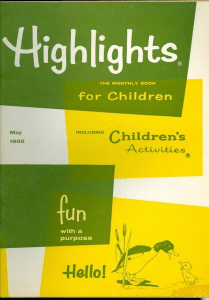
Highlights for Children
Highlights magazine was the magazine for children in the 1960s. Billed as “wholesome fun,” regular features emphasized reading, manners & conduct, health & safety, moral values, music and the arts, nature and science, our country and other lands and peoples, thinking and reasoning, and creativity.
I read Highlights in the doctor’s or dentist’s office, and the activities were short enough that I could finish a few before my name was called.


Our Boys and Girls
Emilie Loring’s father collaborated with Oliver Optic to create one of the first magazines for children, Our Boys and Girls. Like its latter day counterparts, the magazine included puzzles and thought problems, poems, nature and science articles, and poems. Unique to OBG were full plays for children to act out with their family and friends–a natural in the days before radio and television.


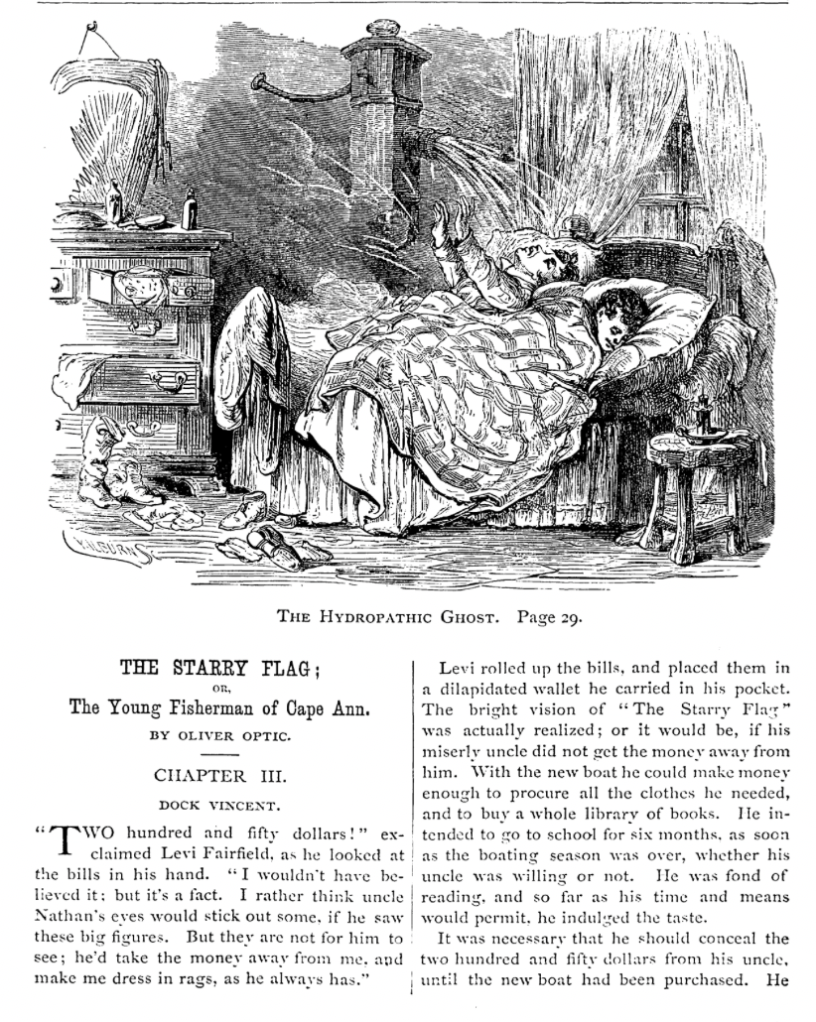
St. Nicholas
Between Our Boys and Girls and Highlights, magazines for children proliferated, including Child Life, Junior Home, and St. Nicholas. By now, the content was predictable: puzzles and thought problems, educational articles, poems, games, and stories.

In the early 1910s, Emilie Loring (as Josephine Story) wrote homemaking and motherhood articles. Initially, she wrote in the first person, sharing helpful tips. Later, she wrote her ideas into little vignettes and short stories that she submitted to homemaking and children’s magazines, including St. Nicholas.
She was in good company. In the same 1914 issue that today’s short story appeared, Frances Hodgson Burnett (The Secret Garden, Little Lord Fauntleroy) and Thornton W. Burgess (Adventures of… Reddy Fox, Peter Cottontail, etc.) also contributed stories.
It’s helpful to see her writing in context:
“The Lost Prince” by Frances Hodgson Burnett

“In his more childish days, Marco had been bitterly troubled by the unsolved mystery. Where had he gone–the lost prince? Had he been killed, or had he been hidden away in a dungeon? But he was so big and brave, he would have broken out of any dungeon. The boy had invented for himself a dozen endings to the story.”
“‘Did no one ever find his sword or his cap–or hear anything or guess anything about him ever–ever–ever?’ he would say restlessly again and again.”
Dorothy Perkins

"There's many a rose that refuses to grow
Unless it is planted and tended just so...
But Dorothy Perkins, so lusty and fair,
Is easily pleased. Give the others your care!
She'll lavish her lovely pink sprays anywhere."
The Temper Tinker by E. O. James

"Tempers to mend! Tempers to mend!
Ho! Bring me your tempers to mend!
Prickly ones--thorny ones--sputtery, squeaky--
Latches off--hinges loose--raspy and creaky--
Fly-off-the-handle and hurt your best friend!
Tempers! Bad tempers to mend! To mend!"
Tommy and the Wishing Stone by Thornton W. Burgess

“‘… You don’t have anything to do but play all day and have a good time. I wish I was a meadow mouse!’
“Right then and there something happened. Tommy didn’t know how it happened, but it just did. Instead of a bare-legged, freckle-faced, sulky boy sitting on the big stone, he suddenly found himself a little, chunky, blunt-headed, furry animal with four ridiculously short, stubby legs, and he was scampering after Danny Meadow-mouse along a private little path through the meadow-grass. He was a meadow-mouse himself! His wish had come true!”
“Gossip: An Endless Chain” is a simple dialogue in which “Aunt Jo” (aka Josephine Story, aka Emilie) and niece Suzanne discuss gossip. The lesson is for children, so Emilie kept it short and direct.
“Gossip, An Endless Chain” by Josephine Story

Suzanne slipped out of her fuzzy sport-coat, and we settled down for our firelit hour of confidences, I in the big easy-chair, she on the low stool with her head resting against my knees.
“Aunt Jo,” she began, “do you think when one promises not to tell a thing one should ever repeat it?”
“Most decidedly not, Suzanne. If you promise not to tell, stick to it, even if the news almost chokes you. For a day or two you will feel irresistibly impelled to disclose the secret which keeps forcing itself to the tip of your tongue; but, if you keep tight hold of your resolution, the temptation will pass, and the next time silence will be easier. Every time one sticks to a determination, ‘t is a battle won toward final conquest.
“Jessica Dole says that, when she promises, she always makes a mental reservation in favor of her mother.”
“That is a safe rule to follow–only, the girl who is about to make the confidence must be told before she discloses her secret; otherwise, Jessica would be receiving goods under false pretenses.”
“Aunt Jo, were you born with views? You always seem so sure.”
“That is one of the compensations of traveling westward, Suzanne,” I laughed. “What is experience for, if it does not develop convictions? On this subject I am in earnest, because I have seen incalculable harm develop from one of those promise-not-to-tell incidents. A young girl whom I knew overheard a confidential talk between two persons; she, under pledge of ‘cross-your-heart-and-hope-to-die’ secrecy, told another girl; the other girl–well–the story traveled, growing bigger and more malignant at every telling, till it almost caused a tragedy.”
“Could one girl start all that?” questioned Suzanne, in an awed voice.
“Yes, indeed! A story, once told, is the beginning of an endless chain which grows and stretches until it reaches and influences minds even in remote places. In spite of all the death-dealing tools and inventions which science has provided, the tongue continues to be the most destructive weapon to life and happiness which the world affords.”
Suzanne gazed thoughtfully into the fire. “I think, Aunt Jo, that I shall break the chain which was passed on to me a while ago.”
“Break it off short! Snap it! Then you will be sure that no harm can come from you, dear. Who knows what a critical link you might be. Human happiness and misery are so often at the mercy of the spoken word. A voice should have a conscience, as well as a mind, behind it.”
“Sometimes, when we girls get together, it makes a tempting clearing-house for criticism of an absent member; but I do try to remember what you have told me: ‘If you have anything to say, just imagine that the person about whom you are to say it is present.’ That thought has closed my lips so quickly, sometimes, that I have almost bitten my tongue through,” confided Suzanne.
With a bound, Goldilocks, the yellow Persian kitten who had taken refuge under the couch when Suzanne had entered, landed on the arm of my chair and reached out a dainty paw toward the shining head resting against my knee. Then she gazed up at me out of inscrutable eyes.
“Much as I love you, I shall have to say it, Goldilocks,” I began, but I gave the yellow kitten an apologetic hug before I continued; “Don’t be a cat-girl, Suzanne. One who purrs to the face and scratches deeply if she feels at all annoyed.”
She twisted around and leaned her arms on my lap. “I know exactly what you mean, Aunt Jo,” she began eagerly; “there is a girl in our set upon whom I fairly dread to turn my back. The moment a girl leaves a group of which she is one, she raps the departed good and hard. Oh, I hope that nobody fears to leave me behind her!”
“No danger of you, my honey! You never hear petty criticism and pin-sticking–that’s what I call those miserable little digs–at home. Your mother and father are too busy finding the best in life for you, the boys, and themselves to indulge in that sort of thing. You wil find that this girl of whom you speak has grown up in an atmosphere of fretful, insistent fault-finding with people and things.”
“Aunt Jo, it’s so easy to be good with you–you always commend one’s efforts.”
“Ah, Suzanne! you begin to realize what appreciation means. Now, dear, never be afraid of commending the good in others. If Billy and Jack do well, praise them heartily. Growing boys are tremendously proud of commendation from a big sister, in spite of their seeming indifference. A bit of honest approbation will oftentimes flood a doubting, faltering soul with courage to push on.”
“I’m so afraid that I may be thought insincere or a flatterer,” confessed Suzanne.
“Nonsense! Any intelligent person can discriminate between appreciation and soft-soap. Even the latter has its uses,” I added with a laugh. “Remember two things, Suzanne: first, break the chain when it is a hateful, gossipy, or disagreeable one. Never pass it on with ‘I think that you should know what So-and-so said about you.’ Peter Standish says that the person who passes on an unkind thought is worse than the originator. And he is right.”
“That sounds like Peter. Now what is the second thing I am to remember?”
“Pass on the good, cheery, inspiring thoughts!”
“I will!” Suzanne sprang to her feet. “And this is an eminently fitting time to begin. Aunt Jo, Peter says that you are the second most wonderful person in his world! What do you think of that?”
“Did he at the same time happen to mention who the most wonderful one is, Suzanne?”
I turned on the light in time to catch the glow which my words brought to the girl’s eyes. My act roused the green parrot, who shook his feathers, cocked his head on one side, and chanted sleepily:
“Oh, there’s only one girl in the world for me!”
Reading Level
These stories by Francis Hodgson Burnett, Thornton W. Burgess, and Emilie Loring are all written at a level that would now be called “YA,” Young Adult, but in 1914 when they were published, they would have been appropriate for younger children. The Fourth Jones Reader, for example, would now be considered “extremely difficult” and appropriate for college graduates but was published in 1903 for the fourth to fifth grades:
“Pupils who enter the fourth school year are supposed to have mastered to at least a fair degree the mechanics of learning to read. They may therefore begin to appreciate the better class of literature, in which ideas are put forth in artistic form.”
“Gossip, An Endless Chain” was written for children, and it’s clearly at a lower level than Emilie Loring’s novels. That got me wondering, so I submitted several excerpts of her novels for evaluation, beginning with:
“I still believe that the beautiful things of life are as real as the ugly things of life; that gay courage may turn threatened defeat into victory; that hitching one’s wagon to the star of achievement lifts one high above the quicksands of discouragement.”
Result? “Extremely difficult, Grade level: College graduate, age range 23+” according to six of the most popular scoring systems. Emilie wrote as she thought, and that was with the complexity and vocabulary of a woman whose education included Sir Walter Scott and Dickens, neither of whom skimped on complexity.
I have never found Emilie Loring’s novels to be difficult. They have both character and substance, and I appreciate that reading level may be one of the aspects of Emilie’s novels that accounts for her appeal among well-educated women. They don’t talk down; you can bring your brain with you when you enter the story.
I think that was the whole point with children’s magazines, too–Enjoy reading and bring your brain with you.
Annual Emilie Loring Tea!
A reminder: Our annual Emilie Loring Tea will be on Emilie’s birthday, September 5th. Pull out your recipes and wash the tea cups! I’ll send a “formal” invitation this weekend.

Happy Landings, everyone!
 The Emilie Loring Collection
Aloha! I enjoyed this immensely! Before you commented on it, I saw the cover of the Highlights and immediately recalled the dr and dentist office visits. I continually asked my mother to subscribe but she declined. Ah, sadness! I discovered that Our school library had all the issues, so I read what I could. I love what you said about being able to “bring my brain with me as I read an Emily”. It is very true. I read my Bible and medical or scientific texts and papers and hate to read a novel that makes me feel, “ patronized”. You have made me realize this is one reason I can read her books over and over with enjoyment. Thank you for continuing to bring your readers such brilliant ideas. It is my joy to receive your mail to my inbox. I’m still contemplating what I can do for the Tea. Thank you Aloha, Pam in Oregon🌴
Sent from my iPad
>
LikeLiked by 2 people
When I opened a Highlights magazine, I looked for the page with hidden pictures first. If I still had time, I looked for short jokes and quick stories. I don’t suppose I ever read one in its entirety.
I’d like to compare Emilie’s writing level with those of other popular authors. I’ll be curious to see if there’s much difference. Then I’ll start planning my tea!
LikeLike
Dear Patti,
I never realized how prolific Emilie was with Children’s magazines and readers and they were so enjoyable for the kids.
Thanks for another insight into Emilie as you have shown so many aspects of her writings to varied audiences.
I will not be able to join you on the Emilie Tea as it is difficult for me to set up with my anemia but getting better with the osteoarthritis with my PT with Nikita Sarkan who is so kind and attentive to my needs.
Enjoy your tea and have a wonderful summer.
Love and CONGRATS!
Raqui
LikeLiked by 1 person
Thanks, Raqui. Keep taking good care of yourself!
LikeLiked by 1 person
This was such a fun post! I remember “Highlights” so well. We had a subscription and by the time we four kids were finished with the issue it was pretty ragged. My favorites were “Flicka, Dicka, and Ricka” and “Snip, Snap, and Snurr.”
Your examples of old children’s stories bring to mind one summer when my mom bid on several boxes of books sight unseen at an auction. When we got them home they were a treasure trove! They contained really old elementary school books, and lots of old story books. If I remember correctly, some of the stories were a little grim, but the pictures were so similar to what you show. That was the summer we all lived in the past!
After reading your last post, I’m re-reading “Give Me One Summer.” It’s been quite awhile and I had forgotten how good it really is. I can see why it was nominated for a Pulitzer.
I hope you enjoy the rest of your summer!
LikeLiked by 1 person
“Snip, Snap, and Snurr!” I hadn’t thought of them in ages! I’m in the lake house that was my grandparents’ retirement home, and it’s filled with old books. Grandpa’s fourth grade reader was an eye-opener. My favorites as a kid were the Books of Knowledge. I loved their mix of fact, fiction, and illustration. They were published in the 1920s but every generation of kids in our family has loved them.
Thanks for writing in. I hope you’ll join us for our tea!
LikeLike
I’m so glad to know that there are others who enjoy reading the things that I like to read.
LikeLiked by 1 person