A challenge in writing Emilie Loring’s biography was to discern the importance of events as they occurred. To do this, I needed to understand what Emilie would have understood. This article from the Boston Post, June 24, 1920, is an example.
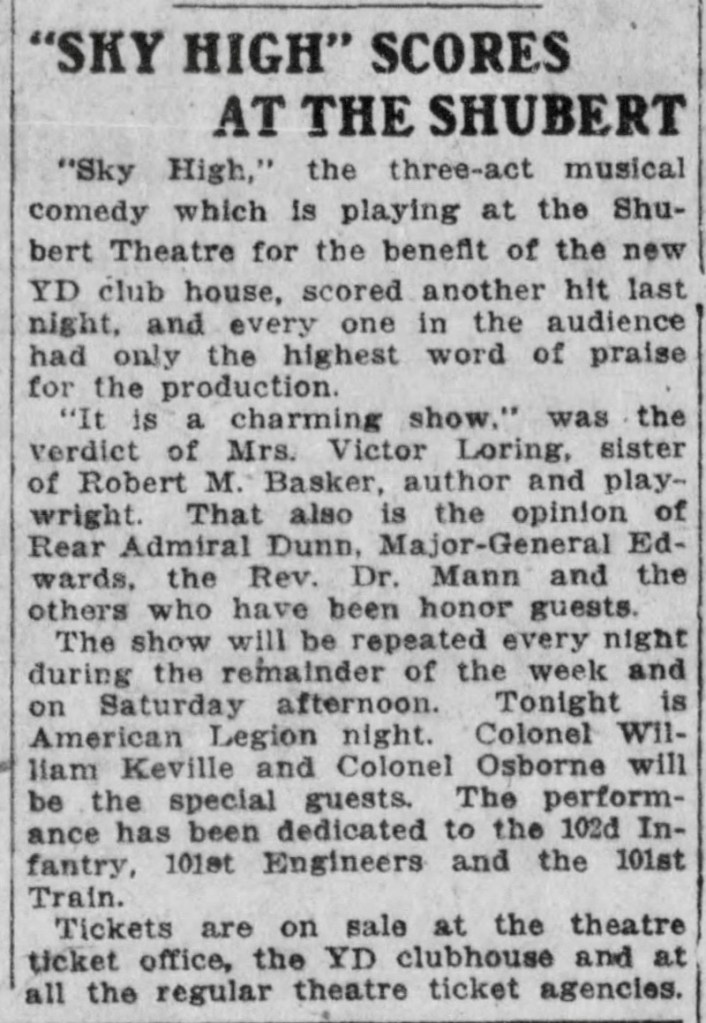
Who were the “YD”s? Why was Emilie’s opinion printed? Was Emilie involved in this performance somehow? She hadn’t yet published her first novel, and yet, her verdict on the show was the only quote. Was Sky High one of her brother’s musical comedies?
Let’s find out…
“YD”

“YD” was the 26th Division in World War I, nicknamed the “Yankee Division.” In 1920, an estimated 10,000 former members of the YD lived within a 10-mile radius of Boston.
This was the first new year since the war’s end and the men’s return, and to support the veterans, a clubhouse was proposed. The community would provide the building, and enlisted men would support and run the club “to bring back the buddyship of combat days” with people who knew what they had experienced. Sky High‘s receipts would all go toward the effort.
“Sky High”
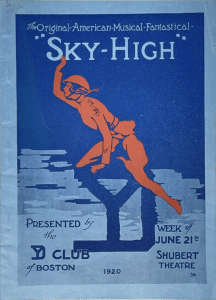
Sky High was an original, amateur production with lyrics by Leverett D. G. Bentley, a reporter for the Boston Globe, and music by Albert M. Kanrich. The cast was all amateurs, except C. B. Pettes, “the premier female impersonator of the American Expeditionary Forces.” My first thought was the Shubert Theatre in New York, but this performance was scheduled for the Shubert Theatre in Boston.
“Snappy and spirited,” Sky High opened with Uncle Sam at his summer home on the New England coast. (Can’t you just imagine a cartoon depiction?) His right-hand man has invented an airship and is challenged to a race by another airship owner. The plot involves a “trip to Venus”–both the planet and a woman of the same name–dancing girls, and silly puns aplenty.
Why Emilie?
Honestly, I have no idea. She’s identified here by her relationship to her brother, Robert, who was a professional writer for the musical stage. But why not ask him? Maybe it was as simple as her being available for a reporter who was on deadline. In any case, this event did not find a place in Happy Landings: Emilie Loring’s Life, Writing, and Wisdom. It took this bit of sleuthing, though, before I could decide.
Flying Boats!
Too good to pass up was this next article about the first passenger aircraft to arrive in Boston. Remember, A Certain Crossroad (1925) would soon feature Judith Halliday in flying costume on its cover.
The text surprised me, though:
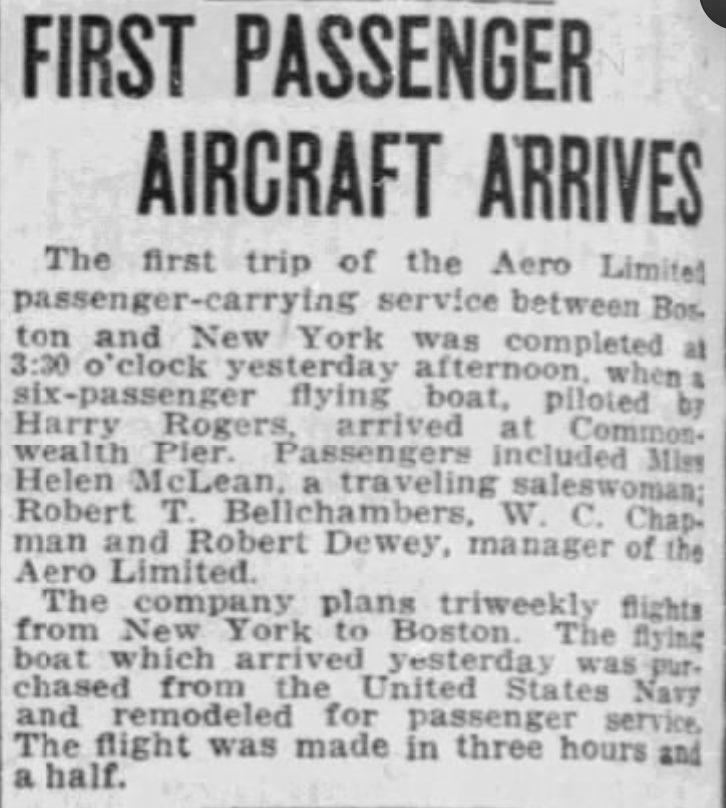

The first trip of the Aero Limited passenger-carrying service between Boston and New York… a six-passenger flying boat, piloted by Harry Rogers, arrived at Commonwealth Pier. . . . The flying boat which arrived yesterday was purchased from the United States Navy and remodeled for passenger service. The flight was made in three hours and a half.
How fun, to imagine that first flight landing in Boston Harbor and sidling up alongside the Commonwealth Pier.
In the Same Issue
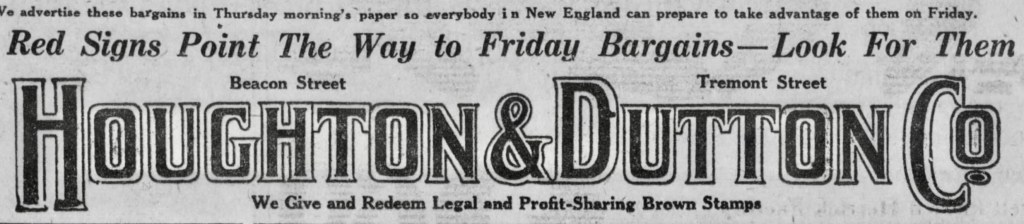
“We Give and Redeem Legal and Profit-Sharing Brown Stamps”

Brown Stamps? Were those like S & H Green Stamps? I used to love shopping through the Green Stamp catalog.
As it turns out, yes. Businesses gave stamps to customers at a usual rate of one stamp per ten-cent purchase. These were saved in books, and one thousand of them could be redeemed for two dollars in cash or $2.50 in merchandise. For faster rewards at Houghton & Dutton Co., a special shopper’s card of one hundred stamps could be redeemed for 25 cents in merchandise.
Just add a little Creolin…

I had never heard of Creolin, had you? It’s a disinfectant derived from wood tar. Dr. Austin Flint II observed in the 1880s that a concentration less than 2% was effective at controlling bacteria in wound dressings. (Connection Moment: This was the son of Dr. Austin Flint, Sr., in whose Cape Cod home Emilie lived in 1890.)
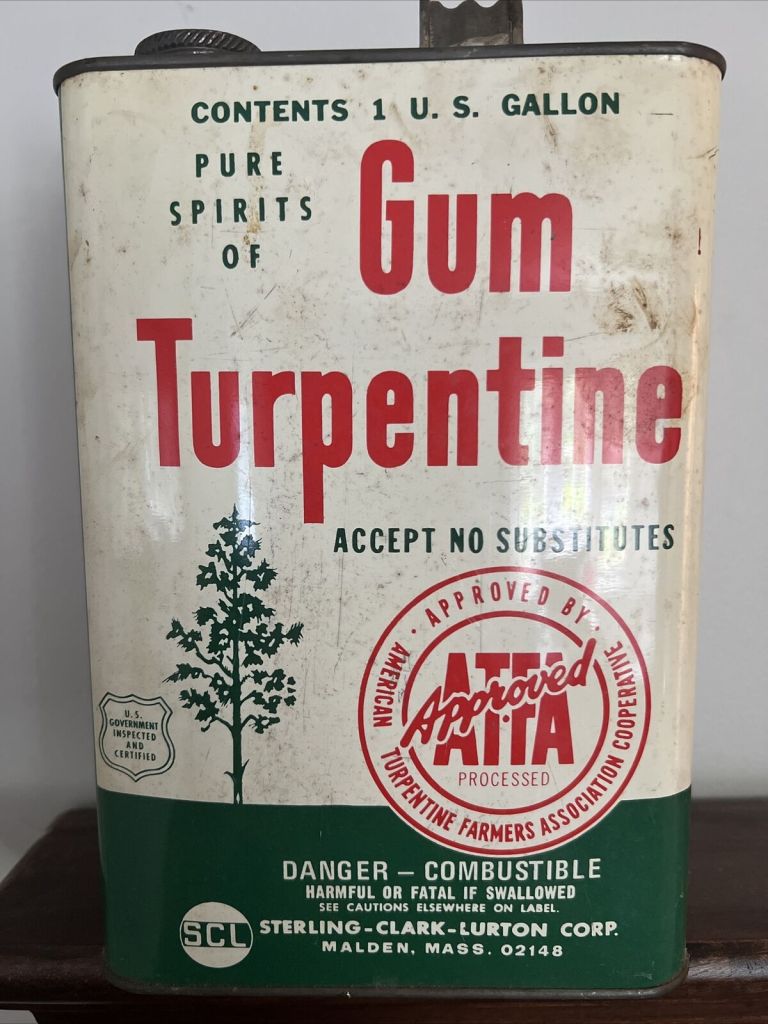
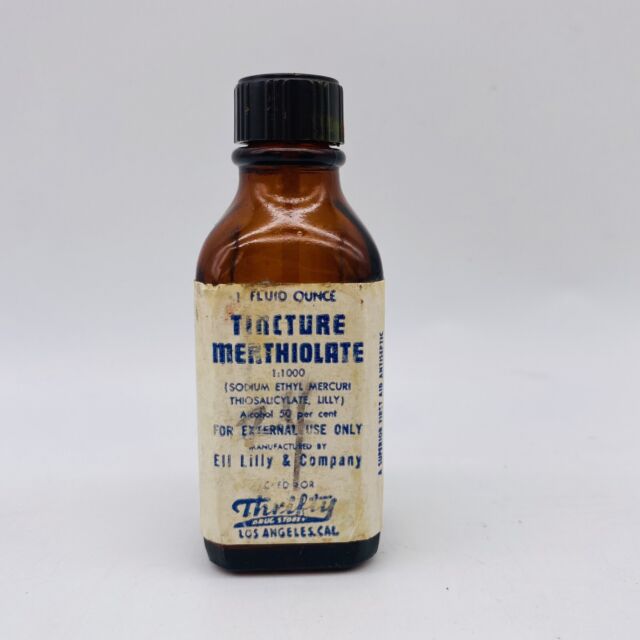

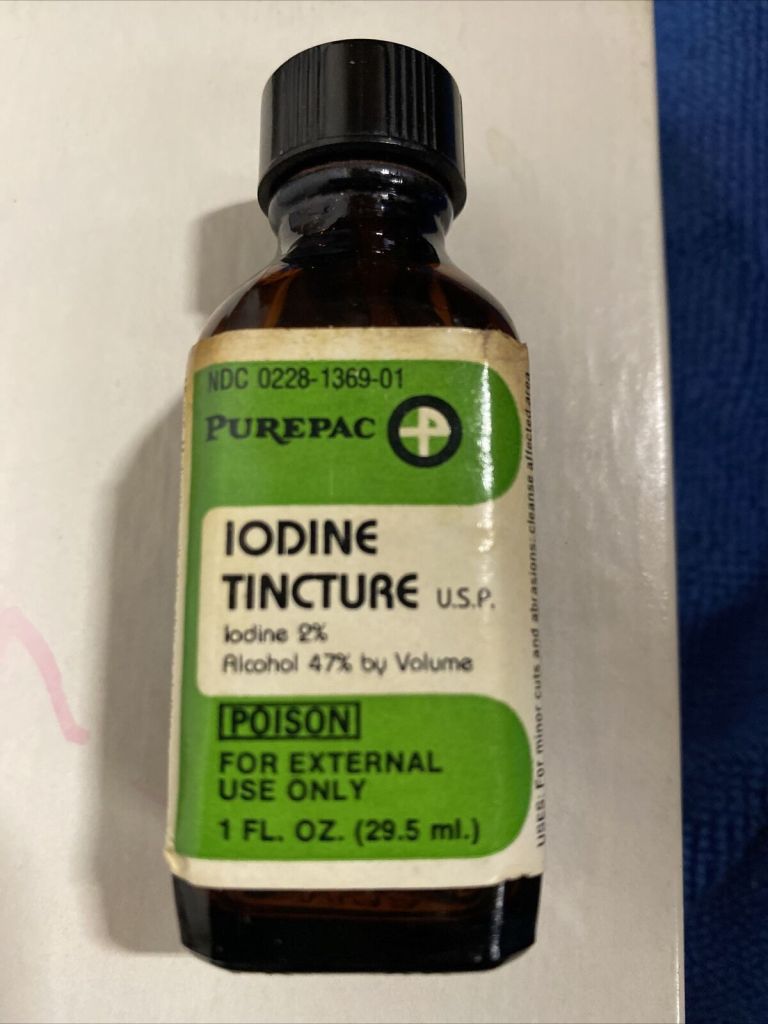

Turpentine also comes from wood tar, and this was a personal connection moment for me, as my Grandpa always poured turpentine on his cuts, instead of the iodine and merthiolate that my Grandma used on us kids. Mercurochrome hurt less than either of these, but we were sure happy when Bactine came on the market–mercury-free and pain-free!
Mission-Style Magazine Rack
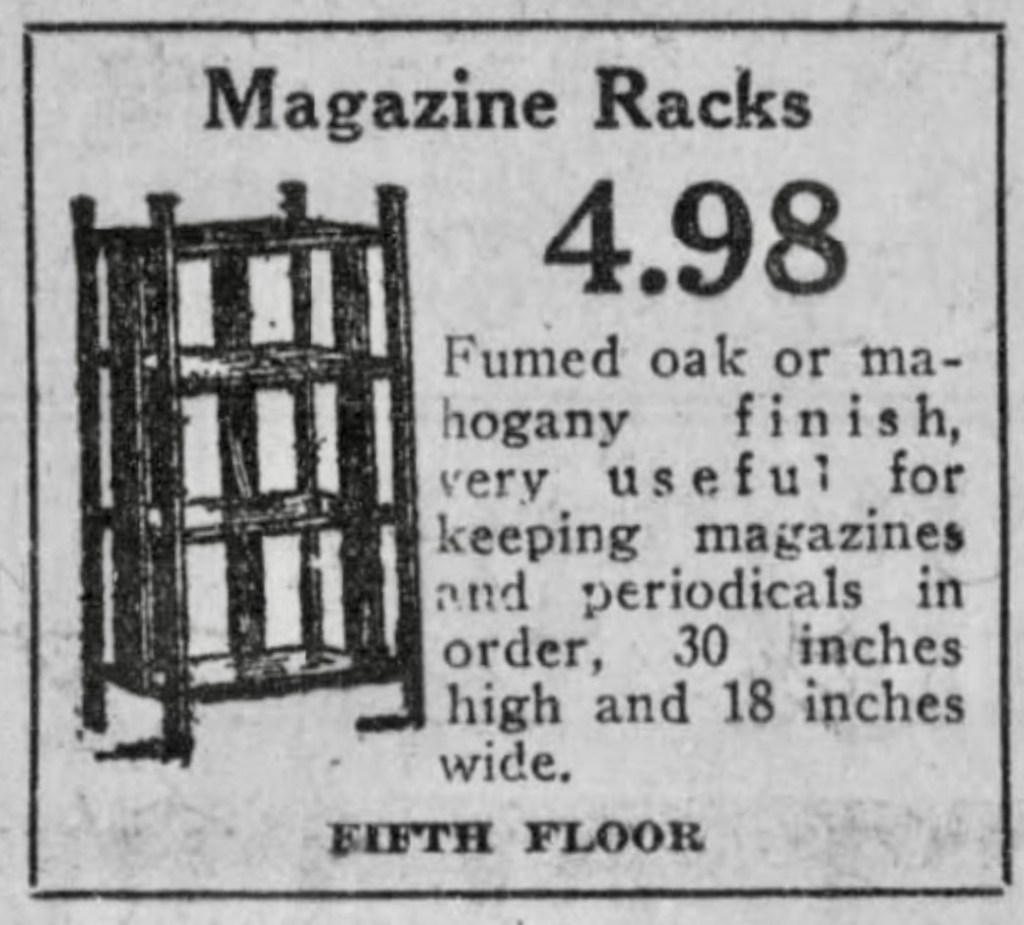

A magazine rack! We have the twin of this set of shelves in our lake-house basement, and we’ve used it as a bookshelf for as long as I can remember. Today, it stores my Grandpa’s volumes of Popular Mechanics’ Home Handyman. Now, I’m imagining it loaded down with HOLIDAY, LIFE, and LOOK magazines.
Also in 1920…
“Noon de plume” (!)
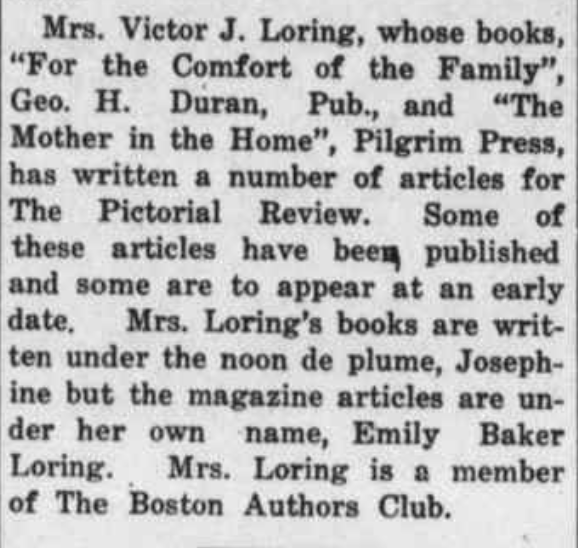
So many things are wrong in this short paragraph, but it got right that Emilie Baker Loring had, by 1920, begun to write under her own name, and she was, indeed, a member of the Boston Authors Club. The same month as Sky High, she wrote “Keep Young:”
…forget your age, taboo birthdays, take up an interest which has beckoned to you through the years, but on whose allurements you have resolutely turned your back because the family needed all your time. Go to it with all the zest and enthusiasm there is in you. Enthusiasm! That’s the magic potion.
Emilie Loring had, by then, ventured into fiction. The kernels of stories we love now as novels got their starts in “An Elusive Legacy,” “Kismet Takes a Hand,” and “Prue of Prosperity Farm.” It was a learning time for her, but her new friend at the Boston Authors Club, Sara Ware Bassett, already had much of it figured out.
Sara Ware Bassett

On October 31, 1920, the Boston Herald featured Sara Ware Bassett as one of the “literary workers of Boston.” I reproduce some of her remarks here, backed by blue, which was so much her favorite color that it was nearly a passion.
Do you see both similarities and differences with Emilie Loring?
“I never read any of my things to anybody. I don’t even try them on the dog!”
“… I never know, when I send a story away, whether it is good or bad. I make myself so much a part of the story that I cannot stand outside and peer into it and judge of its worth…”
“When a publisher writes back that he likes it, I feel as happy and warm as can be. It’s a great satisfaction to know that the emotion and ideas that you felt and thought have actually made the trip across to another mind without getting lost. And when they become quite misinterpreted, the disappointment is even more poignant.”
“… my books always have their beginnings in a character rather than in a plot. Plot does not interest me so much as people–and that is why my books have slight plot. I like people; they’re fascinating–how they meet their problems and what they are glad and sorry about… “
“It is just the failure to see quiet interest that makes our stories in which the heroine is dragged by the hair and heaved over the precipice–or perhaps the hero bounds in at the last moment, out of a tree or over a boulder, and the villain is the one to be heaved. Now, girls don’t get thrown over precipices–none of us ever knew a girl who had indulged in such sport. But the world is filled with people who meet their peculiar problems of joyous or sad living and who are worth writing about. They are my people.”
“It’s just like life. We all astonish ourselves with traits that we didn’t know we possessed.”
A Writer’s Life
There’s no big conclusion here, only this experience that repeats itself, over and over, until a work is done. Discover, learn. Discover, learn.
“I am sure I have made errors. When two events are known, the temptation is to assume a straight line between them, but the unknown “between” may be very different. I have discovered this error many times, and there is no way around it.”
Happy Landings: Emilie Loring’s Life, Writing, and Wisdom
“And you’ve enjoyed every minute of it?”
Emilie Loring
“Every minute. I loved it. Whether the writing came hard or easy, it gave me, and does still, a thrilled sense of satisfaction, of achievement.”
I’ll be doing virtual book talks and club meetings for the next little while. Let me know if your group is interested. (contact@pattibender.com)
For now, grab an “Emilie” and enjoy. With the birth this week of my grandson, Ryan, I think mine will be I Hear Adventure Calling.

 The Emilie Loring Collection
You are AMAZING at research. All this is so interesting. Lots of little rabbit trails to follow. And you present it in a very clear, enjoyable manner. Thank you. What fun!
LikeLiked by 1 person
Thank you, Roberta! It’s fun for me and so satisfying when someone else enjoys it. I appreciate you writing in!
LikeLike
Thanks for the bonus stories!😀 Congratulations on the birth of your grandson! Funny you mentioned I Hear Adventure Calling. I also heard adventure calling and am reading it while at a lake Michigan beach town. Happy Landings!!
LikeLiked by 1 person
It seems like such a treat to enter a story and follow it from the beginning to the end—no notes, no commentary, only an adventure and romance on the coast of Maine. Aaaahh
LikeLiked by 1 person
Here’s a picture of the YD “club house “https://www.digitalcommonwealth.org/search/commonwealth:3f463c621
It was replaced by a motel in the 1960s and a new development is currently being planned.
Congratulations on Ryan!
Constance
LikeLiked by 1 person
Thank you, Constance, for the photo and your congratulations! Clubhouses were so important in the early 20th century. I’ll look for a good book on them. Patti
LikeLike
Congratulations Patti on the birth of your grandson!
LikeLiked by 1 person
Thank you, Mary. Sleepy, happy people here!
LikeLike
CONGRATULATIONS on your grandson, RYAN and enjoy the adventure with him. You have kept me so involved with your findings and discoveries and I learned so much about the 1920’s I loved chapter 21 IDENTITY and her comparisons to Sara in their writings. See you on the 6th for our Defenders Meeting by ZOOM. Love and enjoy your lovely family, Raqui
LikeLike
Thank you, Raqui! It is fun to research little bits and see where they lead. And thank you for your careful reading of Happy Landings. I enjoy both Emilie and Sara Ware, and they were certainly different in their experience and approach. I’m eager for our next meeting of the Defenders. See you then!
LikeLike
So much good stuff here! Thanks for the subtle consideration of these sources, their “facts,” and factoids. And congratulations on the grandson!! That head of hair is impressive.
LikeLiked by 2 people
Thanks, Carol!
LikeLike
PS. Did you notice a misspelled Baker as Basker in that review?
Sent from the all new AOL app for iOS
LikeLiked by 1 person
Oh, yes. It was almost the first thing I saw! I wonder, sometimes, how many articles I miss, because of creative misspellings.
LikeLike