I have a file labeled “Fascinating things that didn’t make it into the book.” Today’s entries all have to do with fish.
Magic Tricks and Entertainments
On one research trip, I opened an envelope pasted inside an 1800s scrapbook and found this card:
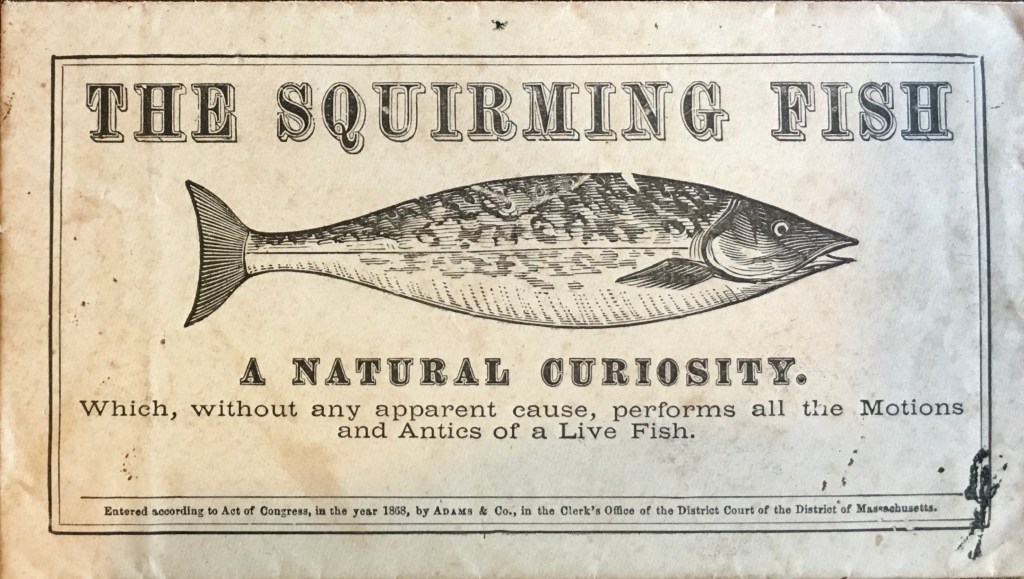
With it were these instructions:
The peculiar properties of the rare material of which this article is formed entitle it to be ranked as one of the wonders of Nature. Seemingly imbued with life when connected with the magnetic currents of the human body, it astonishes the simple, excites the interest of the curious, and presents a problem to the student. Nothing in the entire range of novelties affords so much amusement or so universally commands the attention of all ages and classes of people.
Special Directions: Place the Fish upon the left hand, lengthwise, its head toards the fingers. Its motions will be more or less active, according to the strength of Magnetism and vitality of the person. Should its movements be quite slow, remove it, slightly moisten the surface of the hand with the mouth, or by breathing upon it. This will open the pores of the skin and enable the magnetic currents to act more freely outward. Then replace the Fish upon the hand as before, and it will move “as lively as a cricket.”
Alas, there was no fish in the envelope, squirming or otherwise.
Adams & Co. of Boston had high hopes for their “Squirming Fish” and charged $2 apiece in 1871. Two years later, the price was 25 cents. The “rare material” of which it was made was “apparently paper.”
Family Fish
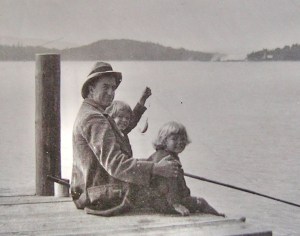
Happy Landings includes this photo of Victor and the boys fishing at the Rangeley Lakes, but I failed to give Emilie her due. It’s a shame that there wasn’t a photo for this one:
Saturday, Mrs. Loring caught a fine one weighing 3 pounds and there have been other good catches.
Phillips Phonograph, August 18, 1899
Emilie’s maternal grandfather, Jerome Boles, was quite the fisherman:
GOOD LUCK– That veteran fisherman, Mr. Jerome Boles, is having fine sport catching bass off Chelsea Beach. We understand that he secured fifty-four beauties one day this week. He will probably remain at the Beach as long as the fish are off there. Boston Traveler, July 14, 1866
That was nothing on what his father, Emilie Loring’s great-grandfather John Boles had done. He and some companions were staying at the Winnicumet Hotel on Hampton Beach, and in a single morning, they caught five hundred sea bass.
The full tale was told in the Daily Bee, August 19, 1848:
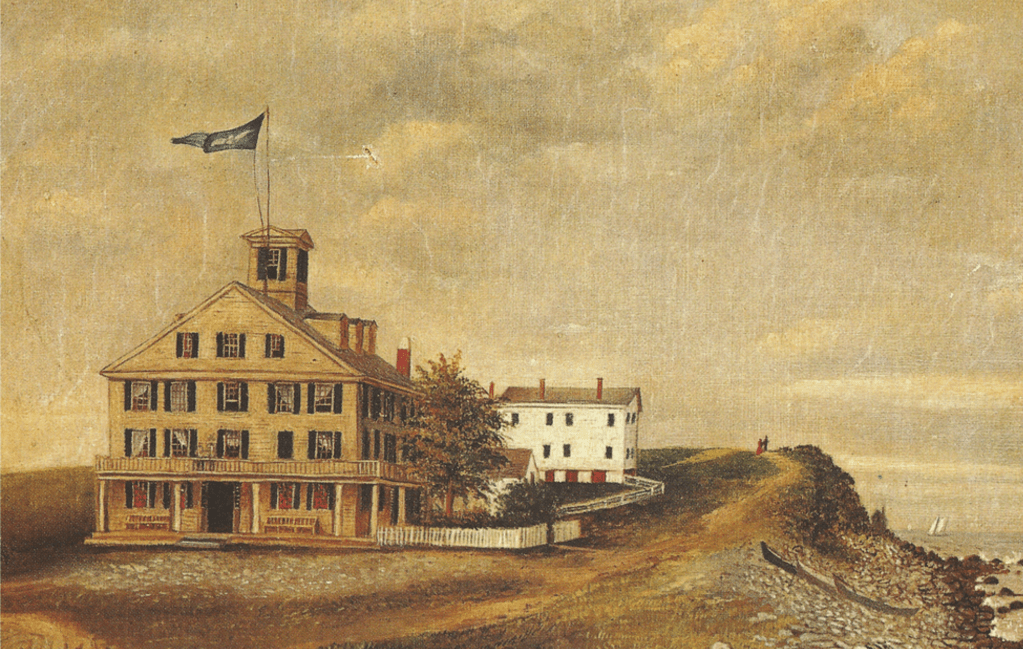
GREAT HAUL OF BASS
A correspondent who is sojourning at Hampton Beach writes us that a party of gentlemen, on Thursday morning, took a boat and rowed to the mouth of Hampton River, on the lookout for Bass. After rowing about for some time, one of the largest schools ever seen was discovered.
The boat was rowed to the shore to fasten one end of the seine, when a party of gentlemen from the city, on a gunning expedition, immediately laid down their guns and equipments, and took hold of one end of it, while the boat was rowed from the shore, paying out the net. As soon as all was right, persons commenced pulling at both ends of the seine, when it was found that there was a haul, beyond question. As soon as shallow water was reached, individuals rushed in and commenced taking out the fish in their arms, to lighten the net, when it was drawn in shore, and it was a great sight to behold. It was estimated that there were upwards of five tons weight of fish–they varied in weight from ten pounds to fifty-eight pounds.
The gentlemen who had the fun of this fishing were Messrs. Isaac Carey, Warren and John Boles, Boston, C. R. Borwn and J. Abbott, Concord, N.H., J. Wiggin, Thomas Leavitt, H. Langley, and J. Perkins, of Hampton Beach. Two of the fish, weighing ten or twelve pounds, came to our office yesterday, and they “were beauties.”
Art and Literature

This portrait always pulls me in. The man is Walter M. Brackett (1823-1919), to whom Selden Loring wrote while serving in France in World War I:
“Having been blessed with orchestra seats for the whole show, I have been forced to observe at close quarters most of the methods of modern warfare and have been included in nearly all the offensives both Allied and German… Father writes of seeing you often and I hope it will not be long before I can enjoy the same privilege, but, in ‘this man’s army’ the only thing to be sure of is that any rumors as to when we get through are entirely false and worthless except as a means of diversion and an exercise in imagination.”


The fish connection is that Walter M. Brackett was an artist well known for his realistic paintings of fish, trout in particular. You’ve heard of the “Sacred Cod?” Brackett’s 1898 re-painting of the wooden fish that hangs in the Massachusetts State House endured until the 1960s.
As the portrait’s photographer, Selden signed his initials, “SML 1917.” This was shortly before he left for France. By then, Mr. Brackett was ninety-four, and his hand shook as he signed his name, but his steady gaze belied that weakness.
Selden never saw him again. Brackett died in March of 1919, and Selden returned in June. Selden’s fish for the Harvard Crimson was in a humorous style all his own.

And back to Emilie Loring!
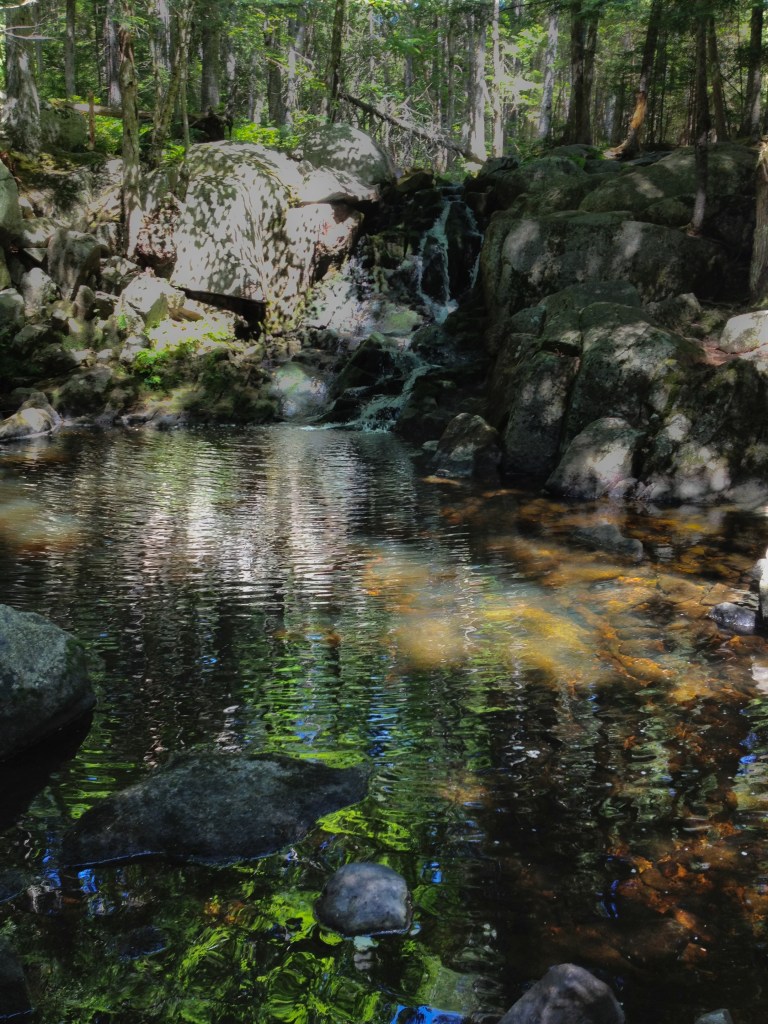

Trout water… The answer to a fisherman’s prayer… Dollars to dimes there were wily old veterans darting or lying like dusky shadows on the bottom of that dark basin between two jutting brown rocks. But what a trap for fly and line!
Where Beauty Dwells
 The Emilie Loring Collection
Dear Patti,
I always escape from my pain of loss in your writings like this one of the fish. I love the photo of Victor and the boys fishing in the lakes. I realize how much information about fish you did not include but was so relevant to the happenings with Emilie and her novels. It gave us the character of the times and the activities they engaged in during those years. I will never look at trout in a cavalier manner again. Love and thanks, Raqui
LikeLiked by 1 person