Ken’s entry song, “Just Ken,” in the Barbie movie gave my conscience a poke:
Doesn’t seem to matter what I do
I’m always number two
Emilie Loring’s biography rightly focused on her, but should I have said more about Victor Loring? He was, after all, not only her husband for fifty-five years but a purposeful and accomplished man in his own right–an individual with a private as well as a public life.

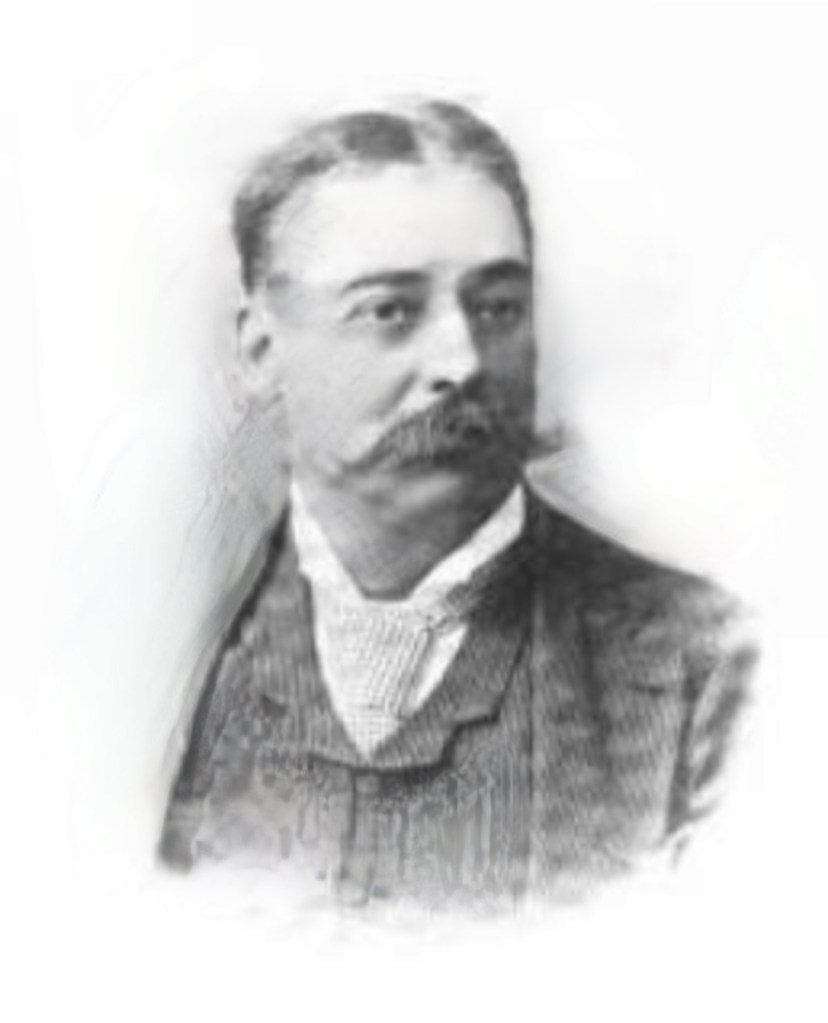
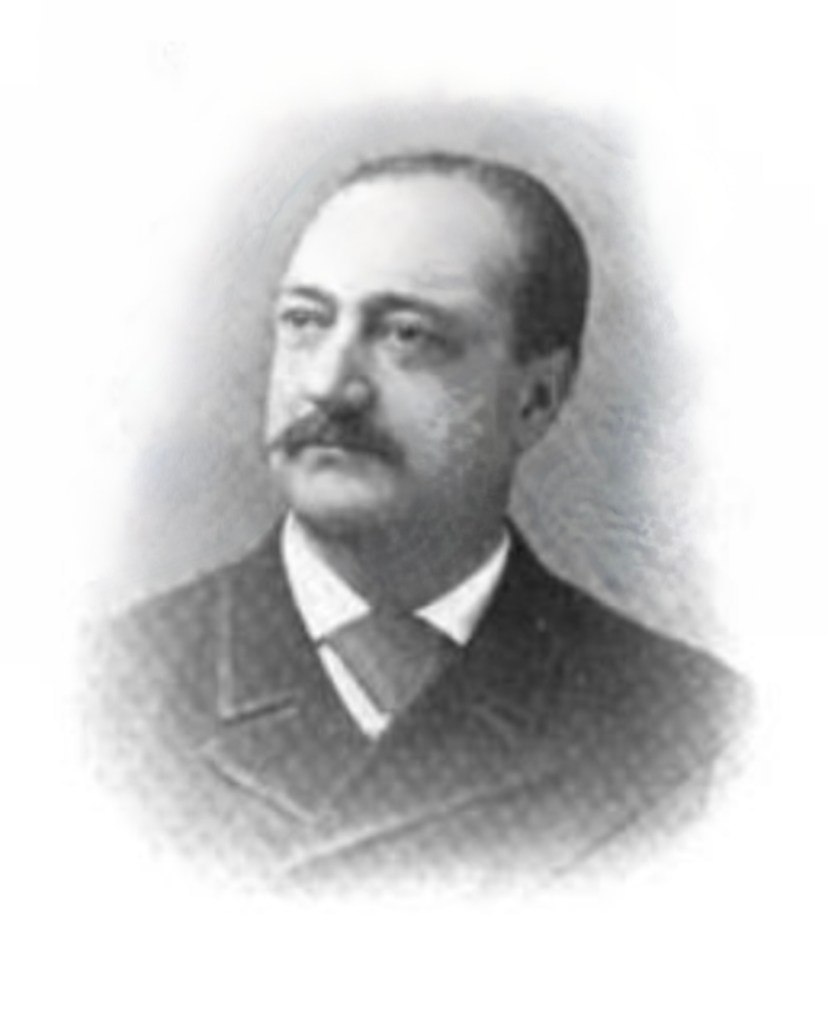
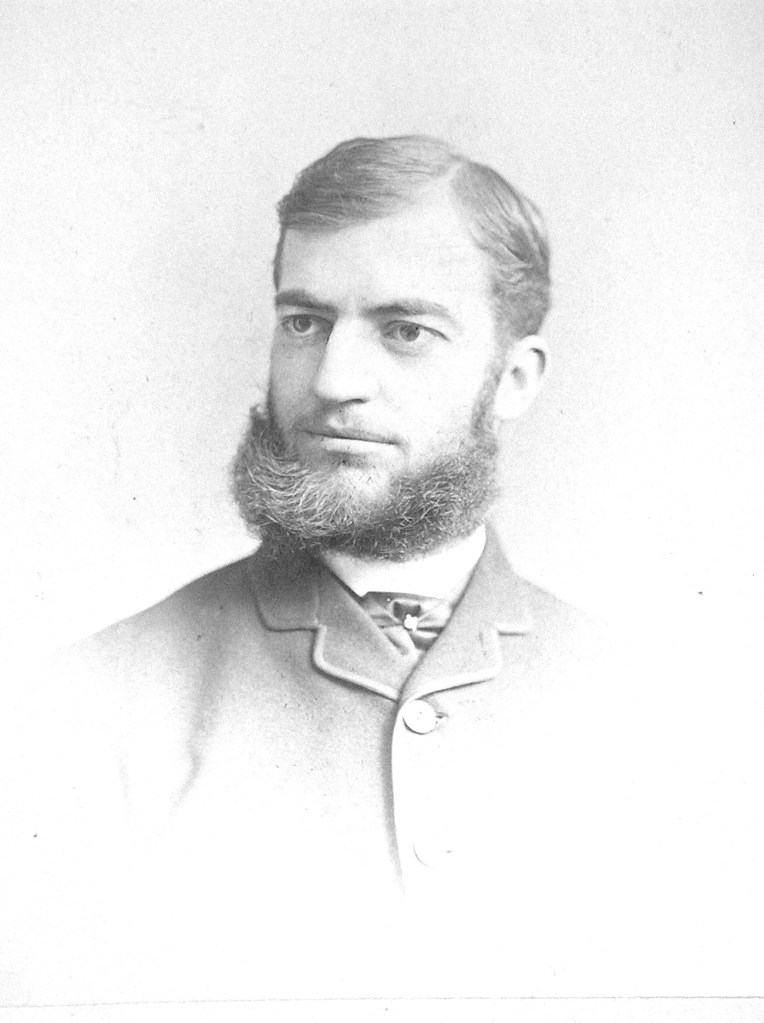
The Loring Men
Having lost their father at an early age, Hollis Loring’s sons left Marlborough, Massachusetts to attend school and launch careers in Boston. Four chose the law: Selden, Edward, Charles, and Victor. All but Charles entered into practice with their sister Kate’s husband, Barron Moulton, as Moulton, Loring & Loring.
Within months, though, after Victor married Emilie, his brothers Selden and Charles both died. Thereafter, it seemed that Victor strove in earnest to live up to all of their legacies–his father’s and his brothers’. Like his father, he chose a life of public service. Like Selden, he supported the Royal Arcanum fraternal life insurance association and the Adirondack Mountain Club. Like Charles, he served in public office and maintained connections with the yachting world. In addition, he steadfastly followed his own passion for Christian works and fellowship, especially stirring men’s consciences toward what they could do for others. A more purposeful fellow it would be hard to find.
Emilie’s dedication of A Certain Crossroad to Victor was apt:
“But always the Knight kept the lady’s hand close in his and always he stepped forward firmly, his eyes straight ahead, for even in the gloom all was sharp-cut and clear to his vision.”
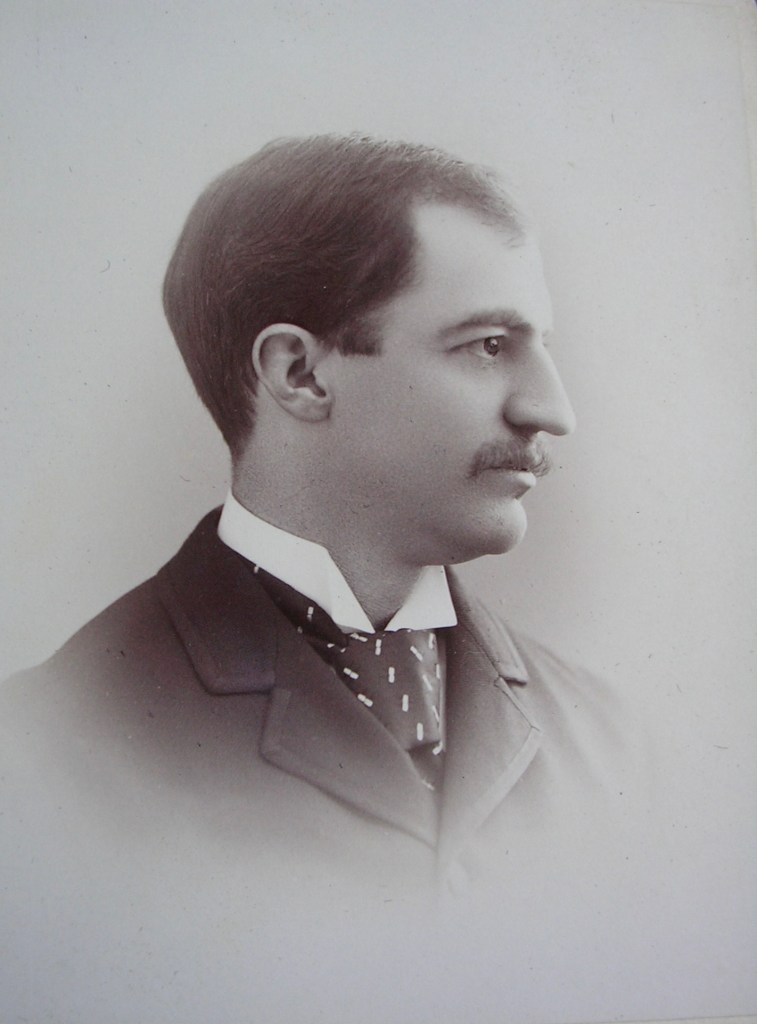
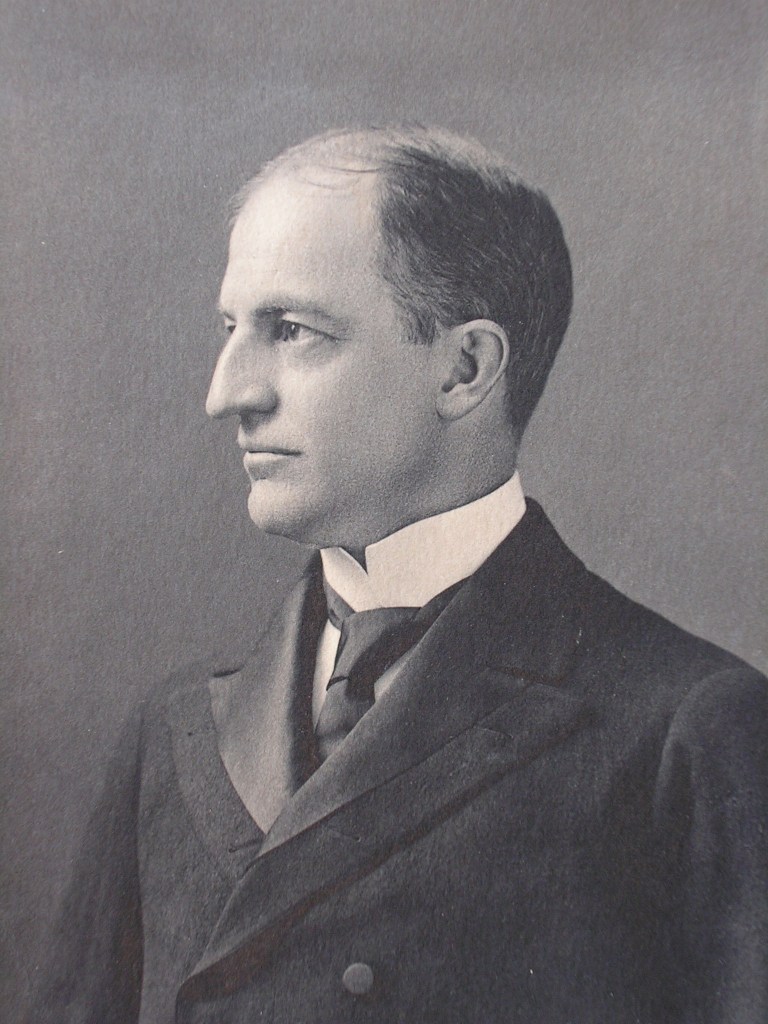
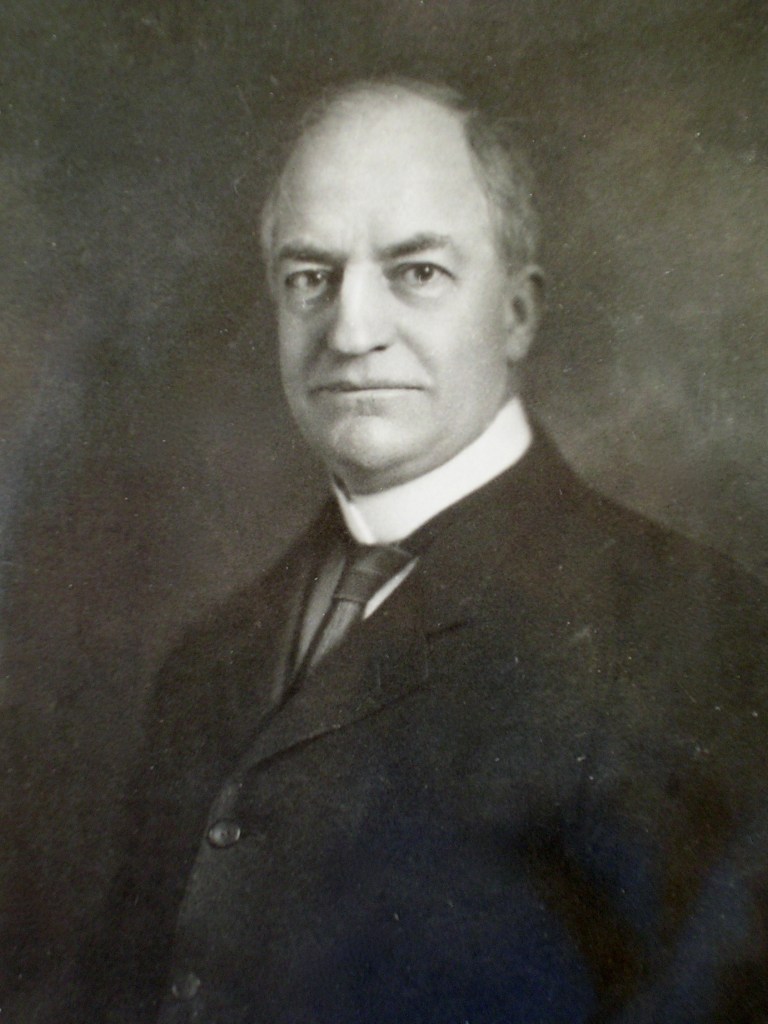
Serious, determined, distinguished… These adjectives all fit Victor, and they fit, too, with Victor’s formal portraits. Honest, forthright, ambitious, hard-working…
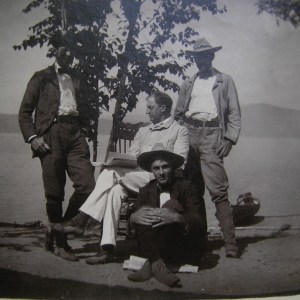
A posed photo of Victor with his Maine guides was sincerely upper-crust, he wearing a white linen suit, seated in a chair with what appears to be a book of maps in his lap–perhaps the lake’s depth/fishing charts? The Maine guides posed informally about him in more rugged wear.
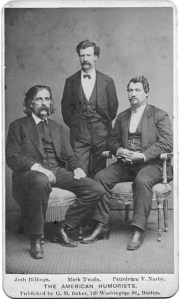
Victor was clearly the “star” of that photo, but we don’t know the context. Was it sincere? Tongue-in-cheek? I’m reminded of the photograph George M. Baker took of three famous humorists of his time–Mark Twain, Josh Billings, and Petroleum V. Nasby–with completely deadpan expressions, clearly tongue-in-cheek.
Did Victor ever unbend? Did he have a sense of humor? Did he have a silly side? Was he romantic? How was he as a dancer?
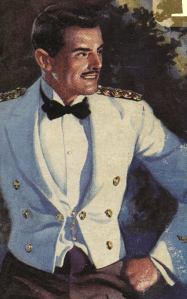
Think about Emilie a moment and about the men she created in her novels. To a man, they are determined, honest, purposeful, and ambitious, but they have more to them than that–humor, for sure, spontaneity that breaks through with boyish enthusiasm, ardor, tenderness… Note, also, that most of the men in her books are thirty-two and the women twenty-four or twenty-five, Victor’s and Emilie’s ages when they married. As occasional standins for Victor, these compellingly attractive men act with stalwart character, thoughtful appreciation, and a sense of humor that both challenges and endears.
Miss Moss asked, “And what about the men? Did you ever find a man possessing the qualities of your very fine heroes?” Emilie replied, “Of course. Otherwise, how could I create them.?”
Happy Landings: Emilie Loring’s Life, Writing, and Wisdom
Posed, formal photos are the norm in biographies, because they make it into publicly available sources: newspapers, directories, magazines, and school albums. Thanks to the Loring family, we get to see more of the private Victor.
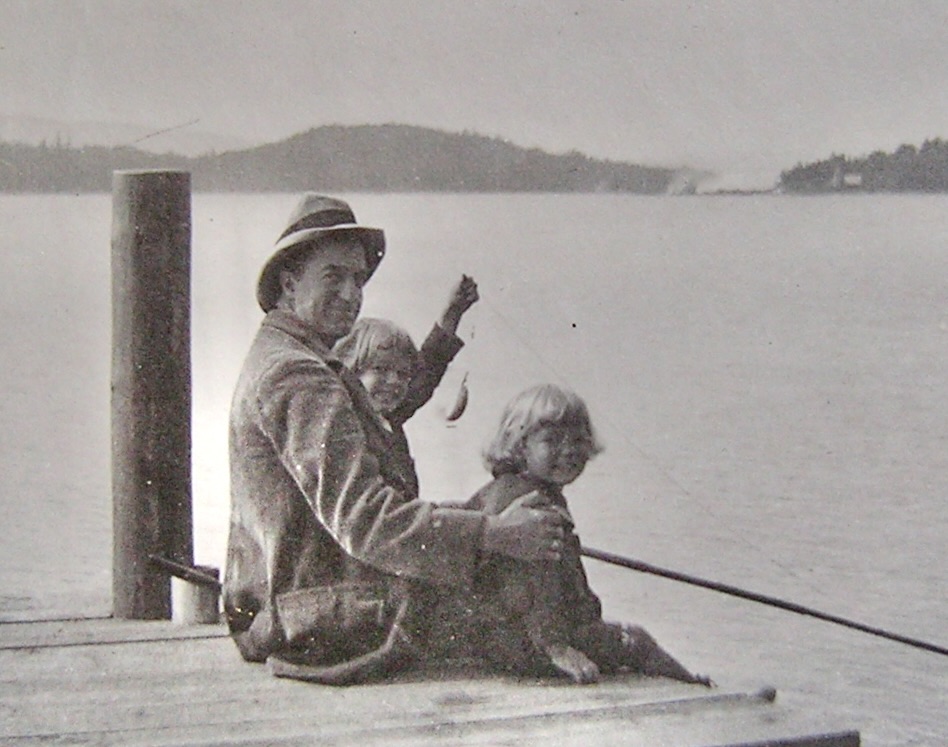

I love this photo of Victor fishing with his sons at the Rangeley Lakes. His hat is crumpled, his coat worn and shabby. Robert caught a fish–“Look! I got one!”–and they’ve all just turned to smile and document the moment on camera. In the next photo, Selden rides on Victor’s shoulders, wearing his Papa’s broad-brimmed, hiking hat–relatable events in the life of a dad with small boys.
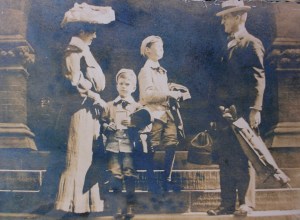
I was sorely tempted to use this family photo in Happy Landings, as it is a rare photo of all four of them together. I held off, because I didn’t have enough contextual information for it. The boys have had their hair cut short since the Rangely photos. Perhaps they are going to school, but what of the short golf clubs that Victor is carrying? This could be about 1902, when Robert was seven and Selden five. Massachusetts readers, do you recognize this location?
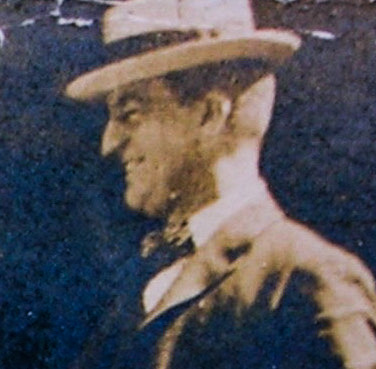
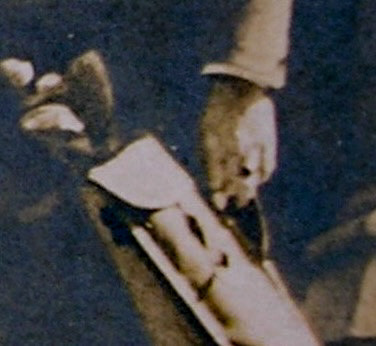
I like Victor’s big smile. The photo is posed, but that smile is genuine.
While we’re here, take a close look at Victor’s left hand. He is wearing a seal ring, as did many of Emilie Loring’s male leads. Used to seal letters and documents with an impression on wax, seal rings were often heritage items bearing a family crest. I wonder where this one is now.
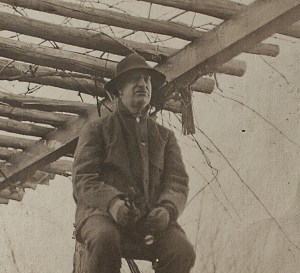

Here is Victor in an unguarded moment. He sits atop a ladder beneath the grape arbor at Wellesley Hills, holding a pair of clippers in his right hand. It was a chilly day; his hat brim is pulled down, and his collar is turned up. We’ve all had photos taken of us in mid-expression. I don’t suppose Victor ever imagined that his would be published for all to see. Nevertheless, someone (Emilie? Selden?) thought enough of the moment to capture it on film.
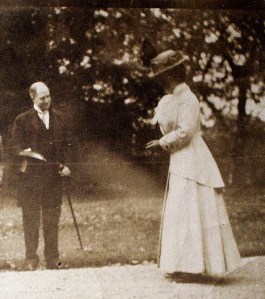
In contrast is this “Congratulations” photo that appears fully in Happy Landings: Emilie Loring’s Life, Writing, and Wisdom. Perspective provides an artistic emphasis: Emilie was on the cusp of success, “bigger” in that moment than Victor. He is dapper, his hat offered in respect and congratulations, his head tilted in affection.

Emilie and Victor were equal partners, true companions, one hundred years ago. That took something special in both of them, and they had it.
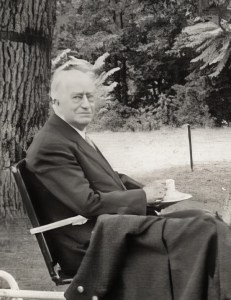
Victor is at a family picnic in this photo. It’s a rare thing to find him out of his suit jacket, but there are a few examples. One is on the boat in the photo of Emilie “navigating,” when he removes his coat but retains his suit vest. Below is another, when he is working to clear Loring Avenue. I wonder if he owned any patterned shirts. He appears well-dressed even when using a crowbar on a trussed up rock. By the way, he was in his seventies at the time.

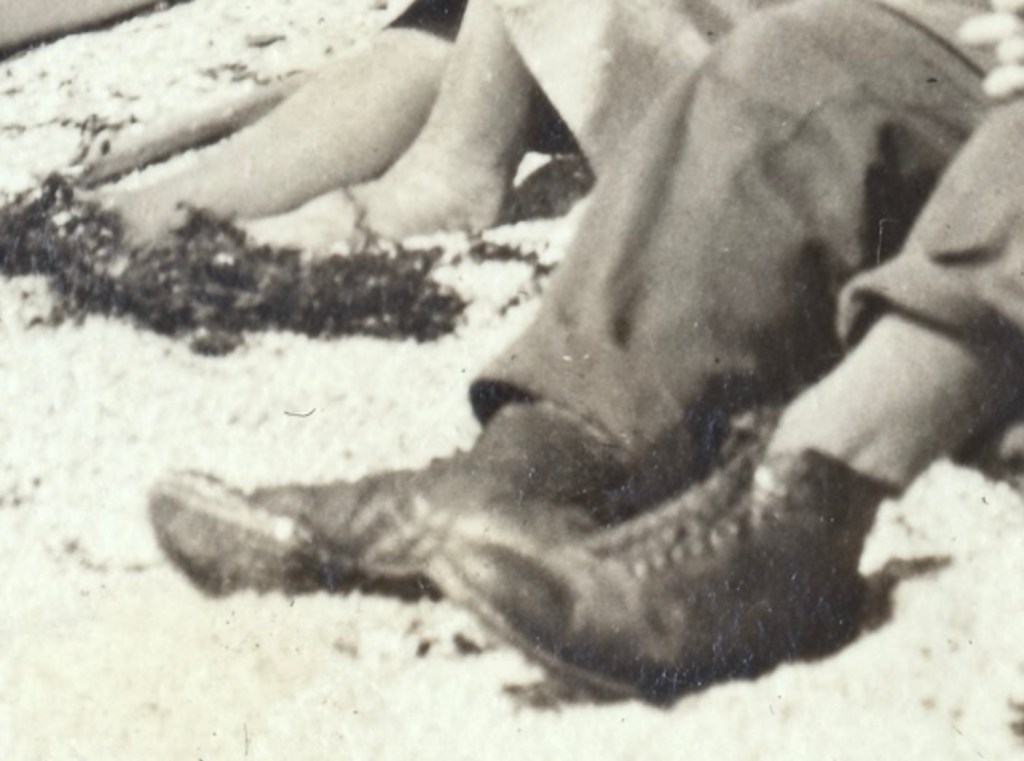
In the second photo, Emilie is barefoot on the beach, but Victor retains his lace-up, leather shoes–sans socks. I’m with Victor on this one. Blue Hill beaches are rock, not sand, and romantic as it is to sit on them barefoot, when you get up to go, you want something on your feet.

I’ll end with this photo, a full, cheek-stretching smile and the passage from Beckoning Trails that Emilie published after Victor’s death in February 1947.
“I admired him, his money meant nothing. I was earning plenty myself, but, we enjoyed the same things, he was enormously proud of what I had accomplished. We were great companions, and Debby, in the last analysis, the good companion is what counts most in marriage.”
Beckoning Trails
 The Emilie Loring Collection
Hi Patti. Testing. It looks like I have to log into WordPress to comment now. I used to not have to do so. Happy Landings!
LikeLiked by 1 person
More thoughts. Interesting that Victor especially became active in the “social gospel” (I suppose you’d call it) of evangelicals/protestantism, according to your book. It seems they focused on helping new immigrants become stable and productive. I think the temperance movement grew from this activity. Yet, Victor and Emilie essentially remained Republican, pro-business and anti-union. EL takes management’s side vis a vis unions in Today is Yours, where the fictional Romney clan combats angry laborers seeking to organize and cause unfriendly feelings toward the family owners of the company. She also makes reference to what we call right to work today in Keepers of the Faith, when Nancy and Sam discuss the labor problems that Sam faces as a manufacturer in time of war. [The Catholic “social gospel” activists of the early 20th century took labor’s side, likely because the laborers were mostly recent Catholic immigrants. ]
Interesting to think about how movements and groups evolve and change over time.
Sorry, it’s the economist and history geek in me. 🙂
LikeLiked by 1 person
I see Victor aligned with Rodney Gerard and David Schuyler in Hilltops Clear, in which those with more have a responsibility to help those with less to access training and jobs, maintaining respect and dignity. Jess Ramsey’s home making classes in Rainbow at Dusk were another example. The situation in Today is Yours echoed a real-life strike at the company of Emilie’s uncle Charles Baker. My take on that was less anti-labor and more “let’s listen to each other; we’re all trying here.” The party of Lincoln was changing. I’ve often wondered how the Lorings parsed that.
LikeLike
Yes I agree with your description of the characters, and it makes sense that that is the social gospel approach of Victor and Emilie too. I have to confess, however, to having a cynical view of a young unmarried debutante advising married women, mothers of children, how to feed their families. The noblesse oblige of the wealthy toward the less advantaged to live dignified productive lives was a theme in EL’s books. I think she generally did a good job of not being patronizing about it. That is a fine line. (The ghost writer in contrast characterized the wealthy as selfish, arrogant and contemptuous of their inferiors. That was an unfortunate change from EL’s original works to the ghost written books.)
LikeLiked by 1 person
A fine line, then as now, with perceptions of the same words and actions differing, depending on the filters one applies. The later books were embittered and cynical—I would love to see Emilie’s reaction to them.
LikeLike
Thank you for sharing these photos and a glimpse into the life of Victor. It makes sense that he must have been at least somewhat like Emilie’s heroes for her to write them as she did.
One thing I discovered in reading biographies is that you learn about other people who were significant in the life and era of the subject of the biography. A biograph is not just about the chosen subject. It’s about her and all the people and events (personal and historical) around her and her associates.
LikeLiked by 1 person
Dear Patti,
It was a rough week for me with Doug gone so I am happy to have your Emilie Loring book to reflect on her positive attitude and today’s commentary on Victor makes me think of my beloved Ed and the way he was always well dressed no matter where he went similar to Victor. My hair dresser would tell me “Col. Ramsey came today and he was always so well dressed from top to bottom, so kind and with a good sense of humor,”
Emilie and Victor were so well matched and I love the choice of portraits you had of him in the book which revealed so many sides of his character, so impressive.
Love and thanks for your analysis of her characters based on him and her and the way it was there then but her romantic characters were so charming and that’s why I love her novels.
Raqui
LikeLiked by 1 person
Thank you, Raqui. You’ve been in my thoughts this week.
My grandfather never went to town without wearing a hat, a custom that now is lost. Fashion changes, of course, and I’m happy to be casual, but I liked that generation’s sense of “getting ready,” of looking one’s best when going out. There was an excitement to it, a sense of expectation about to be fulfilled.
LikeLiked by 1 person
Dear Patti, Thanks for your warm thoughts about me during these difficult days of loss as I feel I am in the clouds and always tired since I do not sleep well. I am happy he is no longer in pain but I miss him so much. He was also my Best Friend as he worked with me on every project and we carried the legacy of Ed and Nadine. I agree with you people then has a sense of pride in their clothing and behavior. It is sad that the era has gone replaced by no respect of oneself and others. I do love the GOOD OLE DAYS! Love and have a nice evening, Raqui
LikeLiked by 1 person
Thanks for this glimpse into the life of Victor Loring. The photos….and your guesses about how they reveal his character….are priceless. Too often we do neglect to see the person in the background of the story.
LikeLike